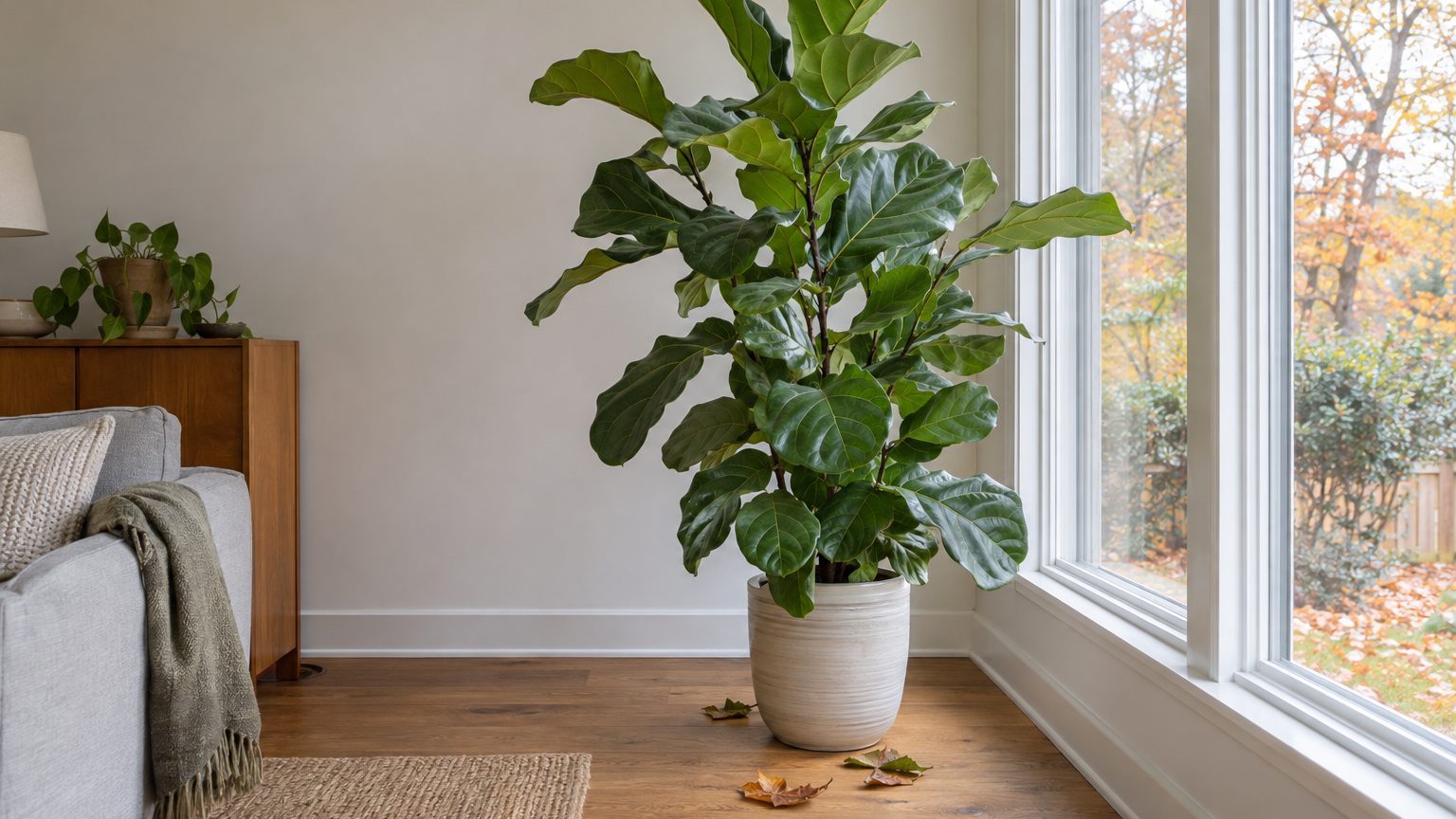
The fiddle leaf fig is very sensitive to temperature changes and reacts by dropping leaves, sometimes while the owner is away and the heat swings. A furnace vent that kicks on and off can do the same thing. Fiddle leaf fig care in winter comes down to three jobs: a steady spot, restrained watering, and protection from moving air.
Stability beats any single number.
Most US guidance lands in the same neighborhood on temperature. The New York Botanical Garden recommends steady room temperatures of 65 to 75°F, with a slight winter drop to around 65°F, made gradually. Other growers set the floor lower, no colder than 50 to 55°F at night, but nobody recommends living near that line. A plant that sits at 68°F all winter beats one that bounces between 55 and 80.
Pick a spot, then leave it there
Winter light is thinner. Days are shorter, the sun sits lower, and the corner that worked in July may now be too dim. Low light can stunt growth and lead to leaf drop, so supplemental grow lights are worth considering if the room stays gloomy. An east-facing window with bright but filtered light is a good default, and a quarter turn every week or so keeps the canopy from leaning toward the glass.
Resist the urge to shuffle the plant around the house chasing sunbeams. Moving the plant often triggers leaf drop, and even a new arrival will shed a few leaves. Some loss in the first two to four weeks after bringing one home is normal.
A fiddle leaf fig treats every relocation as a crisis.
Heater damage and drafts: the two-sided problem
Winter hits this plant from both directions. Hot, dry air pours out of a floor register or radiator on one side, while a cold pane of glass or a door that opens to the outside chills it on the other. Guidance from the botanical garden lists air conditioning vents, open windows, open doors and heat vents as all poorly tolerated. A ficus beside a window that lets in freezing air at night, or above a vent that blasts hot air intermittently, can drop its leaves even if every other condition is ideal.
Dry air adds a second layer of stress. Tropical figs evolved where humidity stays above 50% for most of the year, while winter indoor air with the heating running can fall to 20 to 30% relative humidity. That rarely causes total leaf loss by itself. Instead it brings brown, crispy edges and curling, which leave the plant weaker when a draft arrives.
The fix is mostly geometry. Slide the pot a foot or two back from window glass, move it out of the line of any vent, and seal gaps around doors before you pick the final spot. If you travel over the holidays, leave the thermostat where you normally keep it, because the New York Botanical Garden specifically warns that heat swings while you are gone can leave leaves on the floor when you return.
Misting offers little; a humidifier or a cluster of plants works better.
Water less, feed not at all
Overwatering is the classic winter killer. Growth slows when days shorten, so roots drink less, yet many owners keep the summer schedule. Let the top 2 to 4 inches of soil dry out before watering, then water thoroughly until it runs from the drainage holes. In winter that means watering about half as often. Some growers land on every two to three weeks, but the calendar matters less than the soil.
Push a finger or a wooden chopstick deep into the pot before you reach for the can. The pattern of damage also tells you which way you erred. Root rot from overwatering usually hits older, lower leaves first, with dark patches in the center of the leaf, while drought damages the newest leaves along the outer edges.
Skip the fertilizer until spring. Feeding belongs to spring and summer, and over-feeding can itself cause leaves to drop. One caution: sources disagree on whether the plant truly goes dormant, since some extension educators say it does not. Either way, slower growth means less demand for water and nutrients, and that is what matters for your routine.
When leaves fall anyway
Not every fallen leaf is an emergency. Loss of lower leaves is to some extent natural, because those are the oldest leaves and they yellow and drop with age. Count them. One or two old leaves in a month is housekeeping.
A sudden drop of healthy green leaves is different. That points to environmental shock: a move, a season change, a cold draft. Work backward through the last week. Did the temperature dip, even briefly? Did someone open a window near the plant? Is the soil still soggy days after watering?
Resist the panic response of watering more, feeding, or relocating again, because each of those adds another shock on top of the first. Fix the single cause you identify and give the plant a few weeks. Fiddle leaf figs are slow to forgive but they do recover from most winter mishaps, as long as the roots are intact.
Save repotting for spring, too, since this plant typically needs it only every two years, unless roots are growing through the bottom of the pot. Disturbing the roots in January is one more shock you can easily avoid.
Sources : housedigest.com | libguides.nybg.org