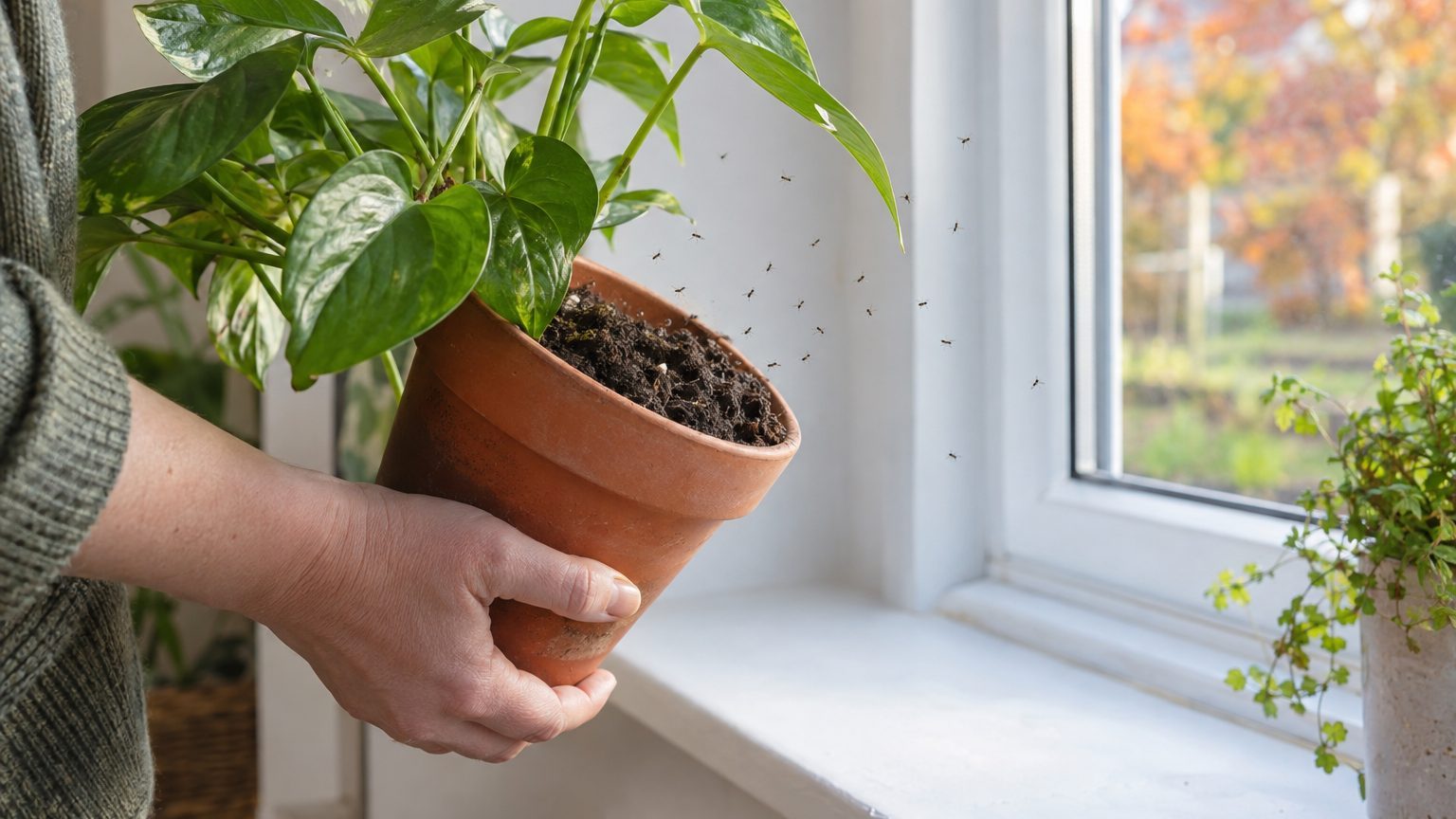
Tap the pot. If a puff of tiny dark flies lifts off the soil, you have fungus gnats in houseplants, and they have probably been breeding there for weeks. They are one of the most common indoor plant pests in the country, and fall is peak season. Plants that spent the summer outdoors often arrive back inside already infested.
Confirming the culprit before you treat
Adults are easy to underestimate. They measure only 1/16 to 1/8 inch long, with long legs and antennae, and they’re drawn to light, so you’ll often spot them circling lamps and windowsills rather than the plants themselves. A Y-shaped vein on the wing is the giveaway under a magnifier.
The adults are the harmless part of the story.
Larvae do the damage. They’re tiny translucent “worms” with an obvious dark gut, and they eat fungi, organic matter and plant roots in the soil. On a mature pothos, that’s usually a cosmetic annoyance. On seedlings and cuttings it’s different: delicate seedlings can be killed, yellowing and often wilting rapidly before they die. Larvae sit in the top 1 to 2 inches of the potting mix, so that’s where to look.
For a sure diagnosis, press a slice of raw potato onto the soil. A quarter-inch slice of skinned potato inserted into the mix pulls larvae toward it, and checking it every three to four days tells you whether they’re still active.
Where they come from, and why they multiply so fast
Moisture is the whole story. Excessively high moisture in potting media is the primary reason gnats abound in homes and offices, because wet soil grows the fungi the larvae eat. Poor drainage, a saucer that sits full of water, and old potting mix that has broken down and holds water longer all give them the same advantage.
The math works against you. A female can lay up to 300 eggs in clusters on or in the crevices of moist soil. Eggs hatch in five to six days, larvae feed for 10 to 14 days, and pupae turn into adults in another five to six days, completing the cycle within four weeks. Adults live only about 10 days, but that’s plenty of time to start the next round. Three overlapping generations in one pot is entirely possible.
Indoors, those generations never really stop.
The flies hitchhike in by several routes. Moist, organic-rich potting soil left outdoors for long periods may already contain larvae, which makes that half-open bag in the garage a suspect. Bathroom and kitchen drains matter too, since the larvae can breed in drains with a buildup of moist debris. If your plants are clean and the gnats persist, check the plumbing.
Treatments that actually work
Start with water, because nothing else works without it. Let the top 1 to 2 inches of soil dry completely before watering again, since larvae can’t survive in dry soil. Bottom watering helps, too: the plant drinks what it needs while the surface stays dry. Be patient, because it may take three to four weeks of modified watering to get gnats in check.
Yellow sticky traps come next, and they’re cheap. Pushed into the soil beside the stem, they catch egg-laying adults, and they also serve as a monitor, so you can tell by the trap count whether you’re winning.
The strongest weapon is a bacterium. Products containing Bacillus thuringiensis subsp. israelensis (Bti) are sold to homeowners and control fungus gnat larvae in soil. Mosquito dunks contain the same organism, and Bti is safe for plants and pets and targets only fungus gnat larvae. There’s a catch, though. These treatments don’t affect eggs, pupae or adults, so one watering won’t finish the job. Repeat applications five to seven days apart to catch each new hatch, and don’t expect results from a single dose.
Beneficial nematodes offer a second biological route. Insect-parasitic nematodes applied as a soil drench, especially Steinernema feltiae, are particularly effective against the larvae. They cost more than Bti and need to be used fresh, so they suit larger collections better than a single fiddle-leaf fig.
Skip the sprays unless things are truly out of hand. Unless an infestation is severe, chemical controls aren’t warranted, and indoors, cultural changes are usually enough. If adult numbers are excessive, pyrethrin-based insecticides can provide temporary control, applied to the plant and the soil surface where adults rest. Read the label first, every time.
Keeping them from coming back
Quarantine is the habit that pays off most. Keep new plants apart from the rest of your collection for a few weeks, with a yellow sticky trap and a daily check, before they join the shelf. It costs nothing and spares the rest of the collection.
Soil and housekeeping matter as well. Choose a mix that drains well, store it away from any infested area, and don’t leave open bags outside. Remove dead leaves and debris, since decaying plant matter attracts gnats. A thin top layer of coarse sand or gravel also makes it harder for adults to reach the soil to lay eggs.
One last point about timing: if you’re propagating cuttings or starting seeds this winter, treat the soil with Bti from day one. Those seedlings are the plants gnat larvae hurt most.
Sources : beaufort.ces.ncsu.edu | theplantindex.com