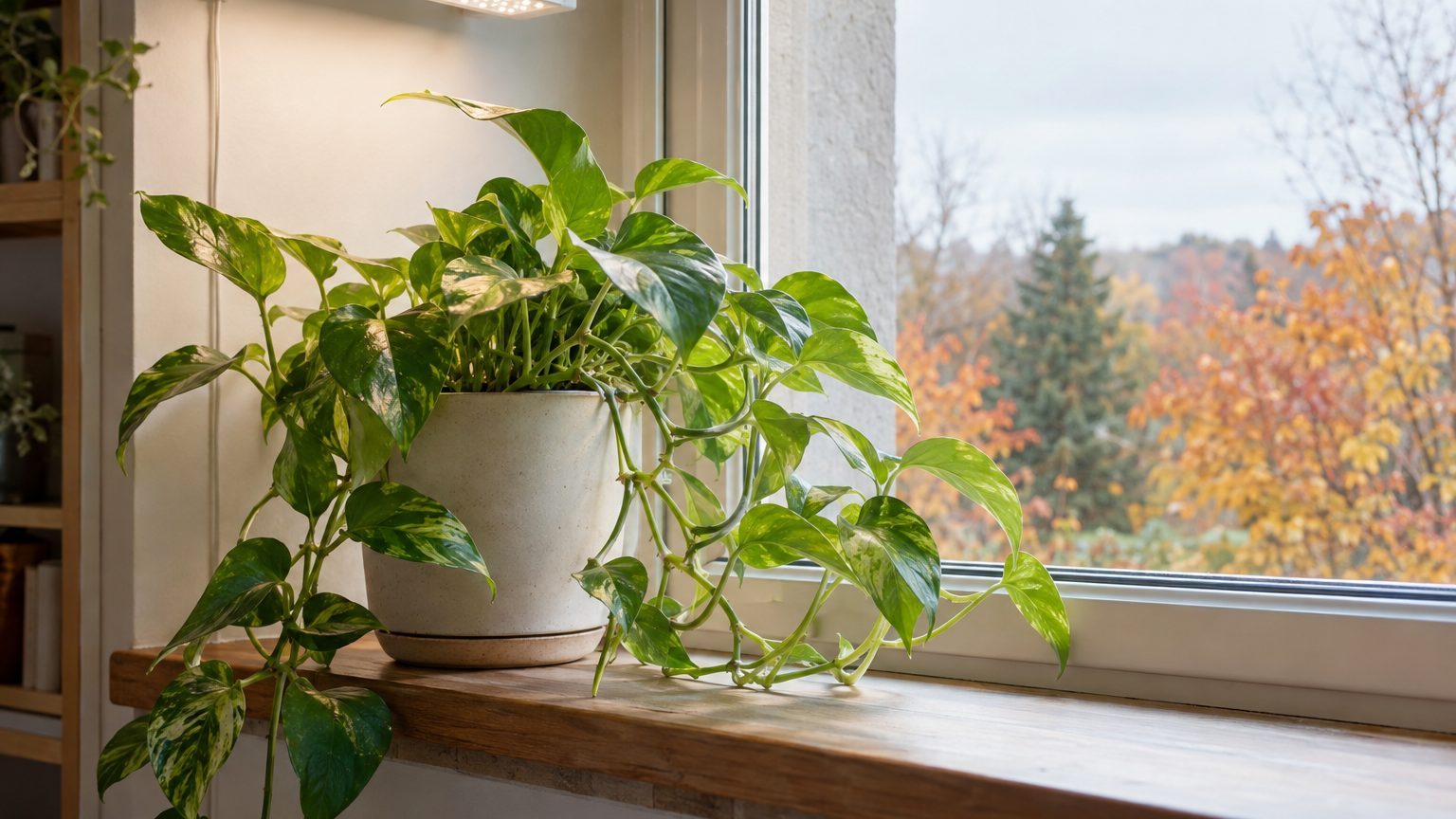
Your pothos used to grow tight and leafy. Now it reaches toward the window on long, bare stems, with leaves spaced out like beads on a string.
That’s winter stretch, and the right light stops it.
Plants lengthen their stems when they can’t find enough light, a response horticulturists call etiolation. Winter makes it worse because days are short and the sun sits low. A plant that did fine in an east window in summer may need a south window in winter, and even a spot three feet back from the glass can fall short of usable light. Grow lights for house plants in winter fill that gap.
The lamp does not need to be fancy. It does need to be the right type, at the right distance, on the right schedule. Get one of the three wrong and the stretching continues.
- Stretched stems are a plant’s response to too little light.
- A full-spectrum LED provides both red and blue wavelengths plants need.
- Most foliage plants do best 12 to 24 inches below a panel light.
- Most foliage plants need 12 to 16 hours of light per day.
Pick a light that counts as a grow light
A standard household LED bulb is not a grow light. Look for a full-spectrum or horticultural fixture, since most plants use both red and blue wavelengths for photosynthesis. LEDs supply both, and Nebraska Extension notes they can be used the same way as a fluorescent grow bar.
The purple “blurple” panels work, but they turn a living room into a nightclub. For most homes, a full-spectrum white LED does the job and looks like ordinary room lighting. It also runs cooler than the old options, which matters when the fixture sits a foot from your fiddle-leaf fig.
Older technology still has a place. Incandescent bulbs lean heavily red and give off very little blue, and a standard bulb lasts around 1,000 hours. A fluorescent tube commonly lasts 10,000 hours or more. Foliage plants tolerate those spectrums well enough, but flowering plants want more red than a basic bulb provides.
Form matters too. Bars and panels suit shelves and plant stands, bulbs suit a single lamp, and a clip-on is fine for one small plant.
Distance: inches matter more than wattage
Light fades fast as you move away from the source.
That’s why a powerful lamp hung three feet above a plant can do less than a modest one hung a foot away. A rough guide from the plant-care side of things: LED panels work at about 12 to 24 inches, LED bulbs at 6 to 12 inches, and fluorescent tubes at 4 to 12. Package directions come first, because output varies a lot between products. Most foliage houseplants land in the 12 to 24 inch range, flowering plants like it closer at 6 to 12 inches, and seedlings sit 3 to 6 inches under the light.
The plant itself is the best gauge. Stretching, pale new growth, or leaning toward the light means the lamp is too far away. Bleached or crispy patches on the top leaves mean it’s too close, and the fix is to raise the fixture 2 to 4 inches. A common starting point for LEDs is 12 inches, then adjust over a couple of weeks.
Coverage counts as well. One small light only reaches a small circle of foliage, so rotate the pot every week or so, and raise the lamp as the plant grows. A big plant may need two fixtures to light every leaf.
Succulents and cacti stretch fastest indoors in winter, so give them the tightest spacing of all. Keep those lights near the 6 to 12 inch end.
Hours: how long, and when
The right schedule depends on how much daylight the plant already gets.
One extension-style rule of thumb: if the plant has some natural light, run the grow light 12 hours on and 12 off. With little or no natural light, go to 16 hours on and 8 off. Other guides land lower for foliage plants, at 10 to 14 hours, and higher for flowering plants and herbs, at 14 to 16. The ranges overlap enough to give you a sensible default. Start at 12 hours and move up only if the plant keeps reaching.
A south window plus six to eight evening hours covers many tropicals through winter. A weak window needs closer to 8 to 12 hours. A windowless corner relies on the lamp alone and needs 12 to 14.
Don’t run the light around the clock. Plants need a dark stretch, and about 8 hours a night is a safe minimum.
Exceptions exist. Christmas cactus and poinsettias bloom in response to shorter days, so give them less light in fall or they won’t set buds.
A $10 outlet timer settles the whole question. Set it for something like 8 a.m. to 8 p.m. and forget it, because consistency beats precision. Lights that flicker on only during gray spells leave plants guessing, and they may stall or drop leaves. Most winter setups run from about November through February, and you can ease back as spring light returns.
If stems keep stretching after two weeks at 12 to 14 hours, adding more hours rarely helps. Weak intensity from too much distance or too little coverage is the usual cause, so lower the lamp first.
One last point: a grow light prevents new stretch but can’t undo old stretch. Stems that have already elongated stay long. Pinch or cut them back to just above a leaf node, and the plant will branch out compactly under the new light. The trimmings can often be rooted in water.
Sources : treleaf.shop | housedigest.com