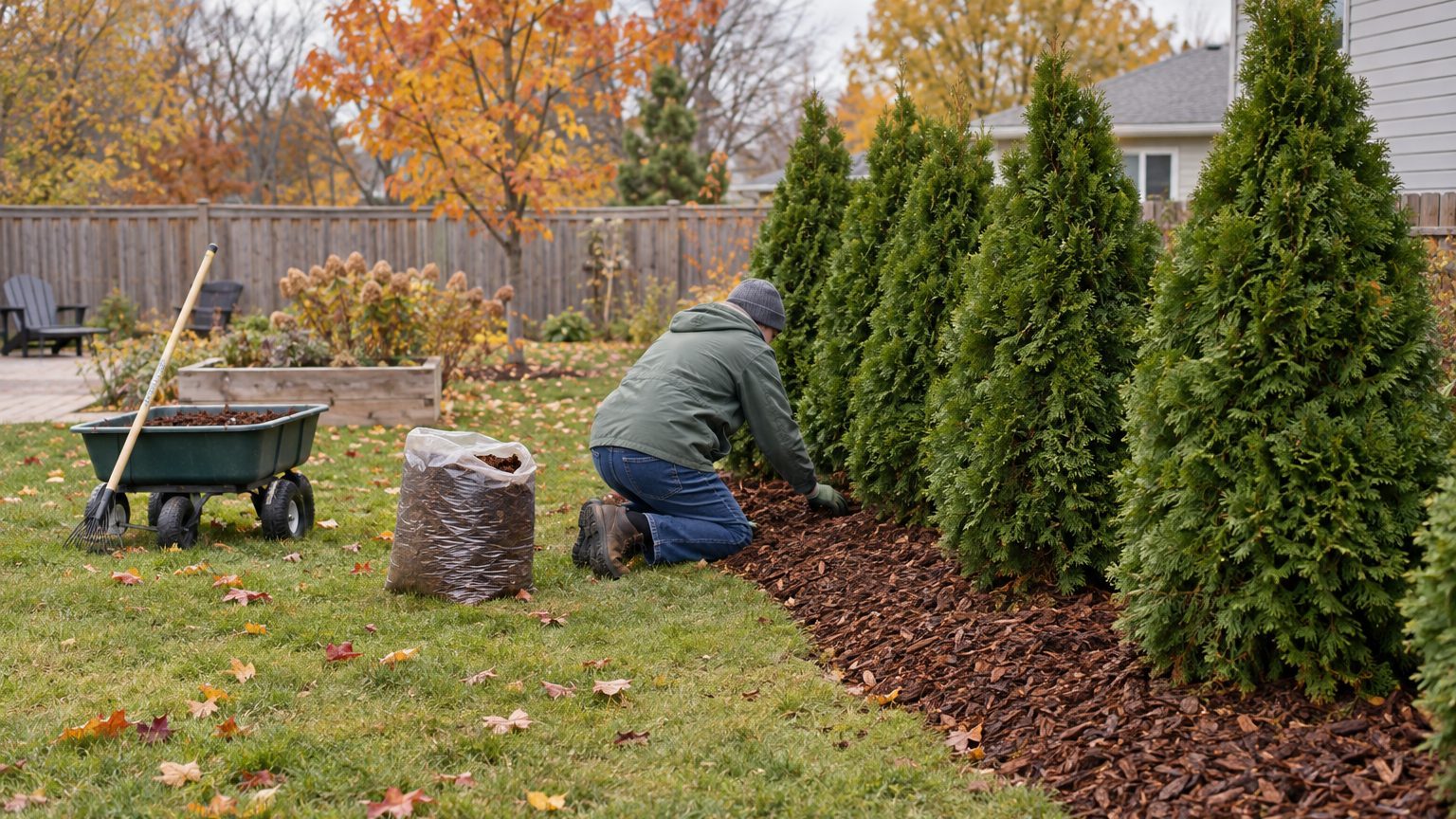
By mid-November, the window for protecting arborvitae is nearly shut. Once the soil locks up, the roots cannot pull in another drop, and the needles keep losing water to wind and low winter sun. That mismatch is what produces the brown, crispy patches homeowners find in March and April. The fix is a short job: deep soaks until the ground freezes, a ring of mulch and, on exposed sites, a burlap screen on stakes. Shovel, hose and a hammer cover nearly all of it.
A deep soak before the freeze does most of the protecting
Evergreens never fully go dormant. University of Wisconsin Extension explains that a January thaw, or even direct sun warming the foliage above freezing, wakes the needles enough to start releasing water. Frozen ground then blocks any refill. If the needles and twigs were already dry from a dry fall, they desiccate, which is the technical word for drying out, and the tissue dies.
The counter is to send the shrub into winter with full roots. The extension service puts the target at about an inch of water a week when rain falls short, with more for sandy soil and newly planted shrubs. It also advises continuing into early or mid-November in the southern and central parts of that state, and stopping earlier farther north. The rule underneath is simple: keep watering until the ground freezes, then stop.
How you apply the water matters as much as how much. A sprinkler that runs twenty minutes wets the mulch and little else. A soaker hose coiled around the base, or a hose set to a slow trickle, lets water sink into the root zone, which on arborvitae is shallow and wide, so the soak has to cover the whole spread and not just a strip along the front. Extension guidance quoted for trees suggests about 10 gallons per inch of trunk diameter, and a small shrub may need around 5 gallons, depending on size and soil. Sandy ground drains faster and needs more frequent soaks than clay.
There is one exception. If the soil is already saturated, extra water does nothing and can add root stress. Push a trowel in and feel the soil a few inches down. If it clumps and drips, skip the hose.
Winter watering is a bonus, not a routine. During a thaw, when the ground has actually softened and the soil under the mulch is dry, a slow drink can reach the roots. Never pour water onto frozen or soggy ground.
Mulch belongs over the root zone, held back from the trunk
Mulch slows the freeze, holds moisture and evens out the freeze-thaw swings that heave shallow roots. Wisconsin Extension recommends 2 inches on clay soils and up to 4 inches on sandy soils, spread out to the drip line, which is the edge of where the branches reach. The New York Botanical Garden’s library gives a slightly lower ceiling of about 3 inches of organic mulch. In practice, 2 to 3 inches of shredded bark, wood chips or leaf compost fits most suburban yards, with the thicker layer for sand.
Pull the mulch back from the stems. The extension guidance says to keep it at least 4 inches from the base of a shrub, and the botanical garden suggests 6 inches. Mulch piled against the trunk holds moisture against the bark and gives mice and voles a sheltered place to chew. Voles are the reason timing matters too: spread mulch after the soil has cooled, not in early fall while the ground is still warm.
One more point on timing. Evergreens planted this fall are the most vulnerable. Their roots have not spread beyond the original root ball, so they depend on you for water and shelter. Young hedges generally need that extra care for their first two or three winters, and the amount of care depends on the site and the plant’s size. A south-facing wall is the worst spot, because reflected heat pushes the needles to transpire on the coldest days.
Burlap works as a windbreak on stakes, not as a wrapper
The common mistake is to wind burlap tight around the shrub like a bandage. Wisconsin Extension warns against it. A tight wrap collects ice, traps moisture and invites disease. Wet burlap also rubs against needles in wind. What helps is a screen standing off the plant that blocks wind and cuts direct sun.
Build it with stakes about 4 to 5 feet tall, driven in roughly 2 feet from the drip line. Put them on the south and west sides, or whichever side takes the prevailing wind. Staple or tie burlap to the stakes, overlap the seams by a few inches and tie it at several heights so it does not flap and sail in a gust. Leave the top open. A closed top can sag under heavy snow and end up lying on the branches, and an open top lets air move. If the pegs are in before the ground freezes, the burlap itself can go on later, on a calm day in November or December.
Tall columnar arborvitae, such as ‘Emerald Green’ types, have a different weak point: snow and ice load. The New York Botanical Garden says wrapping the whole tree can make sense in heavy-snow areas, where the aim is to keep branches from splaying and snapping. In that case, loosely bind the upper branches into a column with soft cloth or landscape wrap, not wire, which can girdle the stems. Gently brushing heavy snow off with a broom, upward and away, also helps. Never whack ice off, because frozen branches break.
Anti-desiccant sprays are a tempting shortcut, but the evidence is thin. Wisconsin Extension says they show limited benefit, degrade quickly and need reapplying after rain or snow. They are no substitute for a wet root zone.
Remove the burlap promptly in spring once the worst wind and temperature swings pass, typically early to mid-spring. Left on too long, it holds moisture against the plant.
If browning shows up anyway, leave it alone for now. Brown foliage shades the live tissue behind it, and branches that look dead may still push growth. Extension guidance is to scratch the bark on an affected branch in spring and look for green underneath, then prune dead material after new foliage emerges. Arborvitae does not sprout from bare, old wood, so cut only back to green growth. A hedge with large dead patches fills in slowly from the sides, and a badly damaged plant may need replacing.
One thing to separate from winter burn is the normal fall shed. Arborvitae drops its oldest inner scales each autumn, which turns the inside of the plant brown for a few weeks while the outer foliage stays green. That needs no treatment, and it is over by the time winter burn becomes a risk.
Source : hort.extension.wisc.edu