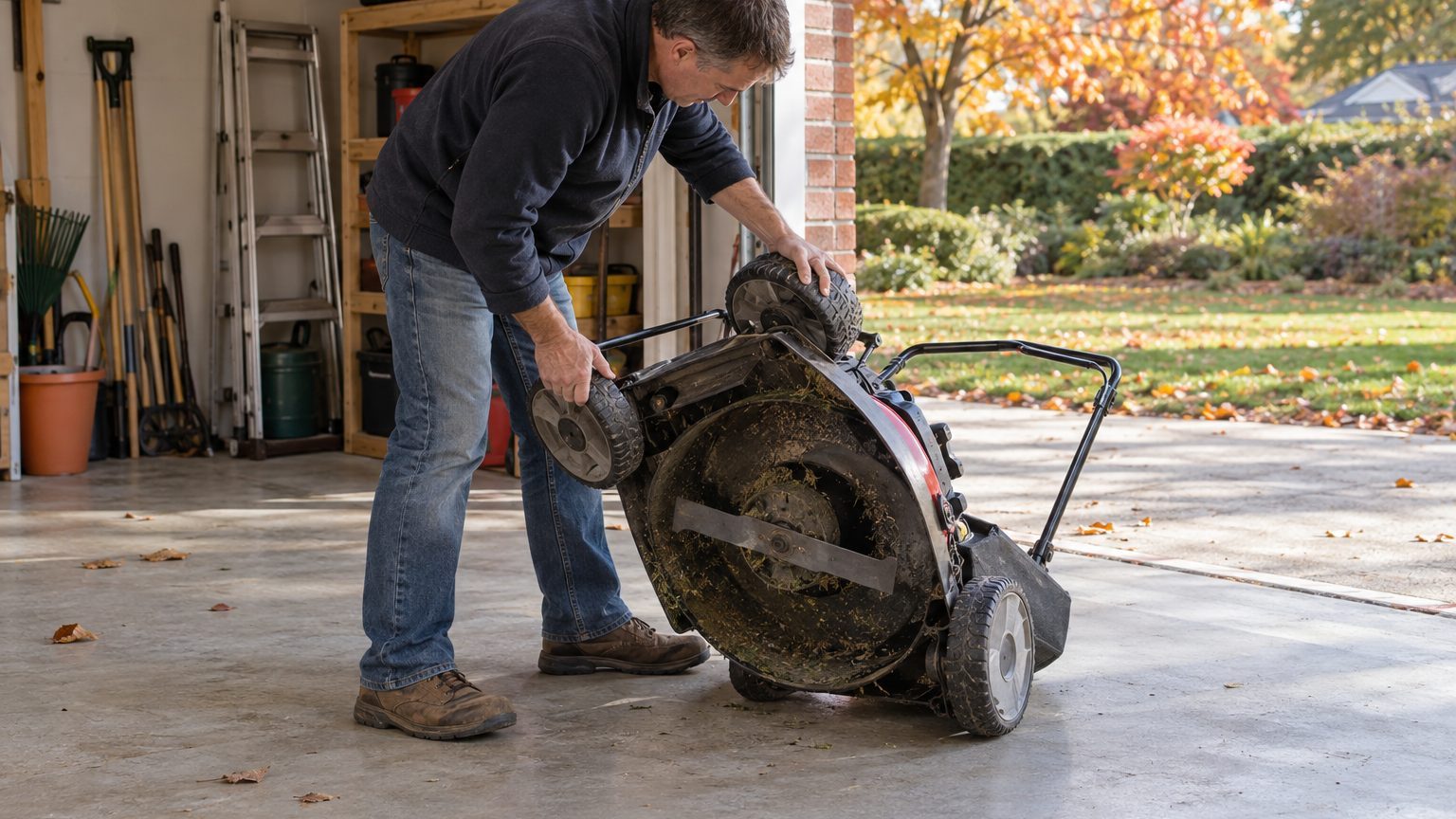
Ethanol-blended gasoline starts to degrade in as little as 30 days, and most of what’s sold at U.S. pumps contains up to 10 percent ethanol. Leave that fuel in a mower all winter and you’ll likely spend spring wrestling with a gummed-up carburetor. A weekend afternoon in November prevents it.
The job breaks into four parts: fuel, oil, blade and battery (if your mower has one). Do them in a sensible order and the whole thing takes about an hour.
Fuel: Stabilize It or Run It Dry
Ethanol attracts moisture from the air, and over weeks the mixture can separate and leave varnish-like deposits in the carburetor’s tiny passages. Those jets are narrower than a pencil lead. It doesn’t take much residue to block them.
You have two sound options. The first is to fill the tank most of the way with fresh fuel, add a fuel stabilizer at the ratio printed on the bottle, and run the engine for five minutes so the treated gas reaches the carburetor. The second is to empty the tank by running the mower until it quits, then pull the spark plug wire and, if you want to be thorough, drain the carburetor bowl.
Stabilizer is the easier path for most people.
Small-engine makers generally favor it, partly because a full tank leaves less room for condensation to form on the metal walls. Ethanol-free fuel, sold at some stations in cans and at the pump, stays usable longer, though it still benefits from a stabilizer if it will sit for months. Never pour old fuel on the ground or down a drain. Many county waste facilities accept it during household hazardous waste collection days.
Oil and Blade: The Messy Middle
Change the oil now, not in April. Used oil holds acids and combustion byproducts that can sit against internal parts for months, and fresh oil protects the engine during storage. Run the engine for a couple of minutes first to warm the oil so it drains faster, then disconnect the spark plug wire before you do anything else. That step is non-negotiable.
Most four-stroke push mowers take roughly 15 to 20 ounces of oil, often SAE 30 or 10W-30, but your owner’s manual has the exact grade and capacity. Drain the old oil into a pan (tipping the mower toward the oil fill hole, with the air filter side facing up, keeps gasoline and oil from soaking the filter). Refill to the mark on the dipstick, no higher. Overfilling creates its own problems, including smoky starts. Two-stroke engines, which are rare on mowers now, mix oil into the fuel and need no change.
While the mower is tilted, look at the blade.
A dull blade tears grass instead of cutting it, leaving frayed brown tips that invite disease, and winter is the cheapest time to fix that because sharpening shops aren’t busy. Remove the blade with a socket wrench, hold the deck steady with a block of wood, and note which side faces down so you reinstall it correctly. Clamp the blade in a vise and work a mill file along the original cutting angle, usually around 30 to 45 degrees, removing the same amount of metal from each end. Then hang it on a nail by its center hole. If one end dips, the blade is unbalanced and needs more filing on the heavy side, since an unbalanced blade shakes the whole machine.
Replace any blade that’s bent, cracked or thinned to a sliver. Torque the bolt to the manufacturer’s spec on reinstalling.
Clean the Deck and Check the Small Parts
Caked-on clippings hold moisture against steel and rust it from underneath. Scrape the underside of the deck with a putty knife, rinse it, and let it dry fully before you put anything back. Swap the air filter if it’s dirty (foam filters can be washed and oiled, paper ones are replaced) and consider a new spark plug, which costs only a few dollars and makes spring starting more reliable.
Battery: The Part Most People Forget
Electric start mowers, riding mowers and cordless models all depend on batteries, and a battery left in an unheated shed is the usual reason a mower won’t turn over in spring. Lead-acid batteries on riding mowers slowly self-discharge, and a deeply drained one can sulfate and lose capacity permanently. Disconnect the negative terminal, or better, bring the battery indoors and connect it to a maintenance charger (sometimes called a trickle or float charger) that tops it off without overcharging.
Lithium-ion packs from cordless mowers want different treatment. Manufacturers typically recommend storing them indoors, away from temperature extremes, at a partial charge somewhere around 40 to 60 percent rather than full or empty. Keep them off a concrete garage floor if it gets freezing, and never charge a pack that’s been sitting in deep cold until it has warmed to room temperature.
A cordless mower with no gas and no oil needs far less prep than a gas one. Wipe it down, clear the deck, sharpen the blade, and put the battery somewhere sensible.
Storing the Machine
Pick a dry, covered spot, ideally an enclosed garage or shed rather than a tarp in the yard. Moisture is the enemy of every system you just serviced. If you must store the mower outside, use a breathable cover, because plastic traps condensation and can do more harm than good.
Keep the machine away from furnaces, water heaters and other open-flame appliances, since fuel vapors can ignite. Some owners stand push mowers on their rear wheels to save floor space, but that is only safe if the fuel tank is empty and the carburetor is dry, otherwise gas can leak into places it shouldn’t be. Check your manual before tipping it up.
Before you walk away, write the date and what you did on a strip of masking tape and stick it to the handle. In spring you’ll know at a glance that the oil is fresh and the fuel is treated, and a lot of owners find that note saves them a second round of guesswork.
One last tip: if the engine has a recoil starter, pull the cord slowly until you feel resistance, which parks the piston on its compression stroke and closes the valves, sealing the cylinder against moisture over winter.