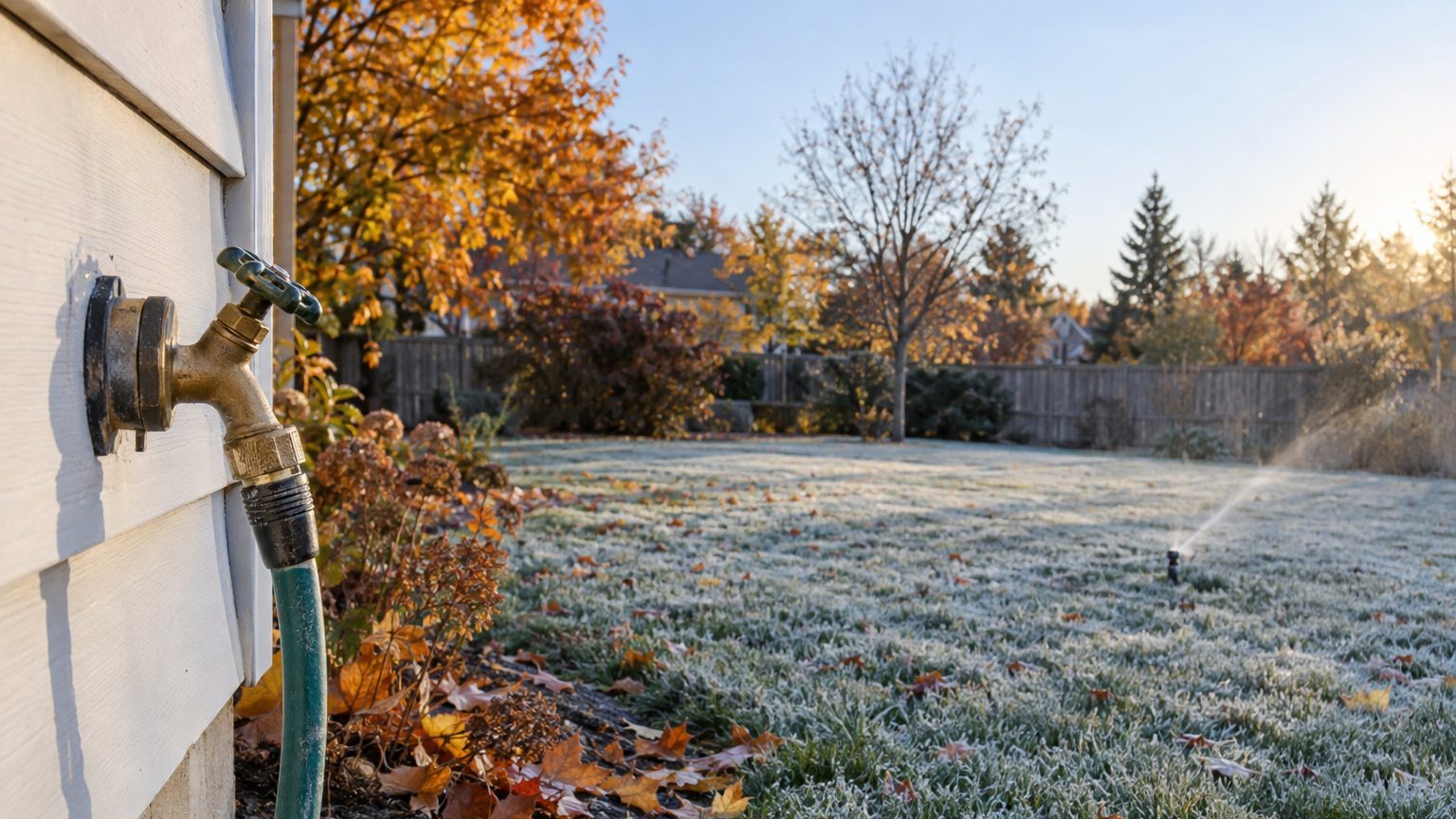
A single frozen sprinkler line can crack in a night, and the repair bill usually shows up in April, when the system turns back on and a geyser erupts from a buried pipe. Water expands about 9 percent as it turns to ice. PVC and polyethylene pipe, fittings and valve bodies can’t absorb that, so the fix is simple: get the water out before the ground freezes.
Three methods do it. Which one applies depends on how your system was built.
Before you touch a valve: timing and shutdown
Aim for a few days before the first hard freeze, which in the northern states often means late October to mid-November. In milder zones, winterizing may be needed only in case of an occasional cold snap, but a night in the low 20s can still damage exposed parts. Soil temperature matters less than air temperature for the aboveground pieces, which freeze first.
Start at the controller. Switch it to “rain mode” or “off” rather than unplugging it, which on many models preserves your programming. Then shut off the water at the system’s main valve, usually in a basement, crawlspace or a buried box near the water meter.
Next, deal with the backflow preventer.
That brass or PVC assembly sticking out of the ground near the house is the most freeze-prone part of the whole system, and it’s the most expensive to replace. Close its shutoff valves (the handles sit at a quarter turn, perpendicular to the pipe when closed), then open the small test-cock valves to let trapped water escape. Many homeowners wrap it in an insulated cover afterward, which adds a layer of protection on top of draining, never in place of it.
Manual drain: the low-tech option
Manual drain systems have a small valve at the low point of each zone line. Open them and gravity does the work. If your yard was installed with these, you will typically find them in a small buried box or just under a cap at the end of a pipe run.
The routine takes about 15 minutes. After shutting off the main supply, open each manual drain valve, which is often a slotted screw or a small knob, and let the water run out. Then open the boiler drain on the main line, the one right beside the shutoff, to let the supply pipe empty too. Leave these valves open through winter, or at least until you’re sure no water is left.
Not every system has them.
Manual draining has a catch. It only removes water that sits low enough to reach the valve, and on uneven lots a section of pipe can hold a pocket of water that never reaches the drain. Pop-up heads are another weak spot, because water can stay in the riser. Some installers recommend a quick check by walking the zones and looking for heads that still hold water.
Auto drain: the valve that works for you
Automatic drain valves sit at low points and stay closed while the line is under pressure. When pressure falls below roughly 10 psi, a spring or diaphragm opens the valve and the line empties on its own. The idea is elegant, and in regions with mild or short winters, it often is enough.
Your job is to trigger it. Shut off the main water supply, then open one or two sprinkler heads or a zone valve by running a manual cycle from the controller, which relieves pressure and lets the valves open. After that, walk the property and check that water is actually exiting at each valve box.
Still, plenty of installers call these valves a convenience rather than a guarantee. Debris and mineral buildup can keep a valve from seating or opening properly, and a stuck valve either leaks all season or fails to drain in winter. Another drawback: if the line slopes the wrong way, drainage can’t happen no matter how well the valve works. For cold climates where the ground freezes deep, most professionals still follow with a blowout.
The blowout: compressed air, done carefully
This is the method that irrigation contractors use in places such as Minnesota, Colorado and upstate New York, and it’s the one I’d choose for any system in a hard-freeze climate. An air compressor forces the remaining water out through the sprinkler heads, zone by zone. Done right, it clears the whole network, including the low spots that gravity misses.
The equipment matters, and so does the number on the gauge. Most residential polyethylene pipe should see no more than about 50 psi, and rigid PVC systems typically tolerate somewhat more, around 50 to 80 psi, though sprinkler heads and fittings are the limiting factor. Too much pressure can crack a fitting or break a head, which defeats the purpose. Volume counts as much as pressure, because you need enough cubic feet per minute (CFM) to carry water out; many homeowners rent a compressor for this reason, since small pancake models struggle to keep up. Look for the CFM rating on the tool and check it against what your system manufacturer or a local irrigation supplier recommends.
The process runs like this:
- Shut off the water supply and relieve pressure in the line.
- Connect the compressor to the blowout port, a fitting installed on the mainline near the backflow preventer.
- Start with the zone farthest from the compressor, or the highest in elevation, and run it until the heads stop spitting water and only a fine mist appears.
- Move through each zone in turn, then cycle through a second time.
- Bleed off the compressor and disconnect.
Never stand over a sprinkler head while it blows. Heads can launch debris, and eye protection is not optional. Also avoid running air through a zone for long stretches, since dry air heats and can warp plastic components. A minute or two per zone, repeated, is better than one long burst.
Hiring a pro is reasonable here. A professional blowout often costs about the price of a few restaurant dinners, and a single cracked valve body costs more than that. For most homeowners with a long, complex system, that math is easy.
Spring trouble starts in fall
Leave the shutoff closed and the boiler drains open through winter, and the controller in rain mode. When spring arrives, close the drains and open the main valve slowly, so air can escape without a sudden pressure surge that hammers the pipes.
One last detail that contractors point out: check your hose bibs and any aboveground pipe that feeds the system. A fully drained network won’t help if the pipe feeding it freezes and splits inside a garage wall.