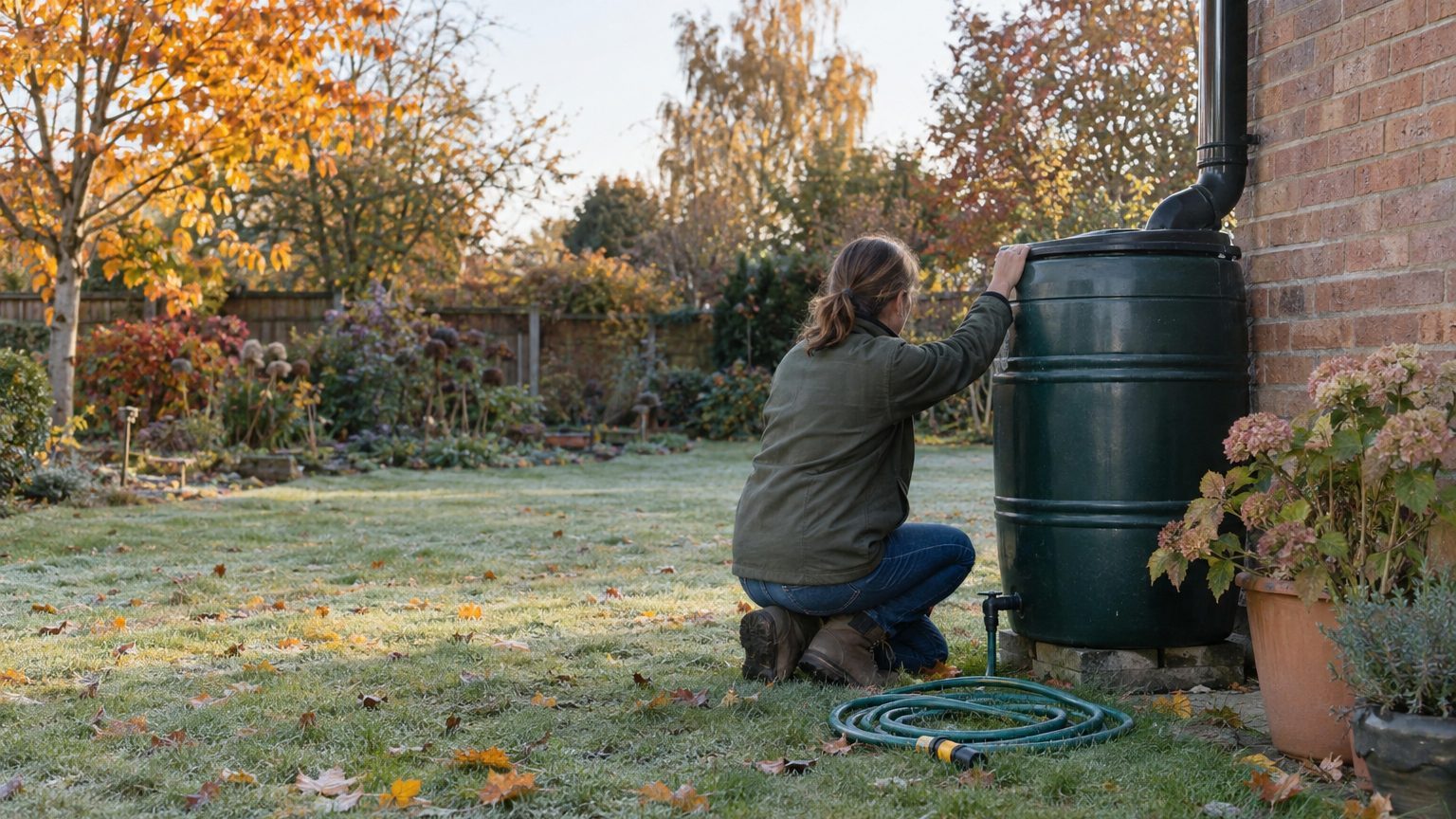
A rain barrel that freezes full can split open, and a barrel that sits through the winter still connected to the downspout will keep refilling and freezing. Ice expands with enough force to easily crack open a wooden or plastic rain barrel, especially when the container is full or near full. Knowing how to winterize a rain barrel takes about half an hour of work, and you do it before the first hard freeze.
- A full rain barrel can weigh over 400 pounds.
- Empty the barrel once nights dip below freezing, before the first hard freeze.
- Store the empty barrel indoors or upside down with the inlet covered.
What a frozen barrel actually costs you
Start with the weight. A gallon of water weighs more than 8 pounds, so a full rain barrel can weigh over 400 lbs. That is roughly the heft of a grand piano’s worth of cast-iron frame, sitting at the corner of your house and slowly turning into a block of ice.
Cracks are the obvious casualty. The quieter damage often hits the spigot first, which is why one gardening guide calls spigots the tiny troublemakers of the rain barrel world, the part that tends to fail before anything else does.
Even a barrel that survives intact loses something. The ice could remain throughout the winter, reducing the capacity of the barrel to capture new runoff and your ability to drain it. A January thaw then sends roof water into a barrel that cannot take it, and the overflow lands against your foundation.
Timing matters more than technique.
Extension programs generally point to the same window: empty the barrel once nights start dipping below freezing, and certainly before the first hard freeze. Waiting costs you little, since a dormant garden barely needs the water anyway. The mistake is treating October as “plenty of time” and then looking up in December.
How to winterize a rain barrel, step by step
Begin with the drain. Open the spigot, hook up a hose if you have one, and put the water to work on shrubs, a compost pile, or the base of newly planted trees. Do this before you move or tip the barrel, because releasing the majority of the water before you tip it over is best, and it spares your back. Aim the discharge away from the house, since you shouldn’t forget to drain the water away from the foundation of your home.
Next, disconnect. How you do it depends on your hardware, and the manufacturer’s instructions for your kit beat any general advice. Many setups simply drop the downspout into a filter on top of the barrel, and in that case there may be nothing to detach. If a diverter connects the two, you’ll likely need a screwdriver to disconnect them.
Some diverters make it easy. With a “Y” style unit, you slide the lever from one side to the other to switch from summer to winter configuration, and the roof water goes back down the downspout. Other kits need more work. For a flexible-insert diverter, the instructions call for removing the screws above and below the attachment, wiggling the insert out, and then using the two screws to attach the flat cap to the downspout.
Cut your downspout to fit the barrel? Then the gap needs closing. Put back the section you removed, or extend the downspout to the ground using a short piece of downspout and a plastic connector from a hardware store. Add an elbow at the bottom so water runs away from the house. A bonus: a downspout or gutter extension keeps roof water from splashing onto buildings or sidewalks, where it might become a slippery hazard.
Skip this part and you’ll regret it in March.
Now clean the empty barrel while it’s open and easy to reach. A mix of ¼ cup of distilled vinegar to a gallon of warm water with a teaspoon of mild dishwashing detergent works well. Swish it around with a mop or brush, rinse, and let it air dry upside down. That diluted solution is safe to pour onto your lawn. Next spring you’ll thank yourself, because the barrel will be ready to hook up the first warm weekend.
Last, strip the extras. Remove hoses, spigot attachments, and any lid or screen you can take off, and keep them in the garage or shed. Short connector hoses and soaker hoses hold more water than most people realize, so they need draining too.
Where the empty barrel spends the winter
Indoors is the best answer. Once the barrel is empty, store it indoors if you have the room. A garage, shed, or basement keeps the plastic out of the temperature swings that make it brittle. Many barrels are made from plastic that can become brittle in winter conditions.
No spare floor space? Leave it outside, but make it hard for water to get in. If it has a screened opening on the top, turn it upside down so it doesn’t fill with rain. For other designs, cover the top inlet with plastic sheeting or a sheet of wood or plastic, and make sure the cover is secure. Some people also leave the spigot open, which lets any stray moisture escape.
Wind is the other threat. An empty barrel weighs a fraction of what a full one does, so winter storms can send it tumbling across the yard. One university extension suggests driving a 2in x 2in post into the ground alongside and tying the barrel to it. Weights or a strap anchored to a fence post do the same job.
One more chore deserves ten minutes while you have a ladder out. Clear the leaves and debris from your gutters and downspouts, which leaves an open pathway for rain to flow through during the winter thaw and makes spring setup much quicker.
If yours already froze solid
Don’t force it. Open the spigot, take off the lid or screen so you can see inside, and let the ice melt on its own. Avoid boiling water, which can warp plastic that is already stressed. Once it has thawed and drained, check the seams, the base, and the area around the spigot fitting, because that is where freeze damage tends to show up first.
Small cracks can sometimes be patched with a plastic-rated sealant, but a split along a seam usually means a replacement. Better news for your budget: a barrel that froze only partway, with the spigot open and room for the ice to expand, often comes through fine.
Finally, remember that rain barrel water is for plants, not people. Roof runoff carries whatever sits on your shingles, so many extension services suggest watering the soil around vegetables instead of the leaves of leafy greens. That’s a reason to keep the barrel clean now, and a reminder for next season’s tomatoes.
Sources : positivebloom.com | getbusygardening.com