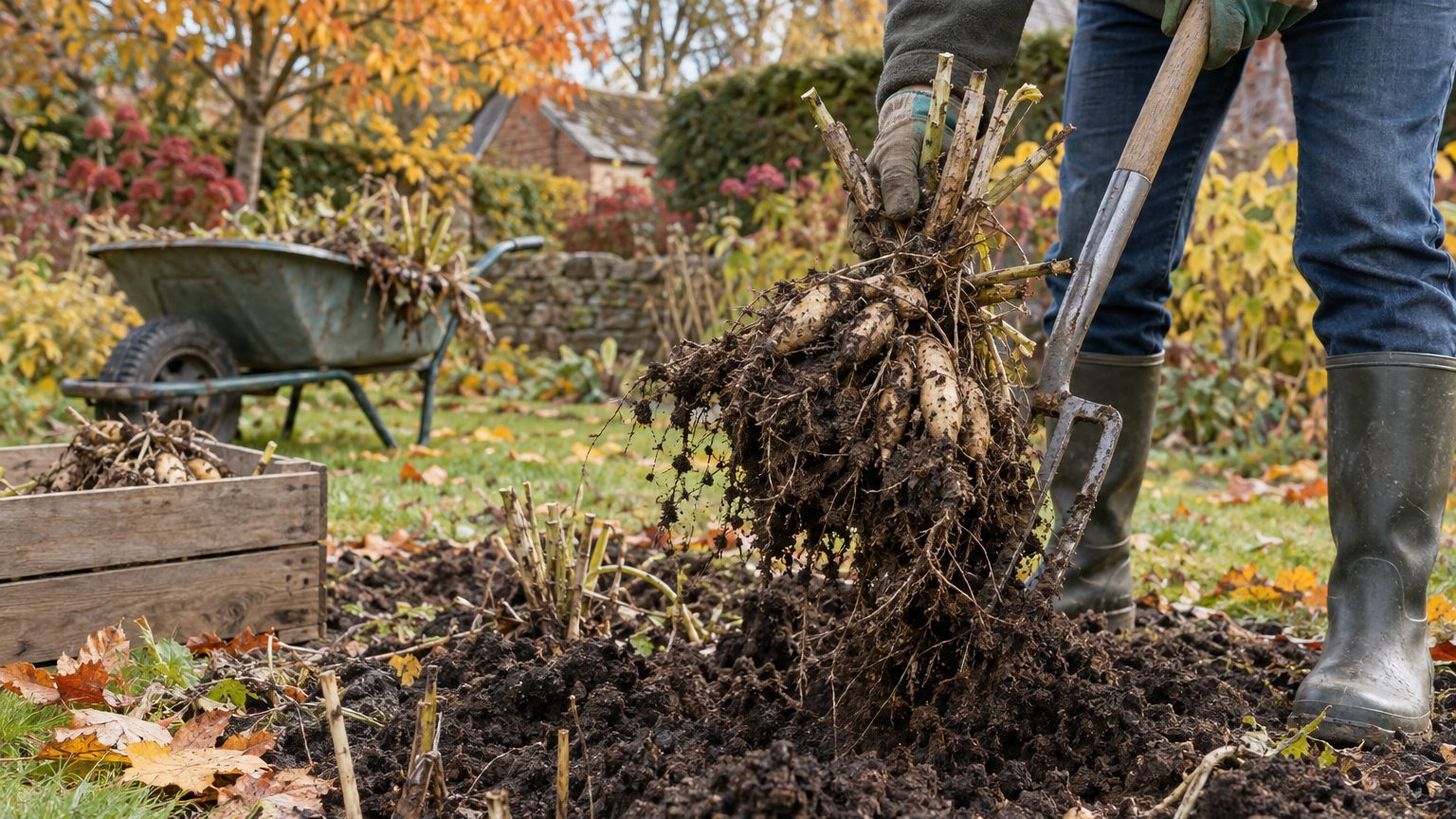
Dahlias are native to Mexico, and they won’t survive the freezing temperatures that many North American gardens experience. Leave the tubers in frozen ground and you’ll probably find mush in May. Dig them at the right moment, in the right way, and one $15 tuber can turn into a clump of five or six.
- Dahlia tubers are dug 1-2 weeks after a freeze so their skins can thicken.
- A garden fork and a starting point at least 12 inches from the stem prevent cut or snapped tubers.
- Tubers store best at roughly 40 to 50°F in a dry, frost-free place, checked monthly for shriveling or rot.
Wait for the frost, then wait some more
The first frost blackens the foliage. That’s the signal, but it isn’t the starting gun.
One grower recommends letting the plants freeze in the garden and waiting about 1-2 weeks after a freeze before lifting them. The reason is underground: the skins are thickening up and the tubers are preparing for winter. Tubers dug too early generally will shrivel and will not survive winter storage. Patience pays here, and it costs nothing.
Some gardeners lift early anyway, ahead of a killing frost. That works too. One approach is to cut the stems to about 6 inches and let the tubers sit in the ground for 3 days or so before digging.
Timing the cut matters as well. Hold off on cutting the plants down until right before you dig, because this way water won’t accumulate in the hollow stems. A stem full of water is an invitation to rot, and the rot travels straight down to the crown.
When you’re ready, cut the stems back to leave a stub. Sources vary a little on the exact length: 3 to 4 inches from one bulb company, 4 to 6 inches from another. Either way, the stub marks the center of the clump and gives you a landmark so you know where to dig.
How to dig up dahlias for winter without snapping the necks
Grab a garden fork, not a spade. A spade’s sharp blade slices straight through anything in its path, while the tines of a fork loosen the soil and lift the clump with far less damage. If your soil is heavy clay, a spade may be unavoidable, and then you’ll need to place the blade carefully.
Start farther out than feels natural. Most guides say to begin at least 12 inches away from the main stem, because digging too close is a common way to slice tubers. A healthy clump can be bigger than you’d guess, since the root ball may be 12 to 18 inches across and equally deep.
Work your way around the plant in a full circle, loosening the soil on every side. Then slide the fork under the clump and lever it up gently.
Don’t haul on the stem.
Each tuber attaches to the crown by a narrow neck, and that neck is the weak point. A tuber with a snapped neck still looks like a healthy root, but it can’t grow a new plant. Lift from underneath, supporting the weight, and treat the whole thing like carrying a sleeping toddler. Brittle, heavy, and unforgiving of sudden moves.
If you’re growing several varieties, label as you go. One gardener’s advice is to dig one variety at a time, keep its clumps together with their label, and finish washing that variety before starting the next. Skip that step and you’ll end up with a box of mystery dahlias come April, which is a fun surprise exactly once.
Drying, cleaning, and the washing debate
Freshly dug tubers are fragile. If you plan to rinse them, give them time first, because letting them sit a couple of hours after digging makes them less likely to break off. Then the argument begins.
Some growers wash the soil off with a hose. They find washing makes the spring division process much easier. Others refuse to rinse at all, saying rinsed tubers sometimes have a tendency to shrivel in winter storage and are hard to dry enough. I lean toward the cautious camp in humid climates. If your basement or garage stays damp, brushing off dry soil is the safer bet.
Where you dry them matters more than the washing choice. Pick a spot that won’t dip below freezing, has good air circulation, and receives indirect sunlight. Drying times differ by source, from a day or two up to several weeks for washed tubers, so judge by feel. The skin should look dry and the tubers should feel firm, not tacky.
Dividing is optional at this stage. You can divide now, or wait and do it during the winter or early next spring. If you wait, there’s no need to wash the clumps, and you can store the whole root ball as it came out of the ground. Many people find the eyes (the little buds that become shoots) easier to spot in late winter, when the clump has begun to wake up.
Storing tubers, and when to skip all of this
Aim for a cool, dark, frost-free spot. An unheated basement, root cellar, or insulated attached garage often fits the bill. Most growers aim for roughly 40 to 50°F. A cheap thermometer and hygrometer are worth having, so you’re working from real numbers instead of guesses.
Trim the thin, stringy feeder roots first. Then pack the tubers in a cardboard box, paper bag, or a plastic tub with the lid set loosely. One grower uses coarse vermiculite, wood shavings, or dry peat moss, arranged so the tubers aren’t touching.
Check the box once a month. Shriveling means the air is too dry, so mist the packing material very lightly. Soft spots or mold mean too much moisture, and the affected tuber should be cut away or tossed before it spreads. As one grower puts it, there is no saving a rotten tuber.
Not everyone has to dig. If you live where the ground doesn’t freeze deeply, you can leave the tubers in place and pile on mulch. One farm suggests a thick layer, 8 to 12 inches, of straw, grass clippings, leaves or compost. Check your USDA zone first, because mulch only protects tubers when the soil stays above hard-freeze territory. And if you only grow a few plants and don’t want the chore, one grower says you can just leave them in the ground, though you’re taking a gamble.
Even in mild zones, a wet winter can rot tubers in poorly drained soil. A raised bed gives you the best odds of leaving them in place.
Whichever route you choose, label one clump of your favorite variety and store it where you can check it easily. It’s the one you’ll want most in June.
Sources : dahliabarn.com | ngb.org