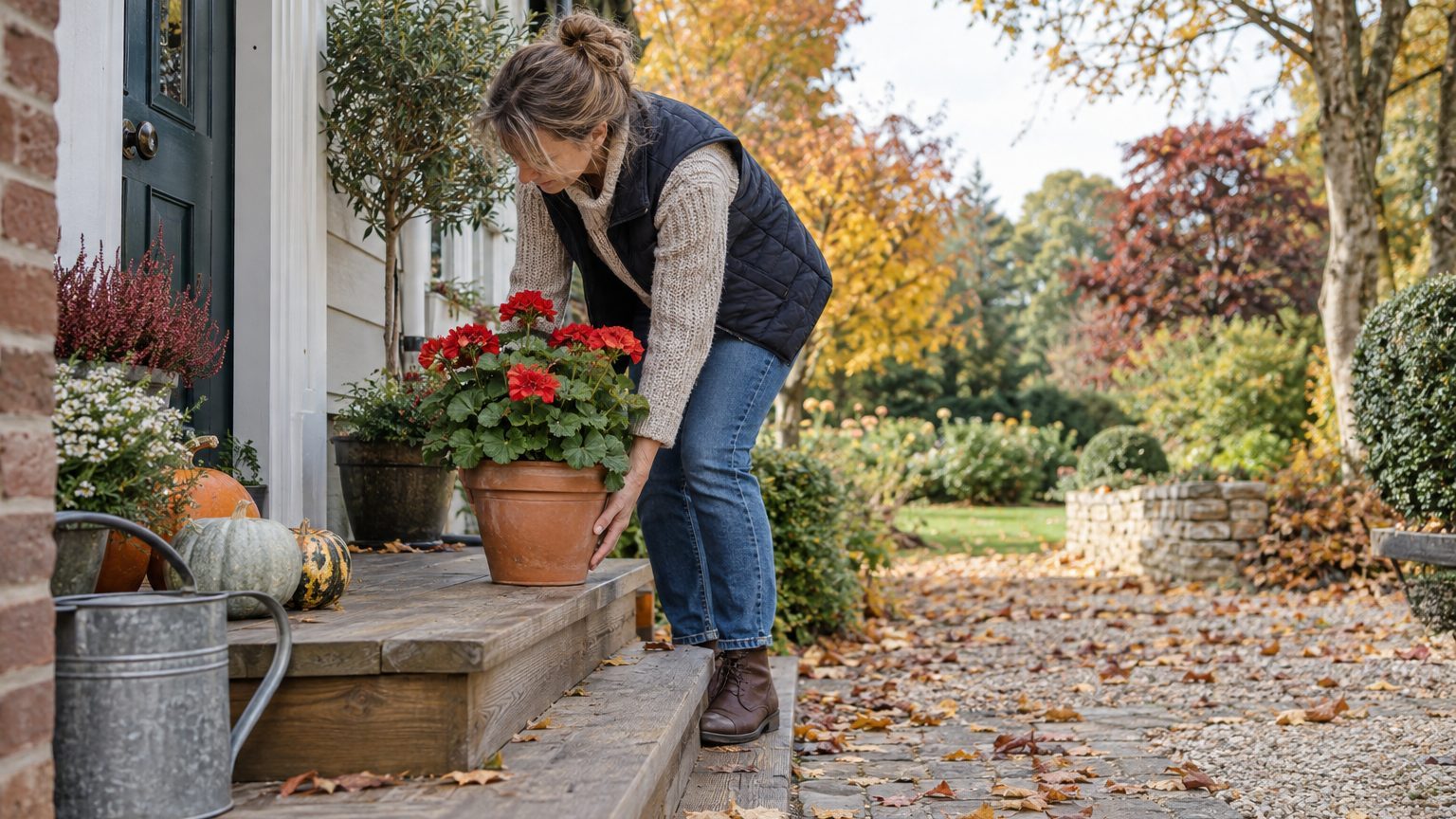
Geraniums that spent the summer on your porch don’t have to end up in the compost bin come October. There are three ways to overwinter geraniums indoors: as a houseplant, a dormant bare root or cuttings. Which one you choose depends partly on how much space you have indoors, and also what temperatures you can accommodate.
The deadline is frost.
- Tender geraniums (Pelargoniums) cannot survive frost and must be brought in before the first hard freeze.
- Dormant geraniums are stored at 45-55°F with no water until spring.
- Cuttings rooted in a tray take about six weeks to develop roots.
Know what you’re saving before you dig
The plants worth rescuing are tender geraniums, botanically Pelargoniums (the zonal, ivy-leaved, regal and scented-leaf types sold in spring flats). In zones 8 and colder, they won’t survive winter outdoors. Hardy geraniums (cranesbill), however, are true perennials that can handle winter outdoors and return each spring. If the plant in your planter has bold, round, sometimes zoned leaves and pom-pom flower heads, it’s the tender kind.
Timing matters as much as technique. Do your digging, potting or cutting before the first hard frost. A single night in the low 30s can turn a month of patience into mush.
Before anything crosses the threshold, inspect it. Always check for any unwanted hitchhikers. One gardener who has tried most of these methods suggests treating the specific pest you find, before moving the plant into your house or greenhouse. Whiteflies and aphids that ride in on a geranium will happily move on to your other houseplants.
The sunny-window route: keep them growing
This is the most familiar approach, and the one that asks the least of your knowledge. Once indoors, trim the plants back by one-third to one-half, water thoroughly and set in a sunny spot. No south window to spare? You can use artificial lighting, or a combination of natural and artificial light.
Skip the radiator shelf. Keep the geraniums away from heat vents or the fireplace as they fare much better in cooler temperatures (60 to 65 degrees F). Water only when the soil feels dry to the touch.
Expect some awkwardness by midwinter. Low light stretches stems, and geraniums are likely to become tall and lanky by late winter. Pinching helps: prune or “pinch back” stems just above a leaf node to produce new growth. Iowa State’s advice is to cut plants back by half to two-thirds in March, after which the geraniums will begin to grow again within a few days and should develop into nice specimens by May.
The trade-off is simple. You get green leaves in January, and sometimes a stray bloom, but you also get a plant that needs a spot in your house for six months.
Letting them sleep: dormant pots and bare roots
For anyone short on windowsills, dormancy is the better deal. For potted plants, the method is almost embarrassingly lazy. You can place them in a cool, dark basement or even a garage, and keep them there until spring temperatures start to warm up. The target is 45-55F (7-13C), and one grower recommends staying no warmer than 60F if you can. A garage works if it stays above freezing.
Stop watering and let the leaves go. That feels wrong, but the thick, succulent geranium stems allow the plants to survive periods of drought. A dormant geranium looks like a pot of sticks. Leave it alone anyway.
Bare-root storage saves floor space. Carefully dig up the geraniums before the first fall frost, then shake the soil from the roots. Place one or two plants in a large paper sack and store in a cool (45 to 55 degree Fahrenheit), dry location. An unheated bedroom or enclosed porch fits the bill. Prefer the old-fashioned way? Hang the plants upside down in cool, dry location, a method one Wisconsin extension educator traces back to her great-grandmother’s fruit cellar.
Waking them up is the part people botch. In March, remove all shriveled, dead material and prune back to firm, green, live stem tissue. Then pot up the plants and water thoroughly. Another guide suggests potting them roughly about six weeks before your last frost date, then waiting two to four weeks for new growth.
Cuttings: the small-footprint insurance policy
Got a prized variety and no basement? Take cuttings. This method works especially well if you have limited space and can’t overwinter large pots. A dozen cuttings fit on a single tray, while one mature plant in a 12-inch pot takes over a corner.
The process is short. Use a sharp knife to cut a 3 to 4 inch section of stem tip, pinch off the lower leaves and dip the cut end in rooting hormone. Push it into a drainage-hole container filled with a rooting medium such as peat moss, sand or perlite. Keep the medium moist, and set it in a brightly lit area but not in direct sunlight as this can burn the cutting.
Patience is the main ingredient. Cuttings should be well-rooted after about 6 weeks, though Iowa State gives a window of six to eight. Once roots have formed, transplant each cutting into their own container filled with potting soil and give them the brightest spot you have.
Cuttings also work as a hedge. Even if you dig up the parent plant and store it dormant, a few rooted tips on the windowsill mean a failed basement doesn’t wipe out the variety. And there’s a bonus for in-ground plantings: geraniums growing directly in the garden can be dug and potted before frost, or you can take cuttings from them instead.
One last check for the dormant crowd: in late winter, scratch a stem gently with a fingernail. Green underneath means the plant is alive, and it’s ready for the March haircut.
Sources : flowerpatchfarmhouse.com | gardeninginsteps.com