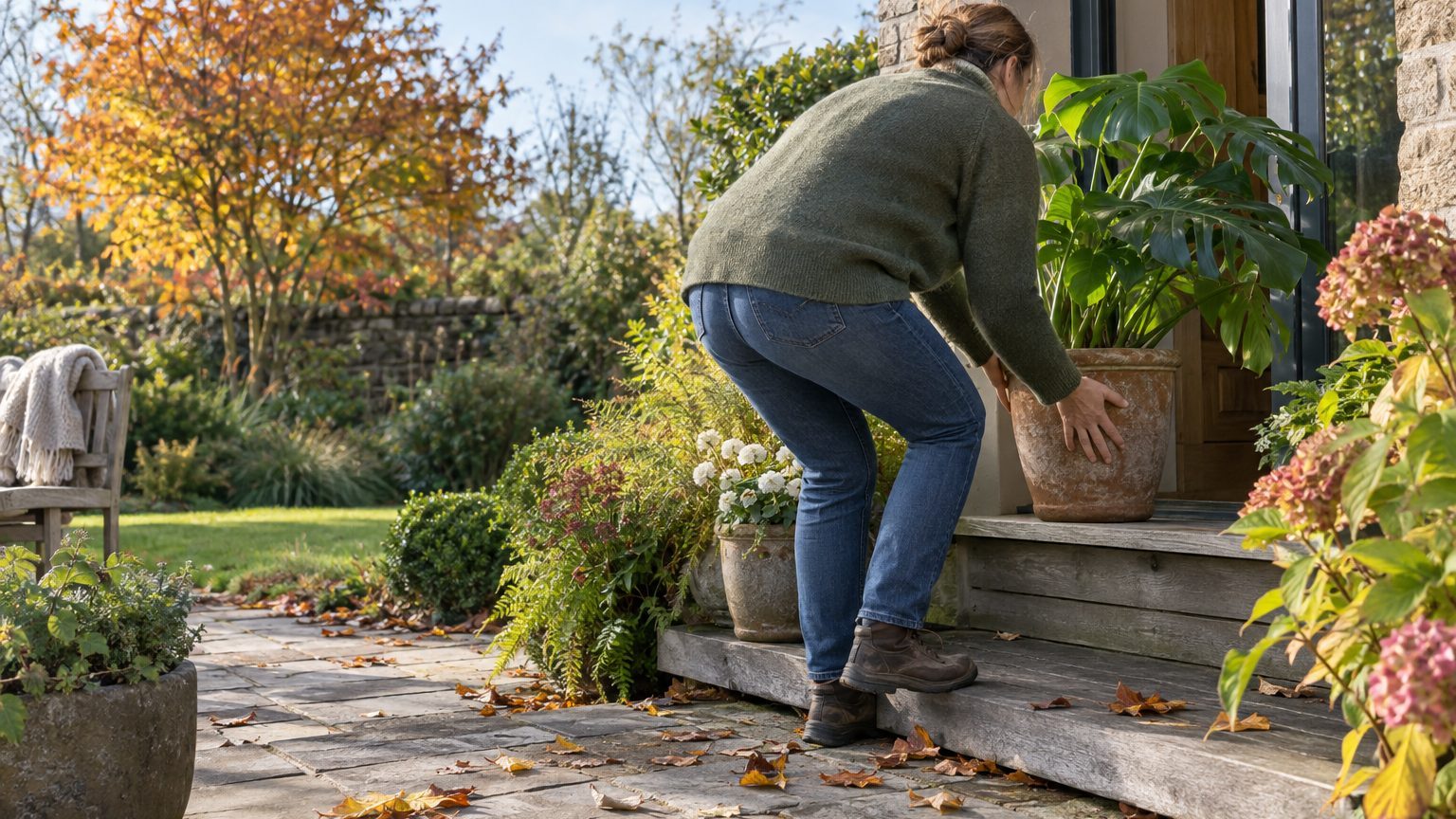
The first frost is the wrong deadline. Most houseplants that spend summer on a patio start to suffer when nights slip into the mid-40s, weeks before the thermometer reaches 32°F. Iowa State University Extension notes that many indoor plants show damage in the mid to lower 40s°F and nearly all die below freezing. That gap is the whole story of how to bring plants inside for winter without losing half of them.
Frost is the funeral, not the warning.
- Bring houseplants in when overnight lows consistently drop below 55°F, not at first frost.
- Check undersides of leaves, stems and soil for pests before moving plants indoors.
- Acclimate plants over about a week by gradually increasing indoor time.
- Expect some leaf drop after the move and water less while plants slow down indoors.
Read the overnight low, not the calendar
Extension services agree on a number, give or take a few degrees. Illinois Extension says to start moving houseplants in when the thermometer consistently drops below 55°F. HGTV’s guidance is to move them before temperatures dip into the 50s, usually four to six weeks before the average first frost. Virginia Cooperative Extension puts it bluntly: bring them in before temperatures dip below 55°F, and don’t wait for frost warnings.
Here is why gardeners get caught. Cold damage on a tropical plant happens weeks before the first frost and is often invisible on the night it occurs. Blackened patches, sudden leaf drop and collapsed stems show up days later, so people blame the move indoors rather than the 46°F night that came before it. A sunny 70°F afternoon tells you nothing. The overnight low is the number that counts.
Not every pot has the same deadline. NC State recommends keeping rubber plant (Ficus elastica) above 55°F, so it comes in early, while succulents and cacti tolerate cool nights better, provided the pot stays dry. In colder states, the calendar tightens: Michigan State University Extension suggests having plants inspected and moved back indoors by around mid-September.
Clean every pot before it crosses the threshold
Pests are the stowaways nobody budgets for. Oklahoma State’s horticulturist describes patio plants as a ride-share for insects: aphids, mealybugs and spider mites hitch a lift, and once inside, they can infect all of the other houseplants. He recommends checking under the leaves, on the stems and even the area between the pot and the saucer.
A quick glance won’t do it. Penn State Extension suggests a magnifying glass or hand lens for leaves, undersides, stems and soil, and a trick that takes ten seconds: hold a piece of white paper under the leaves and tap them gently to see if anything falls. If the plant is small enough, lift it out of the pot, soil and all, to see if anything is hiding in there. Sowbugs, ants and centipedes love the bottom of a pot. Do all of this outdoors, on a garage bench or a shaded corner of the patio, so nothing escapes into the house.
One hitchhiker in October can be an outbreak by January.
Treatment is low-tech. A hose spray removes many pests, though it may take several attempts. Firmly attached scale can be scraped off or wiped away with a sponge. For anything stubborn, Oklahoma State recommends treating with insecticidal soap or another approved product outside, before the plant comes in. Then quarantine: Penn State advises a separate room with bright light and good air circulation, and daily inspections for a week or two, treating whatever pest appears.
Step down the light before the move
The jump from deck to living room is bigger than it looks. One indoor-plant guide that draws on Illinois Extension’s numbers estimates that a sunny deck to a south window is close to an eightfold drop in light, and a north-facing living room is closer to an eightyfold drop. Temperature matters too. Oklahoma State points out that if the air conditioner is still running, there could be as much as 20 degrees’ difference between outdoor and indoor temperatures.
The fix is a week of gradual stepping down. Oklahoma State’s schedule is simple: move plants to a shaded part of the yard for about a week, then bring them indoors for a day or two at a time, gradually leaving them in longer. Another approach: carry the pot in each evening and back out each morning, increasing indoor time over about two weeks until it stays in full time. For the permanent spot, the brightest window you have (typically south or west facing) is the starting point, and a grow light covers the gap where the window won’t.
Cold tonight beats any schedule.
If the forecast shows a chilly night, skip the routine. Move the plant indoors now rather than leaving it exposed just to finish an acclimation plan. A plant that sulks in a dim corner can recover. A tropical that spent a night at 38°F often can’t.
The first weeks indoors
Expect some leaf drop, and don’t panic. Oklahoma State’s specialist says it’s normal for some plants to drop a few leaves after the move, with new growth starting once they adapt to indoor light. Stretching is the opposite signal. Reaching stems mean the plant needs to move closer to a light source or get more time under artificial lighting.
Water is where most good intentions go wrong. Plants slow down considerably indoors, so for most you should let the soil dry slightly between waterings and stop fertilizing until spring. Illinois Extension’s test is the second-knuckle check, which means leaving the pot alone if the mix is still moist at that depth. Overwatering is the season’s other common way to lose a plant.
Placement counts as well. NC State Extension advises keeping plants away from drafty windows, and at a safe distance from fireplaces and heaters. Grouping plants together helps trap heat and humidity. If you use grow lights, don’t leave them on for more than 8 hours a day.
One last nuance for the plant that looks dead by December: some plants, such as Alocasia, may go completely dormant, so the above-ground portion dies back temporarily. Keep the pot, ease off the water, and wait for spring before you toss it.
Sources : news.okstate.edu | betterindoorhouseplants.com