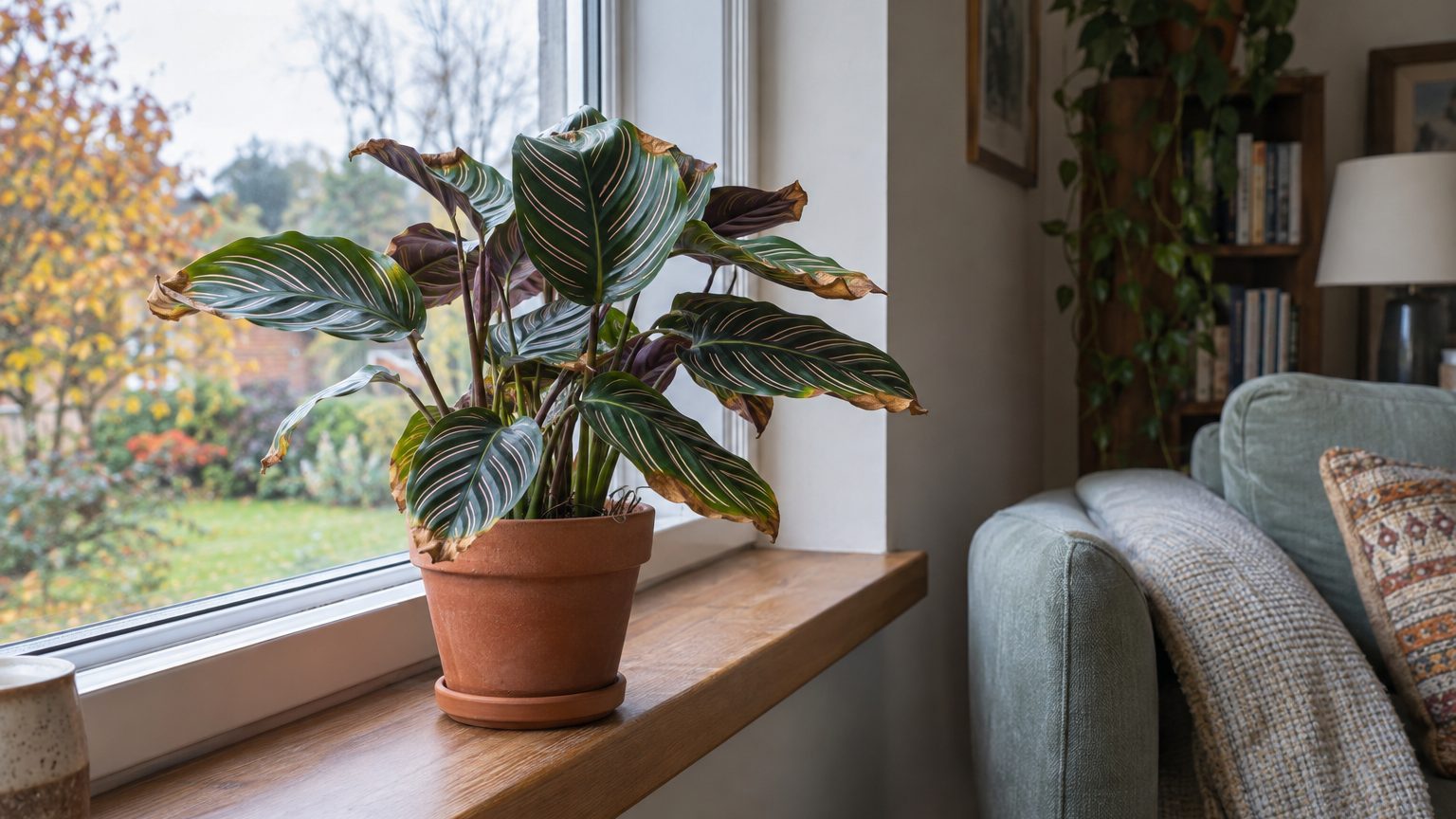
Crispy brown edges on a Calathea in early November usually mean the furnace is winning. Heated indoor air commonly sits around 30 to 50% relative humidity, while most tropical houseplants want closer to 50 to 60%, and fussy ones like Calatheas want more. Raising humidity around a plant is possible, but the methods differ a lot in how well they work.
Some of them barely register on a hygrometer.
- Indoor heated air often sits between 30 and 50 percent relative humidity, below what most tropical houseplants need.
- Moving a plant away from a heating vent costs nothing and reduces moisture loss from the leaves.
- A humidifier running near the plants is the one method that reliably changes humidity across a room.
Why the furnace hits Calatheas first
Calatheas come from the humid understory of tropical forests, where the air is rarely dry. Their thin, broad leaves lose water quickly, and when the air turns parched the margins dry out first. Turn the heat on, and the plant is suddenly living in something closer to desert air than rainforest air. The damage shows up as brown, papery edges and leaves that curl inward during the day.
Vents matter as much as the thermostat. A plant sitting above a heating register gets a stream of hot, dry air that strips moisture from the leaves faster than the room average would suggest. Moving the pot a few feet away from the vent costs nothing and often does more than any gadget.
Damaged leaves won’t turn green again.
Trim the crisped edges if they bother you, following the natural leaf shape, and put your effort into protecting the new growth. Before you buy anything, a cheap digital hygrometer is worth having. Without a reading, you’re guessing, and Extension horticulturists at the University of New Hampshire recommend monitoring humidity with a sensor for exactly that reason.
The no-cost methods: grouping, placement and the bathroom
Plants release water vapor through their leaves and soil. Cluster several together and that moisture lingers in the pocket between them, creating a microclimate that is more humid than the room around it. UNH Extension describes this as a real but modest gain, one that works best with several plants in a room with little air movement. Some gardening guides put the lift at up to about 15 percent, though that figure is best treated as an upper bound rather than a promise.
Don’t pack the pots tight, though. Crowded plants in still air invite mold and pests, so leave a few inches between foliage and keep a little airflow moving, as far from the heating vent as you can manage.
The bathroom works as a seasonal fix. A shower pushes humidity up sharply for a short time, and a bright bathroom window can hold a Calathea comfortably through the dry months. The catch is light, since many bathrooms are dim, and Calatheas want bright but indirect light rather than a dark corner.
Pebble trays and misting: popular, but weaker than their reputation
A pebble tray is a shallow, waterproof dish filled with stones and water, with the pot resting on top. The base of the pot has to stay above the waterline, or the soil wicks up moisture and the roots rot. UNH Extension suggests a tray two to three inches deep, and the benefit grows when you set several plants on it together.
The effect is small. Water evaporating from a tray rises and disperses into the room, so the gain is limited to a pocket around the foliage, and one measured test found only a few percentage points of lift right above the tray. A tray suits a single orchid or a small cluster of ferns on one shelf. It won’t rescue a collection of tropicals in a dry living room.
Refill it weekly and rinse it now and then, because standing water grows algae and attracts gnats.
Misting is the method most people try first and the one extension specialists dismiss most readily. Nebraska Extension points out that you would have to mist every few minutes to change the humidity of the air in any meaningful way. A spritz gives the leaves a brief damp sheen, and within minutes the air is as dry as before. Water sitting on leaves overnight can also encourage fungal spots on some species.
The methods that actually move the needle
A portable humidifier is the one tool that reliably changes the conditions across a space. UNH Extension advises placing it close to the plants, particularly in larger rooms, and running it for several hours each day. Pair it with a hygrometer so you can see when you’ve reached the 50 to 60% range and avoid overshooting. Cool-mist models are the usual pick for plant rooms, and a small unit costs roughly the price of a modest dinner out.
Clean it on the schedule the manufacturer gives. A humidifier with a slimy tank spreads whatever grows in there into the air, and that matters for people as much as for plants. Keep the mist from blowing directly onto the leaves, and set the unit a short distance away so the foliage doesn’t stay soaked.
For one prized Calathea, an enclosure is the nuclear option. A clear plastic bin, a cloche, or a small greenhouse cabinet traps the plant’s own moisture and holds humidity far above room level. Vent it regularly, or the stale, wet air will cause trouble of its own. It looks less elegant than a bare pot on a stand, but for a plant that sulks in dry air, the results can be dramatic.
Combining methods beats leaning on one. A large living room with several tropicals does best with a humidifier doing the heavy lifting and grouped plants holding the humidity between cycles. A lone Calathea on a desk might get a tray, a few neighbors, and a small humidifier nearby, but not blowing straight at it.
Water quality plays a part too, and it’s often the missing piece when leaf tips brown despite good humidity. Calatheas are sensitive to minerals and chemicals in tap water, so letting water sit out overnight or using filtered or rainwater can help. Keep the soil lightly moist as well, because underwatering produces the same crispy edges that dry air does.
Start this week with the free moves: pull the Calathea away from the vent, bunch it with its neighbors, and buy a hygrometer. If the reading stays under about 40% after a few days, add the humidifier. Expect the new leaves, not the damaged ones, to show whether it worked, usually within a few weeks.
Sources : leafypixels.com | chive.com