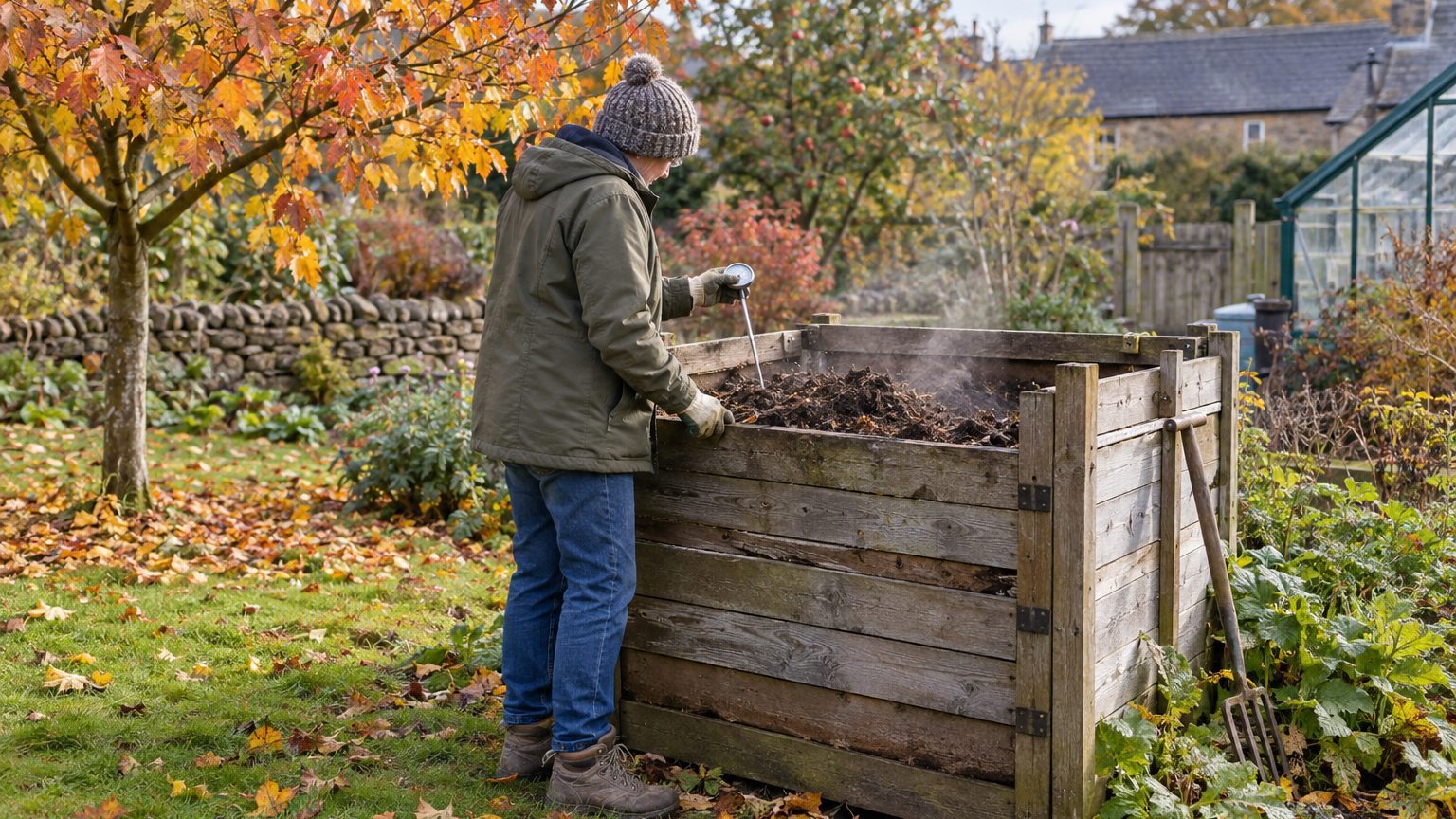
A compost pile that goes cold in December hasn’t died. It has shifted into low gear, and with a few changes it can keep working through January, February and beyond. The trick is understanding what the microbes need and giving it to them before the ground locks up.
Slow is not the same as stopped.
- Psychrophilic bacteria keep decomposing compost slowly even when temperatures fall below 68°F.
- Piles 3 to 4 feet on each side hold heat better than smaller or larger ones.
- A healthy winter pile at its core typically reads 90 to 120°F on a compost thermometer.
What actually happens inside a frozen pile
The fast, hot phase of composting belongs to thermophilic bacteria, which thrive between roughly 113 and 167°F. Once temperatures fall below about 68°F, a different crew (psychrophilic bacteria) takes over and keeps working, just more slowly. University of Illinois Extension describes extreme cold as something that slows composting rather than halting it.
True hot composting is much harder to pull off in winter, according to North Carolina State Extension. What you can maintain is cold composting, where scraps break down over several months instead of several weeks. That has a catch: the heat that kills weed seeds and pathogens won’t be there, so keep invasive plants and seeded weeds out of the winter pile. And when the temperature inside a setup drops below roughly 55°F, microbial activity slows noticeably.
The upside is that Everything you add now is already in place when spring warms things up, ready to decompose faster.
Build it big and wrap it up before the hard freeze
Size does more for a winter pile than any gadget. Ohio State University Extension notes that piles smaller than 3 feet on each side struggle to hold heat in winter, while piles bigger than about 5 feet on a side let too little air reach the center. Aim for the middle of that range, roughly 3 to 4 feet each way.
A big pile is the cheapest insulation there is.
Then add a jacket. University of Minnesota Extension suggests surrounding a bin or pile with straw bales, leaves or even old blankets if the composter is enclosed. A tarp on top keeps snow from piling up and helps hold moisture steady, and Oregon State University Extension adds that winter piles should be covered to keep out excess rain and snow. The target is a texture like a wrung-out sponge, damp but never dripping.
Fall is when you stock up. Bag or pile extra leaves now so you have dry carbon-rich material to layer in all winter, and chop or shred scraps and yard waste before the deep cold arrives, since smaller pieces give slow-moving microbes more surface to work on.
Store-bought bins deserve a hard look. Compact, prefabricated bins are more prone to chilling and freezing, and many tumblers freeze solid during a long cold spell. If yours sits in shade, move it to the sunniest spot you have, or retire it for the season and lean on a full-size pile.
Feeding, turning and watching the thermometer
The classic winter mix is about one part greens (kitchen scraps, coffee grounds) to two parts browns (leaves, straw, shredded paper). Too many greens turn the pile soggy and smelly, while too many browns slow decomposition even further in the cold. Keep a covered stash of dry browns next to the bin so you aren’t digging through snow for them.
Turning changes in winter. Every time you open the pile, you let out the warm air at its center, so University of Kentucky Cooperative Extension warns that winter turning means heat loss inside the pile. Minnesota’s advice is to turn much less often but still check on it now and then. If snow buries the pile, clear some of it so air can circulate, but don’t strip the pile bare.
A long-stem compost thermometer takes the guesswork out. A reading of 90 to 120°F at the core means decomposition is going strong, and even cooler readings show progress.
Steam on a frosty morning is a good sign.
Michigan State University Extension points out that active piles steam and often melt the snow right off their tops. If yours wears a permanent white blanket, it’s probably cold all the way through. For truly nasty weather, keep a second lidded container near the back door for scraps, then empty it into the pile during a safe break rather than trekking out in a blizzard. Cutting large scraps into smaller sections before they go in helps too.
When the outdoor pile is out of the question
Some winters simply win. University of Illinois Extension acknowledges that in the coldest stretches it can make sense to pause outdoor composting and switch to an indoor worm bin, a bokashi bucket, or a food scrap drop-off service if your town has one.
Worm bins come with ground rules. If the temperature gets too cold, red wigglers freeze or flee, according to NC State Extension, so a bin needs to live somewhere protected, such as a basement, garage or utility room. In milder climates, an in-ground worm bin topped with a layer of insulating material and a few inches of dry leaves lets worms burrow below the coldest air, an approach Eco-Cycle in Colorado demonstrates.
Even the most committed composters in Colorado admit that a stretch of several weeks each winter can be too snowy and cold for anything but dumping the scrap bucket on the pile and heading back inside. That’s fine. The key is not letting it become a habit all the way to spring, because scraps left to pile up unmixed can turn into a frozen heap that thaws into a slimy mess. Mix it in as soon as you can reach the pile again.
One last point in your favor: the pile you tend this winter has a head start. When March warms the soil, a pile full of chopped scraps and dry leaves wakes up working instead of starting from zero.
Sources : extension.umn.edu | letsgocompost.org