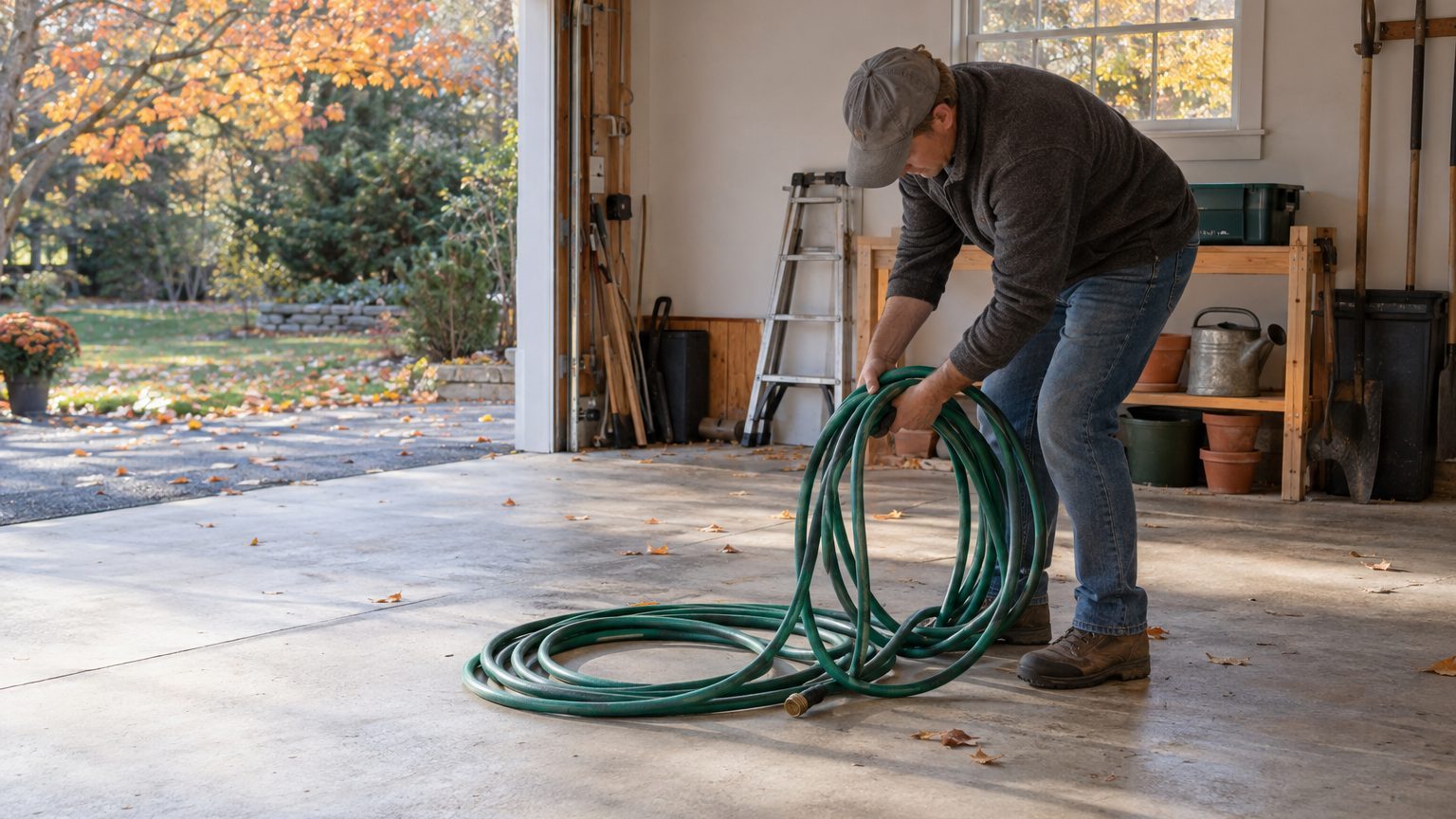
A garden hose that splits after a single freeze almost always had water left inside it. That trapped water turned to ice, pushed outward on the hose wall, and left a crack you probably won’t find until you turn the spigot on in spring.
The fix takes about ten minutes.
- Water left inside a hose expands about 9 percent when it freezes.
- Hoses stored indoors each winter can last 5 to 7 years or more.
- Draining takes about ten minutes using gravity and a raised surface.
Why one cold night is enough to ruin a hose
Water expands by roughly 9 percent when it freezes. A hose wall is built to handle pressure from flowing water, not a rigid plug of ice forming in one spot and swelling against a seam. Vinyl and rubber also stiffen in the cold, so they flex less and give way sooner.
Some hoses survive the first freeze and fail in the second or third. Others look fine until the thaw, when the leak finally shows up near a coupling or along a kink.
The hose isn’t the only thing at risk. A hose left attached to the outdoor faucet can hold water against the spigot, and ice expansion there can damage the hose bib. In some cases it causes a hidden leak inside the wall, which costs far more than a new hose.
Oregon State University Extension says a hose can technically stay outdoors through winter if it is completely drained. The catch is that repeated temperature swings age the material faster and shorten its life.
How to drain a garden hose properly
Start at the spigot. Unscrew the hose, then take off every nozzle, sprinkler, timer and splitter, since each one holds its own pocket of water. If you’ve linked several lengths together, separate them and treat each as its own hose.
Gravity does the real work. Oregon State University Extension suggests running the hose over an elevated surface, such as a deck rail, a sawhorse or the edge of a raised bed. Begin at one end and work toward the other, keeping the remaining length raised so the water keeps moving out.
You can also stretch the hose down a slope, or hold one end high and walk the other end through your hands like you’re pulling rope.
Don’t skip the nozzle. Shake out the water and let it dry before storing it, because spray heads with small chambers and triggers hold a surprising amount.
Then turn to the faucet itself. If your house has an interior shutoff valve for the outdoor spigot, close it, go outside and open the faucet to let the line empty. Some shutoff valves have a small bleeder cap that releases pressure and drains the pipe more fully. Afterward, watch the spigot for a minute or two, because a slow drip can build ice and cause the very problem you’re trying to avoid.
Coiling without creating the next kink
Tight bundles shorten a hose’s life.
It’s tempting to wind the hose into the smallest possible package so it fits on a shelf. Resist that. Loops about 2 feet across follow the hose’s natural curve and put the least stress on the wall, while tighter coils can cause breaks even when the hose is kept somewhere warm.
Coil each length separately and check that nothing is pinched. A kink that stays folded for five months turns into a weak spot, and the next time you pressurize the hose it can crack right there.
This is also the right moment to inspect. Run your hands along the hose and look for cracks, bulges, soft spots and damaged connectors. A hose that already leaks at the coupling or has a bulge won’t improve over winter, so replace it now instead of in May, when every household in the neighborhood is buying one. Rubber washers inside the female coupling cost almost nothing and are worth swapping if they look flat or cracked.
Where to keep it until spring
The best spot is an enclosed space that stays above freezing or at least out of the worst weather. A garage, shed or basement all work. The University of Maryland Extension recommends draining hoses before freezing weather arrives and storing them in a garage or shed.
Keep the hose off the concrete or soil. A hose lying on the ground collects moisture, and over a long winter that can lead to mildew and rot. Keep it away from sharp tools and heavy objects too, since a rake handle or a bag of fertilizer resting on top will leave a permanent dent.
For hanging, pick a wide, curved hose hanger or a large hook instead of a single nail. A nail concentrates the full weight of the hose on one narrow point, and that point is where the hose will kink. A hose reel mounted on an interior wall, or a simple shelf or bin, also does the job.
Storage makes a measurable difference. Estimates for a decent-quality hose run about 5 to 7 years or more when it is brought indoors each winter, against roughly 2 years when it stays outside, connected and full. Over a decade, that gap decides whether you buy one hose or four.
If you really have no indoor space, drain the hose, coil it and park it in the most sheltered corner you have, off the ground and away from direct weather. It’s a fallback, not a plan. A cheap insulated cover over the spigot adds some protection against wind and cold, but it doesn’t make up for skipping the draining.
One more detail for anyone with a frost-free faucet: those fixtures are built to drain themselves through a sloped stem, but only if the hose is off. Leave a hose attached and the water can’t clear the pipe, which defeats the design.