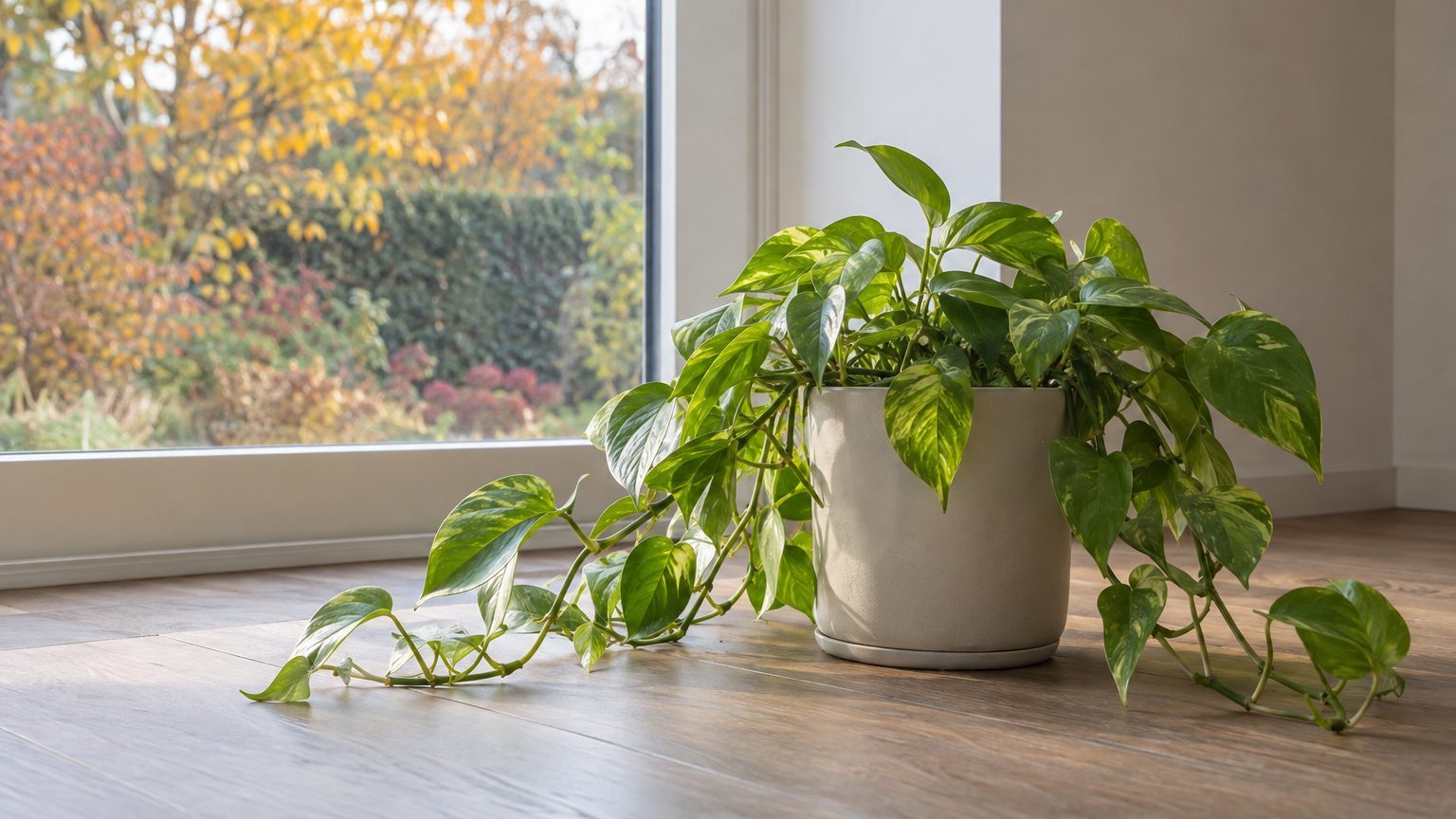
Your pothos hasn’t given up. It’s idling. Between November and February, most vines in American homes slow to a crawl or stop pushing out new leaves altogether, and the cause is almost always a shortage of light, not a mistake you made.
Why pothos growth stalls when the days get short
Pothos is a tropical vine that climbs tree trunks in its native range. It has no true dormancy, but it slows down when light drops, and every other need (water, food, warmth) drops with it.
Light is the throttle.
University of Florida extension researchers note that pothos tolerates light levels as low as 50 foot-candles, though new growth suffers there. At 150 foot-candles or more, the plant holds its color and leaf quality. A windowsill in July can deliver many times that. A spot a few feet back from the same window in December may fall right at the survival line, which is why the vine stretches, stalls, and sheds a few lower leaves.
Temperature matters too. Pothos is comfortable between roughly 60°F and 85°F and shouldn’t sit below about 50°F. The usual winter offenders are a cold windowpane against the leaves, a draft from a door, or a heating vent blowing dry air across the foliage.
The practical takeaway: adjust care to the light your plant actually receives, not to the date on the calendar.
Pothos care in winter starts with light
Move the plant closer to a window, but not against the glass. Bright, indirect light is the target, so a spot near an east window or a few feet from a south or west one works well. If you use a south or west exposure, keep the pot at least 8 to 10 inches back from the glass so the leaves aren’t scorched by direct sun or chilled by cold air. Rotate the pot every week or two, because the vines lean toward the light.
Variegated types show the problem first. Marble Queen, Neon, and other lighter cultivars lose their cream or chartreuse patterning when light is poor, because the pale tissue contributes little to photosynthesis. Fading variegation is a light-starvation signal. A bare stretch of stem between leaves says the same thing.
A grow light is the cleanest fix for a dim room. A basic full-spectrum LED bulb in a clamp lamp, run for several hours a day, is enough to keep a pothos behaving as if it were summer. Wipe dust off the leaves too, since a dull film blocks light.
Dust is a quiet thief.
Watering: the winter mistake that actually kills pothos
Cooler rooms and slower growth mean the plant drinks less. Soil stays wet longer, roots sit in water with little oxygen, and rot sets in. Most pothos lost in winter drown rather than starve.
A common pattern is watering every 7 to 10 days in summer and stretching to 10 to 14 days in winter, though some growers go longer with large pots in cool rooms. Treat those numbers as a starting point. Forced-air heat can dry the top inch of soil faster than you’d expect, so a rigid schedule can swing you toward underwatering just as easily.
Push a finger an inch into the soil. If it’s dry, water thoroughly until liquid runs out the drainage holes, then empty the saucer after about 30 minutes. If it’s still damp, wait a few more days. Lifting the pot also helps: once you learn how heavy it feels right after watering, a light pot is a reliable cue.
Leaves report back. Yellowing usually points to too much water. Crispy brown tips can mean the opposite (underwatering or dry air), but fertilizer salt buildup causes them as well, so check the soil surface for a white crust before you change the watering.
Skip the misting. Cool, humid leaf surfaces in low light invite fungal leaf spot, and pothos tolerates ordinary household humidity just fine.
Weight beats the calendar.
Fertilizer: stop feeding until the light returns
Plants use fertilizer to build new tissue, and a pothos that isn’t growing has nothing to build. Most care guides suggest skipping feeding from about October or November through February. Unused nutrients pile up in the potting mix as salts, which burn root tips and show up as brown leaf edges and a crusty film on the soil.
If you suspect buildup, flush the pot by running water through it slowly for a minute or two and letting it drain fully. Doing this every few months, even outside winter, keeps salts from accumulating.
There’s one exception. A pothos under a grow light for long daily hours keeps growing, and it can be fed through winter at a reduced rate. Use a balanced liquid fertilizer at half strength, no more than once a month.
Pruning follows the same logic as feeding, so hold off on heavy cuts until spring. A plant with little energy to spare recovers slowly from them. Leggy vines can wait.
When March arrives and the days stretch out, resume the half-strength monthly feeding and watch for new leaves unrolling at the vine tips. That’s also the best time to trim stragglers, since pothos cuttings root with little effort in a glass of water. You can turn a winter-weary vine into three or four fresh plants for the price of a few clippings.
Sources : plantsatglance.com | gardeninsider.org