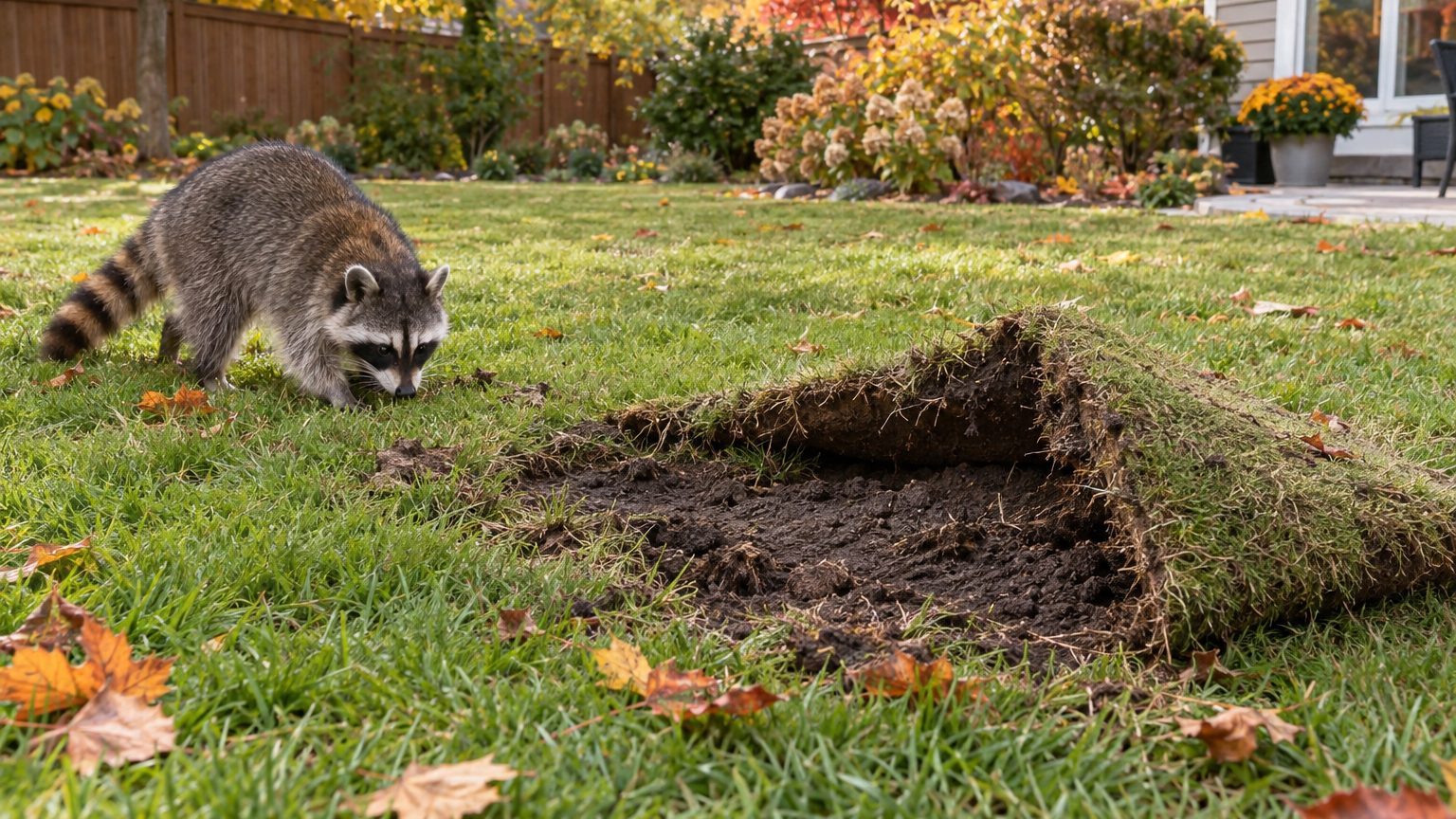
Raccoons don’t tear up lawns out of spite. They’re hunting grubs, the fat white larvae of beetles that chew on grass roots. Once those roots are chewed through, the turf peels back like a loose rug. Understanding that is the first step in learning how to stop raccoons from digging up your lawn, because the fix has less to do with the raccoons than with what’s underneath your grass.
The damage looks worse than it is, and most of it can be repaired.
- Raccoons dig up lawns mainly to eat grubs, the larvae of beetles that feed on grass roots.
- Digging alone does not confirm a grub problem; five or more grubs per square foot usually warrants treatment.
- Beneficial nematodes work best in late summer or early fall, when grubs are young and near the surface.
Why your lawn gets rolled up overnight
Moles, skunks and raccoons relish the fat, white grubs of beetles that live below the surface of the lawn. Raccoons and skunks dig in the lawn especially in spring and fall, looking for grubs, earthworms or soil insects. Grubs feed on the roots, so infested turf loses its grip on the soil, and a raccoon’s hands can slide under it with almost no effort.
New sod is even more vulnerable. Fresh soil and constant watering draw worms and grubs up to the surface, right under the sod. Raccoons figure that out fast, and they can roll up large chunks of sod to eat what’s under it.
Digging doesn’t prove you have a grub problem, though. Michigan State University Extension points out that having raccoons digging does not mean there are grubs. Peel back a square foot of damaged turf and count what you find. Extension guidance suggests that if you find fewer than five grubs per square foot, castor oil-based surface repellents are worth a try. At five or more, most lawn-care guidance says treatment is warranted, and some pest-control sources note that healthy turf can tolerate far more grubs than raccoons will.
Count first, buy second.
Repair tonight’s damage before the sun dries it out
If the turf has been flipped, fold it back right away. Water it, and put a root-building fertilizer on it, before the exposed roots dry out. A flap left upside down for a sunny afternoon is often a dead flap.
Then make the spot a frustrating place to work. Lay chicken wire, bird netting or chain-link over the damaged area, and move it every few days so it doesn’t grow into the lawn. Raccoons will probably try to lift the barrier, fail a few times, and give up. For fresh sod, tent stakes or garden spikes hold the edges down until the roots take hold. Pull the staples once the turf has rooted, or your mower blade will find them for you.
Repellents are a mixed bag. Cayenne pepper along the lawn edge irritates raccoons, but it washes off with rain or irrigation. Predator urine gets mixed reviews, and one garden center reports that raccoons in urban areas, away from natural predators, don’t recognize the scent. Motion-activated sprinklers can startle them for a while, but raccoons are smart, and some pest-control operators say they learn to ignore the spray within a few weeks.
Take away the side dishes, too. Lock lids on trash bins, keep pet food indoors, and cover the compost pile. A raccoon that has found a reliable meal in your yard keeps checking back, and may return to dig even after the insects are gone, if it found food there before.
Kill the grubs, but mind the calendar
Barriers are a bandage. Removing the grubs is the cure, and the usual organic route is beneficial nematodes, microscopic roundworms that hunt grubs in the soil. Look for the species Heterorhabditis bacteriophora, a “cruiser” type that actively moves through the soil to find its prey. They need moisture to do it, so keep the soil wet before and after you apply them. Expect patience, too: it takes roughly two to three weeks for nematodes to significantly reduce the grub population.
Timing matters more than the product. Nematode applications work best in late summer or early fall, when grubs are young and near the surface, and spring applications are ineffective. Mature larvae in spring are simply too big for nematodes to kill. Many homeowners lose a season, and some money, by treating at the wrong moment.
That leaves a question for anyone reading this in November. Treating now won’t do much, since grubs sink deeper as the soil cools. Raccoons and skunks won’t dig 6 to 8 inches down, because they want an easy lunch near the surface. The digging often fades by itself once the ground chills, so use the winter for repairs and planning.
Put late August on next year’s calendar.
If you’d rather go the conventional route, products containing imidacloprid or chlorantraniliprole are applied in early fall, when grubs are near the surface and most vulnerable. Follow the label exactly, because these products also affect non-target insects. Milky spore, a bacterium that infects grubs, targets Japanese beetle larvae specifically, so it won’t help if a different beetle is your culprit.
Build a lawn that’s hard to flip
A thick, deeply rooted lawn is your best long-term defense. Beetles prefer to lay their eggs in thin, stressed turf, and weak roots make a lawn easy to roll. Mow at 3 to 4 inches and fertilize to build a healthy root system. In spring, overseed the bare patches once the soil warms, and water often enough that the new roots can anchor before the next round of grubs arrives.
Be realistic about the timeline, too. Pest-control operators say raccoons keep returning to a food site until it’s no longer worth the energy, which means a lawn must be both hard to open and poor in food before they give up. Some operators recommend trapping, but wildlife laws on trapping and relocating raccoons vary by state, so check with your state wildlife agency before setting anything.
One last piece of perspective: a Toronto wildlife organization points out that those grubs would have killed the grass above them anyway. The raccoons dug up the problem. They just did it with no manners.
Sources : canr.msu.edu | ecohome.net