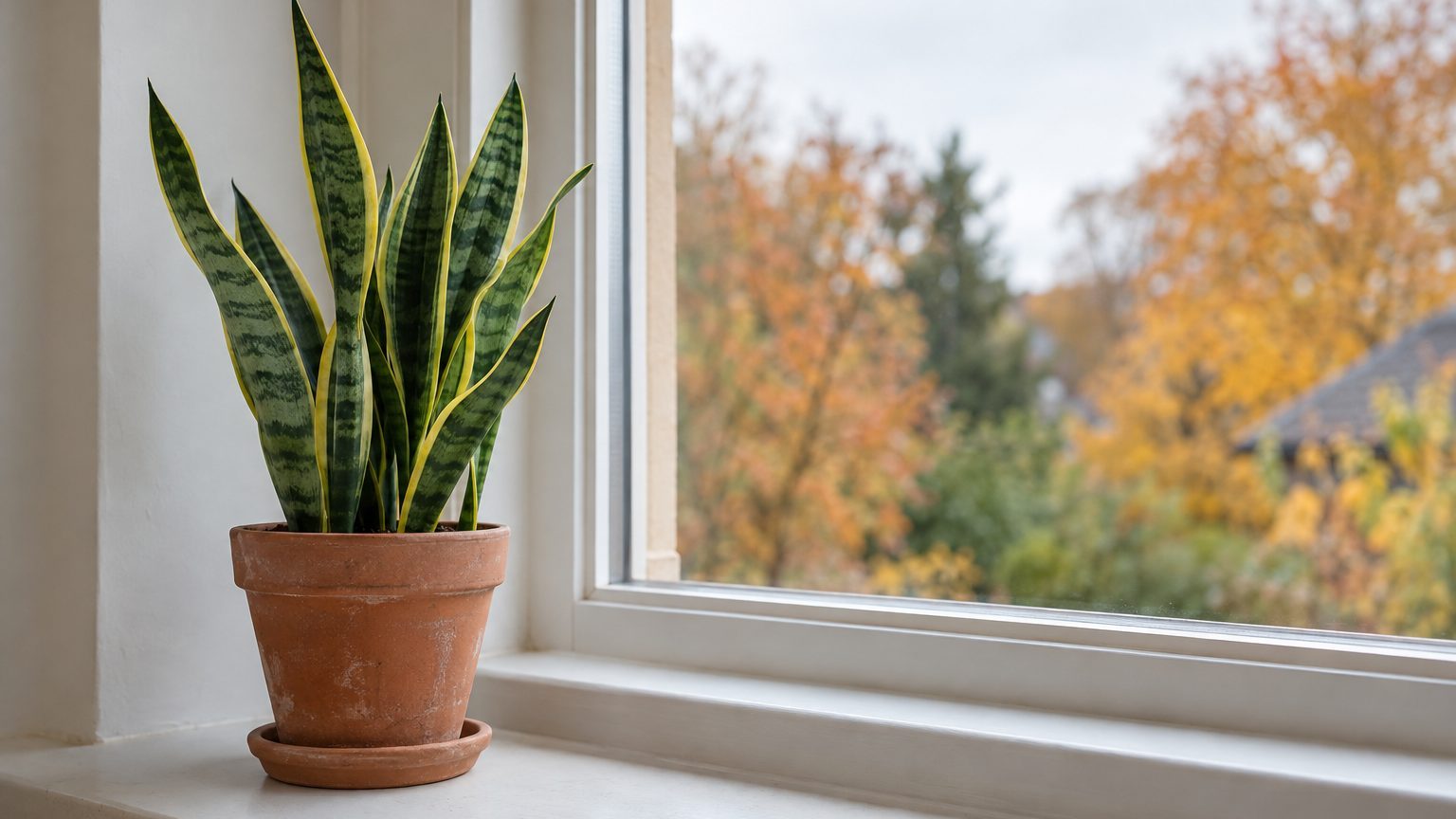
Most snake plants that die in winter drown. Extension services at NC State and Clemson put the winter watering interval at roughly four to eight weeks, which is far longer than the two to three weeks many owners keep up from habit. Good snake plant care in winter mostly means doing less, and doing it on purpose.
Skip a watering. The plant will forgive you.
Watering: the part that decides whether the plant survives
Snake plants (Dracaena trifasciata, still sold under the old name sansevieria) store water in thick, upright leaves and in underground rhizomes. From November to February, growth drops to near dormancy, so the plant uses very little of what you give it. Water that sits in cold, dim soil has nowhere to go, and the roots begin to rot. That rot often only shows in late winter, when the leaves turn mushy at the base.
Recommended intervals vary a little. NC State Extension suggests watering every one to two months in winter, while Clemson’s Home and Garden Information Center says every four to six weeks, with more light meaning more frequent watering. Some guides go to six or eight weeks for plants in low-light rooms. A plant in a bright south window with a terracotta pot will sit at the short end of that range. One in a dim hallway in a plastic pot may go two months.
The calendar is only a starting guess.
The real test is the soil. Push a finger or a wooden skewer all the way to the bottom of the pot, and water only if it comes out completely dry and clean. If you feel any dampness, wait another week and test again. Because the top inch of soil dries long before the bottom does, a quick poke at the surface will mislead you.
When you do water, soak the pot thoroughly and let it drain completely. Frequent sips are worse than one real watering, because they keep the top layer damp and leave the bottom soggy. Use room-temperature water. Ice-cold water straight from a winter tap shocks roots that are already sluggish.
Empty the saucer within 20 minutes.
Pot choice matters more in winter than in summer. Terracotta pulls moisture out through its walls and dries the mix faster, which gives you a margin for error. Glazed ceramic and plastic hold water much longer, and a snake plant in a decorative cachepot with no drainage is the classic casualty. Lift the plant out and check the cachepot for standing water every time you water.
Wrinkled leaves in winter confuse people. Wrinkling can mean thirst, but in a cool, dim room it more often means the roots are sitting wet and can’t take up water. Check the soil before you reach for the watering can.
Light: what the short days take away
Snake plants have a reputation for thriving in a dark corner. They tolerate low light, but tolerating isn’t the same as doing well. Iowa State University Extension notes that in low light the leaf coloring and patterns become muted, and variegated types such as the ones with yellow edges fade fastest.
Winter shortens the days by several hours in most of the northern US. The sun also sits lower, so a window that gave strong light in July may give only a weak glow in December. Move the plant closer to the glass, or to a south or west window if you have one. NC State lists direct sun for two to six hours a day as something the plant accepts, and low winter sun rarely scorches it the way a July afternoon can.
Dust matters too. A film on the leaves cuts the light the plant receives, so wipe each blade with a damp cloth once a month. It takes two minutes and helps more than most owners expect.
A grow light fixes the worst cases. A full-spectrum LED running 8 to 10 hours a day keeps a plant in a north-facing room photosynthesizing, and a timer from the hardware store takes the work out of it. Keep the lamp roughly 24 to 48 inches from the foliage, since too close can burn the leaves. Without added light, a north-room snake plant usually stops growing, which is fine as long as your watering drops to match.
If you have to choose between more light and more water, choose light.
Temperature, feeding and the other small adjustments
Cold is the one thing snake plants truly dislike. NC State lists a tolerance of about 50°F, and several growers prefer to keep the room above 55°F to be safe. Windowsills are the trap. On a freezing night the air next to the glass can be many degrees colder than the room, and leaves touching the pane can develop soft, water-soaked patches. Pull the pot back a few inches from the window at night, or slide a piece of cardboard between plant and glass.
Heating vents cause the opposite problem. Hot, dry air from a register dries the soil unevenly and stresses the leaf tips, so keep the plant out of the airflow. A spot that holds steady between about 60°F and 75°F suits it best.
Put the fertilizer away. A dormant plant can’t use the nutrients, and salts build up in the soil. The New York Botanical Garden connects winter feeding and watering to leggy, floppy growth, because the plant is told to grow when there isn’t enough light to support it. Feeding can wait until spring.
Repotting can wait too. Snake plants like being snug, and disturbing roots in winter slows recovery. If the pot is cracking or the plant is badly root-bound, do the job in late spring.
Misting is pointless. These plants evolved in dry West African scrubland, and wet leaves in cool air only invite rot and spotting. Wipe the leaves instead.
Households with pets should know the plant is toxic to cats and dogs if chewed. Winter, when the plants are all crowded together on the sunny windowsill, is when curious animals tend to find them.
Waking the plant up in spring
The signal comes in March or so, when new spears start pushing up from the soil and the days are visibly longer. Don’t jump straight back to a summer schedule. Going from one watering a month to every two weeks shocks the roots, so step up gradually over March and April and watch how fast the soil dries.
That is also the moment for the first light feeding at half strength, and for repotting if the roots are circling the pot. A plant that survived winter on neglect will usually answer with a flush of new growth by May.
One last trick for the forgetful: tape a small note to the pot with the date you last watered. It beats trusting memory in a season when the plant looks identical whether it needs water or not.
Sources : build-construct.com | housedigest.com