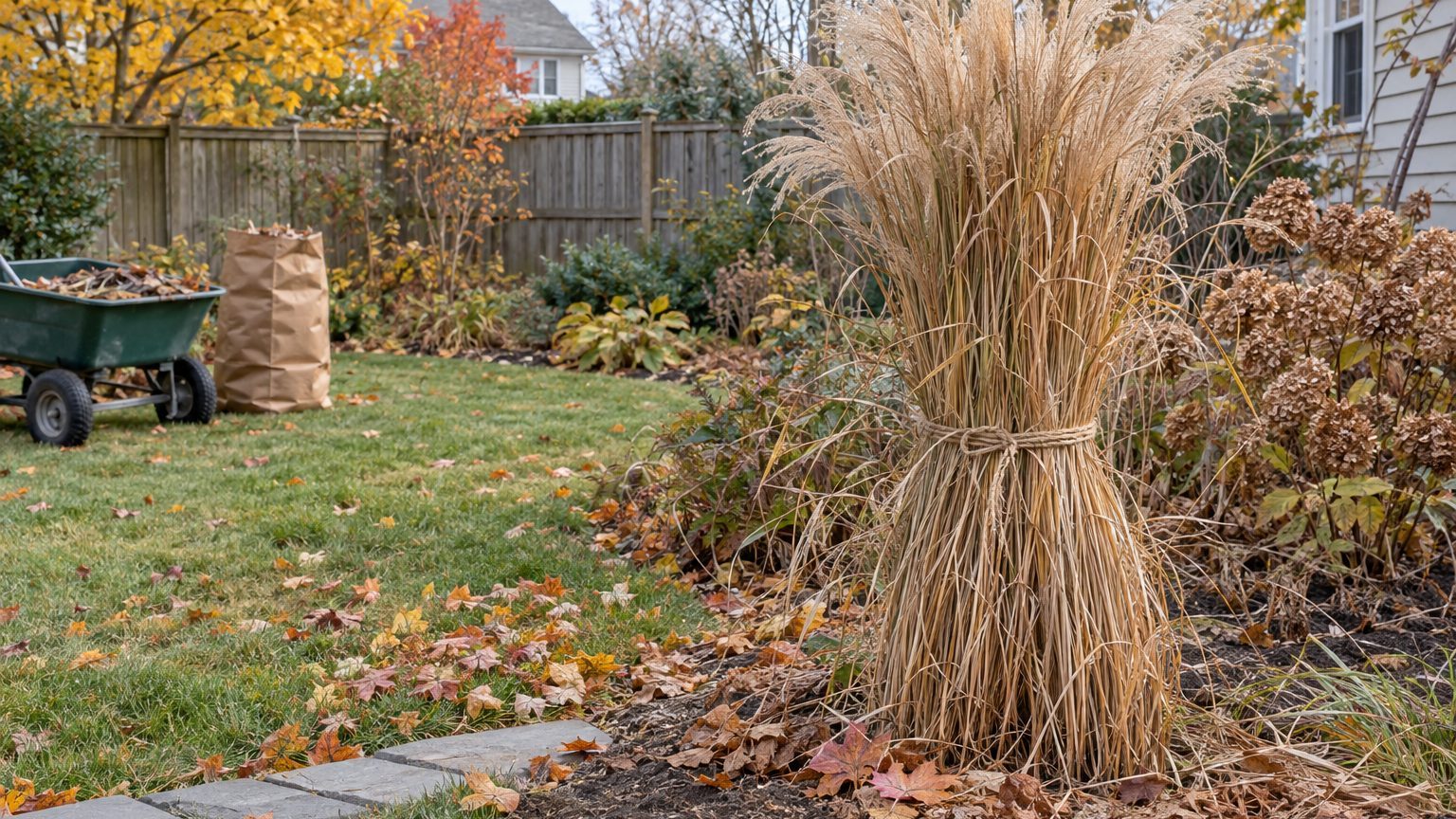
Your maiden grass turned straw-colored after the first hard frost, and now it’s shedding blades across the lawn and leaning over the walkway. Should you cut it this weekend? For most healthy clumps, waiting until late winter or early spring is the better call. Four situations favor cutting now: a very tall clump, a grass that reseeds, a clump close to the house in wildfire country, and a clump you simply can’t stand to look at until March.
Why standing clumps earn their keep until spring
Dormant foliage works as a winter coat for the crown, the dense base where new shoots form. Dead stems left in place help insulate it, and cutting too close to the ground exposes the crown to freezing weather, where it can rot. The dried stems also shelter nesting insects and feed winter birds, according to the Xerces Society and other conservation groups.
Waiting has a cost, but a small one. Old growth left too long into spring can delay new shoots by up to three weeks, according to the Ask Extension network. That is why many extension services that address the question land on the same window: after the worst of winter, before green appears at the base. Iowa State University Extension puts the job in April for Iowa, cutting to within 2 to 4 inches of the ground.
Warm-season grasses that justify a fall cut
Warm-season grasses start growing late in spring, peak in summer heat, and turn brown after the first hard frost. Miscanthus (maiden grass), switchgrass, fountain grass and little bluestem all belong here. Because their foliage is completely dead by November, a fall cut removes nothing alive. What you give up is the winter look and the wildlife cover.
Height is the usual reason to cut early. A miscanthus clump of 6 to 12 feet catches snow and ice, and it can flop across a path after a storm. Reseeding is the second reason. Northern sea oats and bunny tail grass drop seed that sprouts across the yard if the heads stand all winter, so cutting them in fall prevents a crop of seedlings. Pampas grass is invasive in some regions, which makes a fall trim there a containment measure.
The third reason applies mainly in the West and Southeast. In wildfire country, a tall dry clump against a deck, fence or wall gives a passing ember fuel. If you cut in fall, wait until the grass is fully brown after several frosts, because trimming earlier cuts into plants that are still storing energy.
Cool-season and evergreen types that should stay mostly intact
Cool-season grasses grow in spring and fall and often keep green or blue tones through winter. Blue oat grass, tufted hair grass and fescues are common examples. Cutting them in fall wastes the one thing they offer in the cold months. When you do cut them in late winter, remove no more than two-thirds of the plant, according to the University of California Marin Master Gardeners. Heavier cuts can let moisture collect in the crown and cause rot.
Feather reed grass is the exception worth knowing. Its tall flower stalks collapse and look ragged by February, so many gardeners cut it in late winter rather than waiting for spring. Evergreen sedges and rushes need even less. Comb dead blades out with gloved fingers, or snip them selectively. A hard cut in fall hits plants that are still photosynthesizing.
Bundling and cutting a clump, step by step
The job takes gloves, long sleeves, safety glasses, a bungee cord or twine, and a cutting tool matched to the clump. Hedge shears handle grasses up to about 5 feet. Taller clumps go faster with a power hedge trimmer. Pruning shears are enough for small clumps under 2 feet. Miscanthus and pampas grass have blade edges that slice bare skin, so cover up.
- Gather the clump into a column and tie it. Put the first tie a few inches above where you plan to cut. For a big, bushy clump, add a second and third tie about a foot apart.
- Cut straight across the bundle. Warm-season grasses that stay under 3 feet get cut to 3 inches. Taller ones get cut to 6 inches, according to the UC Marin Master Gardeners. Iowa State’s 2 to 4 inch range sits at the low end of that spread.
- Lean the bundle away from the crown as it falls, then carry it off in one piece.
- Reach into the stubble and pull out loose dead material, then rake stray blades from the surrounding soil.
The bundled stalks can go in the compost pile or be bagged for yard waste. Tall stems that haven’t gone to seed also make good mulch for beds once chopped. Plumes cut in fall can go in a vase indoors.
The spring window if you wait
Spring timing depends on your region, because the target is the weeks before new growth, not a calendar date. That means March in Arkansas, April around Chicago and Fargo, and sometimes early May in Maine. The cut height stays the same as in fall, since the crown is just as vulnerable in March as in November.
Cutting late has a penalty. Slicing through fresh green blades leaves brown tips on them for the rest of the season. If shoots are already 2 to 3 inches tall, trim only the brown stems above them and leave the green alone. You may end up with a slightly shaggy clump this year, and an earlier cut next time avoids it.
Spring is also the time to divide a clump whose center has died out, which typically happens every three to four years. Dig it up, keep the vigorous outer sections, discard the dead center, replant, and water well until new growth shows.
Source : ask.extension.org