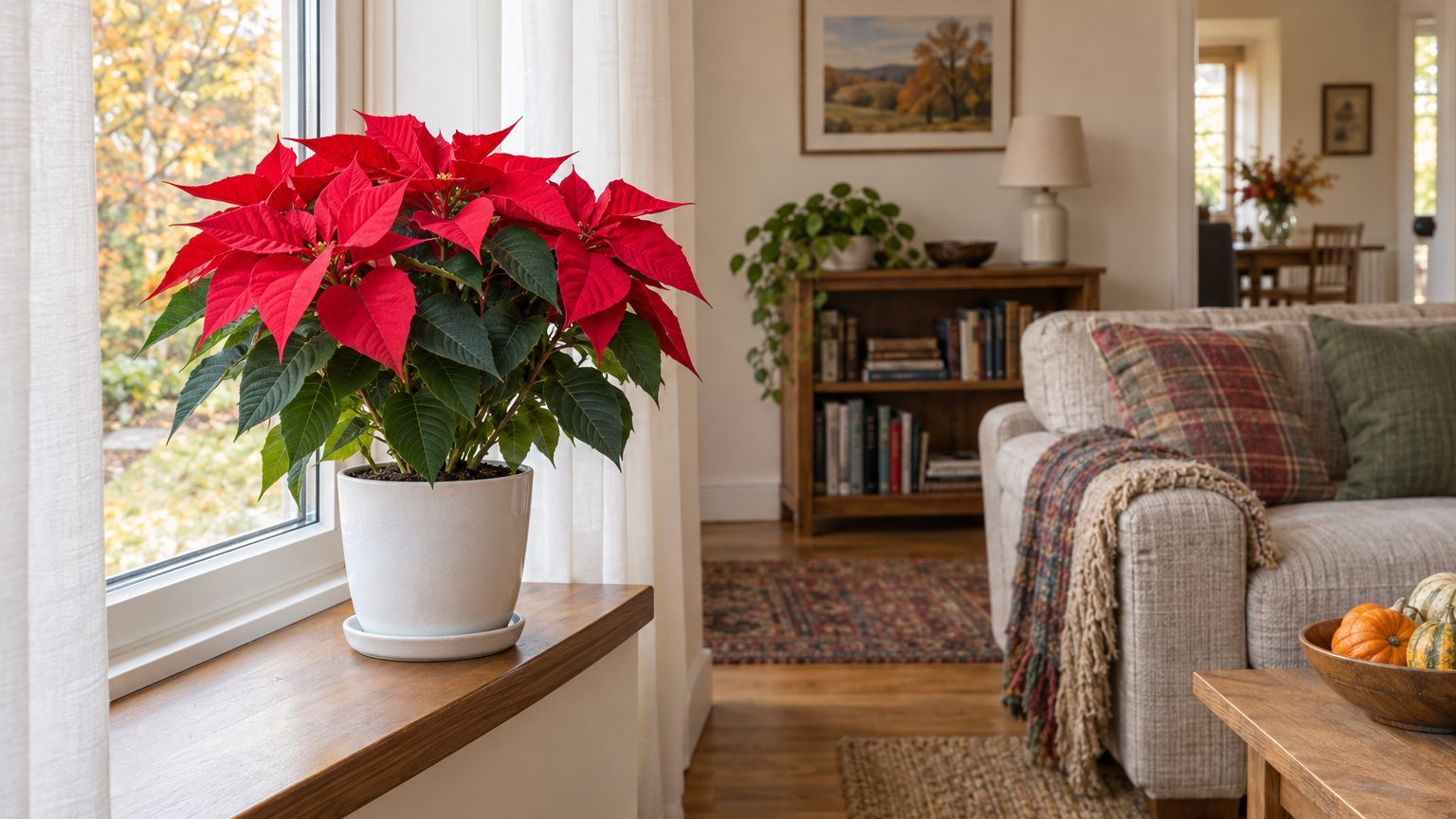
To care for a poinsettia indoors, put it where it gets at least six hours of bright, indirect light. Hold the room at roughly 60°F to 70°F and keep the plant clear of drafts, heat vents and cold glass. Water when the top inch of soil feels dry, then empty the saucer. Check that the pot drains, remove the foil sleeve, and skip fertilizer while the plant is in color. With that routine, the bracts usually stay showy for several weeks, often into late winter.
How to care for a poinsettia indoors
Poinsettias (Euphorbia pulcherrima) are native to Mexico, where they grow as shrubs that can top 10 feet. Three habits cover most of their indoor care.
Give it bright, indirect light for at least 6 hours a day
Colorado State University Extension puts the target at six hours of indirect natural daylight. Direct sun can fade the bract color, and if you can’t avoid it, a sheer curtain takes the edge off. Mississippi State University Extension adds a practical cost: a poinsettia in direct sun will survive, but it needs more water and the display won’t last as long.
The best spot in most houses is a few feet back from a south window, or right at an east or west one. Skip the sill where the leaves press against cold glass on a January night.
Keep it away from drafts, heat vents and cold windowpanes
University of Minnesota Extension lists the usual offenders: cold drafts, heat ducts, fireplaces, fans and space heaters. Anything that swings the temperature or dries the air stresses the plant. Keep bracts from touching cold windowpanes, too, because the outdoor chill transfers straight through the glass.
Water only when the top inch of soil feels dry (and never let it sit in water)
Push a finger into the soil: if the top inch is dry, it’s time to water. Lifting the pot works as a test too: a light pot is a thirsty pot. When it’s time, carry the plant to the sink, water until it runs out the bottom, let it drain fully, and return it to its saucer only when the dripping stops.
Overwatering is a major cause of early leaf and bract drop. Standing water rots the roots, and leaf drop is one of the first symptoms. Small pots dry out faster than large ones (a 4-inch pot can need water well before an 8-inch one), so check small plants more often.
How to care for a poinsettia after christmas
The holiday display ends on its own schedule, and what you do next is a choice:
- Keep it if you have a bright window, don’t mind a plain green plant for most of the year, and like the idea of a project.
- Toss it (compost is fine) if light is scarce, your schedule is packed, or you just wanted the holiday color.
Both choices are legitimate, since most store-bought poinsettias are grown for one season. For more holiday-season plants, see our guide to christmas plants.
January to March: keep the plant going or let it go
With proper care, poinsettias can keep their color for several months. Keep giving them the same light and the same dry-check watering. When roughly half the leaves and bracts have dropped, University of Illinois Extension suggests cutting back on water until the soil is completely dry, which sends the plant into dormancy. Store it somewhere cool and dark, and water just enough to keep the stems from shriveling. Fertilize only if you see new growth.
April to May: prune, repot and start feeding
Once new growth begins, usually by early May, cut the plant back to within 4 to 6 inches of the soil. Pruning is also the moment to repot into a slightly larger container with fresh, well-draining potting mix, if the roots are crowding. Don’t jump to a huge pot, because excess soil holds excess water. Wear gloves, since the milky sap can irritate skin, especially if you have a latex allergy.
Summer and fall: where to put it and when to stop
Outside USDA zones 9 to 11, move the plant outdoors only after temperatures reliably stay above about 60°F, in eastern sun or light shade. Pinch the tips through mid-August so it branches, and bring it back inside before temperatures threaten to drop below 60°F. Getting it to color up again requires about 14 hours of uninterrupted darkness each night from late September. Many people stop at a leafy green houseplant, and that’s a perfectly good outcome.
| Period | Light | Temperature | Watering | Fertilizer | Main task |
|---|---|---|---|---|---|
| December-January (holiday display) | Bright, indirect, 6+ hours | About 60°F-70°F, never below 50°F | When the top inch is dry; empty the saucer | None while in bloom | Enjoy the bracts; remove the foil sleeve |
| February-March (fading bracts) | Same bright spot | Same range; cool storage if going dormant | Reduce as leaves and bracts drop; keep stems from shriveling | Only if new growth appears | Decide to keep or compost |
| April-May (pruning and repotting) | Bright window | Normal room warmth, no cold drafts | When the top inch is dry | Start when new growth appears: half strength, all-purpose | Cut to 4-6 inches; repot into a slightly larger pot |
| June-August (summer growth) | Eastern sun or light shade outdoors, or a bright window | Outdoors only once reliably above about 60°F | Regular, more often as growth speeds up | Every 3-4 weeks | Pinch tips until mid-August |
| September-November (fall) | Bright, indirect | Bring indoors before it threatens to drop below 60°F | When the top inch is dry | Taper off | Move indoors; choose foliage plant or rebloom routine |
How to care for a poinsettia plant
Light and water get the attention, but the pot decides how forgiving the plant will be. Set it up once, correctly, and most problems never start.
Pot, drainage and the foil sleeve problem
That shiny foil sleeve is a water trap. It holds runoff around the roots, which is how root rot starts. Pull it off before watering (University of Minnesota Extension advises removing decorative foil or outer pots first), or punch holes in the bottom and set the pot on a saucer you empty after each watering. If you love a decorative cachepot, keep the plant in its plastic nursery pot inside it and lift it out to water.
Soil and fertilizer: what it needs and when
Use a well-draining potting mix that stays moderately moist without turning soggy. Fertilizer is simple: none during the holidays. Start when you see new growth, using an all-purpose houseplant fertilizer mixed at half the label strength, every 3 to 4 weeks.
Pests to watch for: whiteflies, fungus gnats and mealybugs
Whiteflies are tiny and rise in a cloud when you brush the leaves. Mealybugs look like bits of cotton in the leaf joints. Fungus gnats hover around soil that stays too wet. Isolate the plant, wipe off what you can, and use insecticidal soap on persistent infestations. For gnats, let the soil dry out more between waterings.
Quick symptom checker: yellow leaves, drooping, sticky residue
- Drooping: too dry, or soggy roots that can no longer take up water. Feel the soil, lift the pot, then fix the watering. Cold exposure can cause it too.
- Yellow leaves: usually overwatering, a dim spot or chilly air. Empty the saucer and move it to brighter, warmer light.
- Leaf drop: a sudden chill below 50°F, a draft, overwatering or low light. Find the draft first.
- Sticky residue: honeydew from whiteflies or mealybugs. Wipe the leaves and treat the pests.
What is the best temperature for a poinsettia?
Poinsettias like the same temperature you do, with a slightly cooler night. Cold is their weak point.
Ideal day and night range in degrees Fahrenheit
Extension guidance clusters around the same numbers: 65°F to 70°F is ideal for indoor temperatures, per University of Minnesota Extension. Colorado State University Extension suggests 67°F to 70°F by day and 60°F to 62°F at night, and Mississippi State University Extension allows 68°F to 72°F by day and 60°F to 65°F at night. A steady 60°F to 70°F, a little cooler at night, is a safe target.
The cold-shock danger zone under 50°F (including the walk from the store to your car)
Mississippi State University Extension puts the line at 50°F, and Colorado State University Extension’s care tips advise staying above 55°F. Below 50°F, poinsettias show stress and leaves can drop, which is why they are not good candidates for outdoor displays or winter porches. The risky stretch is the walk to the car: cold exposure on the way can damage bracts and leaves, and leaf drop may follow. Ask for the plant to be bagged or sleeved, warm the car first, and don’t leave it in a trunk while you run another errand.
How do you pick a healthy poinsettia at the store?
The best care can’t fix a poorly handled plant. Spend two minutes at the display before you buy.
What to check: true flowers (cyathia), bract color, leaf condition, soil moisture
The colorful “petals” are bracts, which are modified leaves. The true flowers are the tiny yellow cyathia in the center. Look for cyathia that are still tight and fresh, not shedding yellow pollen, because open ones mean the plant is already aging. Choose full, evenly colored bracts and uniformly green foliage with no lower leaves missing, which is Colorado State University Extension’s guidance. The soil should be slightly moist, not bone dry and not soggy.
Red flags: sleeved plants left in drafty entryways, dropped leaves, soggy pots
Pass on plants parked near the sliding doors, especially in sleeves, because cold air hits them every time the door opens. Walk away from bare lower stems, leaves on the floor of the display and pots that feel heavy and wet. A sleeve can hide the problem, so check the bottom: if water is pooling, the roots are in trouble.
Frequently Asked Questions
How long do poinsettias last indoors?
With good light, steady warmth and careful watering, the bracts commonly stay colorful for several weeks, and sometimes for months. The plant itself can live for years as a houseplant, though it will usually lose its color after the holidays.
Do poinsettias need direct sunlight?
No. They do best with at least six hours of bright, indirect light, and strong direct sun can fade the bracts and dry the plant out faster.
Should I remove the foil wrapper from a poinsettia?
Yes, or at least poke drainage holes through it. Foil traps water around the roots and invites root rot. Take the plant out of the foil to water it, and put it back only when it has stopped dripping.
Can poinsettias live outside?
Only in USDA zones 9 to 11, where they grow as shrubs. In colder climates they can spend summer outdoors in light shade once nights are reliably above about 60°F, but they need to come back inside before temperatures threaten to drop below that.
Should I fertilize a poinsettia while it is blooming?
No. Wait until new growth appears in spring, then use an all-purpose houseplant fertilizer at half strength every 3 to 4 weeks.
Sources: extension.colostate.edu | extension.illinois.edu | extension.msstate.edu