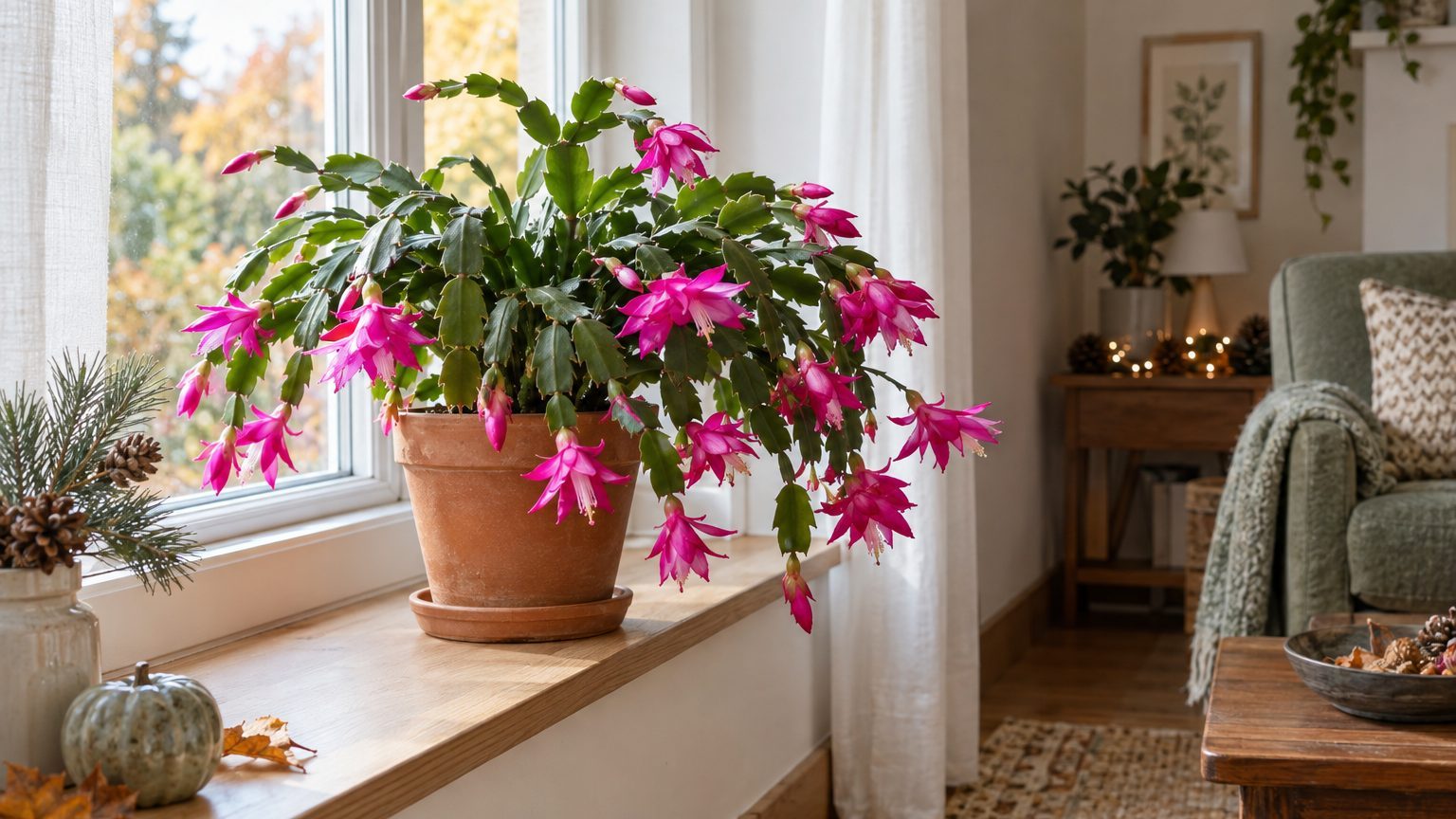
Most Christmas plants want the same short list: bright, indirect light, a spot away from heaters and cold drafts, and water only when the top inch or so of soil feels dry. Poinsettias, cyclamen and amaryllis do best in cooler rooms. Christmas cactus and kalanchoe cope with ordinary home temperatures but dislike soggy soil. Empty the saucer every time. If you have cats or dogs, check the ASPCA plant database before placing anything.
The ASPCA lists poinsettia as toxic but describes the effect as irritation to the mouth and stomach, “generally over-rated in toxicity.”
Amaryllis, cyclamen and kalanchoe are listed as toxic. Christmas cactus is non-toxic.
Christmas cactus care
Despite the name, this is no desert plant.
Holiday cacti are native to Brazil, where they grow as epiphytes on tree branches in shady, humid rain forests.
Light, water and temperature at a glance
Give it bright, filtered light.
University of Minnesota Extension suggests a cool, bright location with daytime temperatures of 65 to 70°F and evening temperatures of 55 to 65°F.
Holiday cacti will not grow well in heavy, wet soils.
Water when the top inch dries, and keep the soil lightly moist rather than bone dry. Keep it away from heat vents and fireplaces.
How to tell which holiday cactus you own
Many plants sold in November as “Christmas cactus” are actually Thanksgiving cactus.
Thanksgiving cactus is most easily recognized by pointed, toothed stem segments
, while true Christmas cactus has smoother, scalloped segments.
Christmas cactus generally flowers later than Thanksgiving cactus.
Both are non-toxic to pets, and care is nearly identical.
The most common problems and where to find the fix
Bud drop usually follows a move, a draft or a swing from dry to soggy. Reblooming is the harder part.
Holiday cacti are “short-day” plants that set buds as daylight shrinks, and they also need cool nights.
With nights at 60 to 65°F, they need at least 12 hours of complete darkness for about 6 weeks.
The full schedule belongs in the Christmas cactus care guide.
How to care for a poinsettia
Poinsettias are tropical shrubs from southern Mexico, and the store-to-home trip is where many of them are damaged. The plant is tougher than its reputation once it is home.
A carefully chosen plant should stay attractive indoors for at least eight weeks, often into spring.
Choosing a healthy plant at the store and getting it home safely
Look for foliage covering most of the stem.
Skip plants displayed in drafty entrances or on cold loading docks.
Temperatures below 50°F cause chilling injury, so the store should sleeve the plant for the trip.
Carry it in a warm vehicle, not the trunk.
Chilling injury shows up as blue or white discoloration on the bracts and possibly leaf drop.
Light, water and temperature at a glance
Clemson Cooperative Extension recommends at least 6 hours of bright, indirect sunlight daily.
Poinsettias generally do best at the temperatures most people keep their homes in winter, 60 to 70°F.
Water when the surface feels dry or the pot feels light when you lift it.
Then let it drain. Remove or puncture the decorative foil so water cannot pool around the roots.
Why poinsettias fail in the first few weeks
Two causes are especially common. The first is water.
Watering soil that is already wet can suffocate the roots, causing leaves to wilt, yellow and drop, often because of root rot.
The second is cold or hot air.
Avoid cold drafts and excessive heat from heating ducts or large incandescent lamps.
Amaryllis care
Amaryllis (Hippeastrum) is one of the faster-blooming plants in the holiday lineup.
Potted, waxed and bare-bulb kits: what to expect from each
A potted bulb is the simplest:
check the pot before watering, and after the first watering give just enough to keep the soil barely moist.
A bare bulb needs a pot only slightly wider than the bulb.
Waxed bulbs make easy gifts because they need no water or soil
, but
these bulbs may not bloom again in your home, or will bloom for a much shorter time.
Timing varies by source:
South African-grown bulbs typically bloom 3 to 5 weeks after potting, Dutch-grown bulbs 6 to 8 weeks.
Light, water and staking at a glance
Give a sprouting bulb bright light and water only when the top of the soil dries. Flower stalks get top-heavy, so a stake and a heavy pot prevent tipping.
Once the buds show color, move the plant out of direct sunlight into a cooler spot, which helps the blossoms last longer.
What the bulb needs once the flowers fade
Cut the flower stalk 1 to 2 inches above the bulb.
Leave the strap-like leaves, which feed the bulb.
Extension sources differ on rest.
Iowa State says bulbs need 8 to 10 weeks at 50 to 55°F to bloom
, while
Illinois Extension says a dormant period is not required but helps control rebloom timing.
Holiday plants safe for pets
The ASPCA database is the reference. Its entries are sorted by dogs and cats, and they change, so confirm each plant there or with your vet.
Pet-friendly holiday plants
The ASPCA lists Christmas cactus as non-toxic to dogs, cats and horses.
Rosemary is also listed as non-toxic to dogs and cats.
Listings for Norfolk Island pine are mixed, so confirm its ASPCA entry before buying.
NC State’s plant database tags it non-toxic for dogs and cats
, though other sources list it as toxic or report mild stomach upset, so check before you buy.
Even non-toxic plants can cause vomiting or stomach upset if eaten.
Holiday plants to keep away from cats and dogs
Poinsettia sits at the mild end:
the irritant sap can cause mouth and stomach irritation and sometimes vomiting.
It is not the deadly plant of popular myth. The others are more serious.
The ASPCA lists amaryllis as toxic to dogs and cats, with the bulb the most poisonous part.
Cyclamen causes salivation, vomiting and diarrhea, and large ingestions of tubers can cause heart rhythm abnormalities, seizures and death.
Kalanchoe is listed as toxic, with vomiting, diarrhea and, rarely, abnormal heart rhythm.
For cats, true lilies are a separate and serious risk.
What to do if your pet chews a plant
Remove plant material from the animal’s mouth and move the plant. Note the plant and roughly how much was eaten.
The ASPCA’s 24-hour emergency poison hotline is (888) 426-4435
, and Pet Poison Helpline is another option. Call even if your pet seems fine after a bulb or tuber, because signs can be delayed.
Which Christmas plants are the best choice for your home?
The most popular Christmas plants are poinsettia, Christmas cactus, amaryllis, cyclamen, Norfolk Island pine, rosemary topiary and kalanchoe. This table puts the basics side by side. The right-hand column names the care guide topic for each plant.
| Plant | Light | Watering cue | Room temperature | Usual display window | Pet safety (ASPCA) | After the holidays | Care guide |
|---|---|---|---|---|---|---|---|
| Christmas cactus | Bright, filtered | Top inch dry; never soggy | Average, cooler nights | Late fall into winter | Non-toxic | Keep; needs long nights to rebloom | Christmas cactus care guide |
| Poinsettia | Bright, indirect | Surface dry or pot light | 60 to 70°F, never below 50°F | Holidays, often into spring | Listed toxic; mild irritation | Keep as foliage or compost | Poinsettia care guide |
| Amaryllis | Bright, then cooler out of direct sun | Potted: when soil dries; waxed: none | Average; cooler prolongs blooms | Weeks after potting, kit-dependent | Toxic; bulb worst | Keep and rest, or compost a waxed bulb | Amaryllis care guide |
| Norfolk Island pine | Bright, indirect | Top inch dry | Average, no cold drafts | Year-round foliage | Listings differ; check before buying | Keep | Norfolk Island pine guide |
| Cyclamen | Bright, indirect | Surface dry; keep evenly moist | 60 to 65°F days, about 50°F nights | Several months of bloom | Toxic; tuber worst | Keep and rest, or compost | Cyclamen care guide |
| Rosemary topiary | Brightest window | Let soil dry slightly | Cool to average, dry air | Green all season | Non-toxic | Keep | Rosemary topiary guide |
| Kalanchoe | Bright | After soil dries | Average home | Weeks to months of color | Toxic | Keep or compost | Kalanchoe care guide |
Easiest options for beginners
For beginners, pick kalanchoe, Christmas cactus or poinsettia.
Poinsettias are easy to care for and should last the whole season with a few basic habits.
Kalanchoe forgives a missed watering because it stores water in its leaves.
Best options for low light
No holiday plant thrives in a dim corner. Christmas cactus tolerates filtered light, while a poinsettia in low light
may show leaf drop, spindly growth and sparse blooming.
Norfolk Island pine suffers too. Move any of them to the brightest spot you have.
Plants that live beyond the holidays vs. short-term color
For a plant to keep, choose Christmas cactus, Norfolk Island pine or rosemary.
Holiday cacti can live a long time.
Amaryllis is long-lived if you feed the leaves. Poinsettia, cyclamen and kalanchoe are often treated as seasonal color, although all three can be kept.
Quick profiles: Norfolk Island pine, cyclamen, rosemary and kalanchoe
Norfolk Island pine.
It is not a true pine and is far too tender to plant outdoors in cold climates.
It thrives at 50 percent relative humidity, yet an average house can drop to 15 percent in winter.
Cyclamen.
Ideal daytime temperatures are 60 to 65°F with night temperatures around 50°F, and above 70°F the buds fail to develop.
Rosemary. It wants the brightest window and soil that dries slightly between waterings. Kalanchoe.
It likes bright, indirect light and watering when dry.
How do you keep holiday plants healthy in winter drafts and dry indoor air?
Where to place plants: windows, heaters, fireplaces and entryways
Do holiday plants need direct sunlight? Mostly no. Bright, indirect light suits most of them, and direct sun can fade bracts.
Place a poinsettia near a sunny window but do not let it touch the cold glass.
Keep it away from drafts, excessive heat and dry air from appliances, fireplaces and ventilating ducts.
Cyclamen likewise suffers near vents, because
heat vents dry the soil out too quickly.
Humidity and temperature ranges that work for most holiday plants
Most do well at 60 to 70°F. Cyclamen and poinsettia like the cooler end, and nights a few degrees cooler help blooms last. Humidity matters most for Norfolk Island pine.
Use a pebble humidity tray, group plants together or run a small humidifier.
Rosemary is the exception, since it prefers drier air.
How to carry plants home in cold weather
If the outdoor temperature is below 50°F, do not carry an unwrapped poinsettia from the shop to your car.
Ask for a plant sleeve, warm the car first and take the plant straight home.
Once home, run this first-week checklist:
- Take off the foil or sleeve, or poke drainage holes through it.
- Check that the pot has a drainage hole and empty the saucer.
- Choose a bright spot away from heaters and cold glass.
- Rule out cold drafts from doors and vents.
- Press a finger into the soil every few days and water only when it feels dry.
If something looks wrong, match the symptom:
- Drooping: check moisture first, then cold exposure (poinsettia and cyclamen guides).
- Yellow leaves: usually overwatering or too much heat (poinsettia and cyclamen guides).
- Dropped buds: draft, move or dry soil (Christmas cactus and poinsettia guides).
- Leggy growth: too little light (Norfolk Island pine and kalanchoe guides).
What should you do with holiday plants after the holidays?
Yes, you can keep Christmas plants after the holidays, and many will rebloom. Each one needs its own rest or light schedule, so this is a short decision guide rather than full instructions.
Keep, rest or compost: a decision guide by plant
Keep Christmas cactus, Norfolk Island pine and rosemary as regular houseplants. Poinsettia is a keeper only if you like a leafy shrub.
Clemson says to prune it back to about 8 inches when the bracts fade in March or April.
Rest an amaryllis bulb after the leaves yellow. Cyclamen naturally rests after flowering.
Taper off watering until the leaves die back, then store it in a cool, dim spot for two to three months.
Reblooming a compact cyclamen at home is difficult
, so composting is reasonable. A waxed amaryllis bulb is often spent. Kalanchoe can be kept, and
pruning after flowering can encourage another flush of blooms.
When to repot, trim or start a rest period
Repot sparingly.
Christmas cactus needs repotting only about once every three years, best done after the bloom period.
A poinsettia can be moved in early June to a container 2 to 4 inches bigger.
Start amaryllis rest in late summer or fall, cyclamen rest in summer, and Christmas cactus long nights around September. Trim poinsettia in spring, kalanchoe after flowering and Norfolk Island pine only to remove dead tips.
Norfolk Island pines do not regenerate branches from bare spots
, so never cut the leader.
Frequently Asked Questions
How long do Christmas plants last indoors?
It depends on the plant. A poinsettia typically stays attractive for at least eight weeks, often into spring.
Cyclamen blooms for up to three months.
Christmas cactus, Norfolk Island pine, rosemary and amaryllis bulbs can live for years with proper care.
Can you put holiday plants near a fireplace or heater?
No. Warm, dry air from vents and fireplaces dries soil quickly and causes leaf and bud drop. Keep plants a few feet from any heat source, and keep them clear of cold glass at night.
Why is my new holiday plant drooping after I brought it home?
Check the soil first. A drooping plant can be too dry, but it can also be waterlogged in a foil-wrapped pot. Chilling on the trip home is another common cause, and
chilling injury can cause bract discoloration and leaf drop.
Remove the foil, empty any trapped water, and place the plant in a warm, bright spot.
Do Christmas plants need fertilizer?
Not while they are in bloom. Feed after the display ends or when active growth resumes.
Nebraska Extension suggests fertilizing amaryllis every 2 to 4 weeks with a dilute solution once the flowers fade.
Minnesota Extension suggests half-strength fertilizer for Christmas cactus.
Sources: ag.purdue.edu | blogs.ifas.ufl.edu | cales.arizona.edu