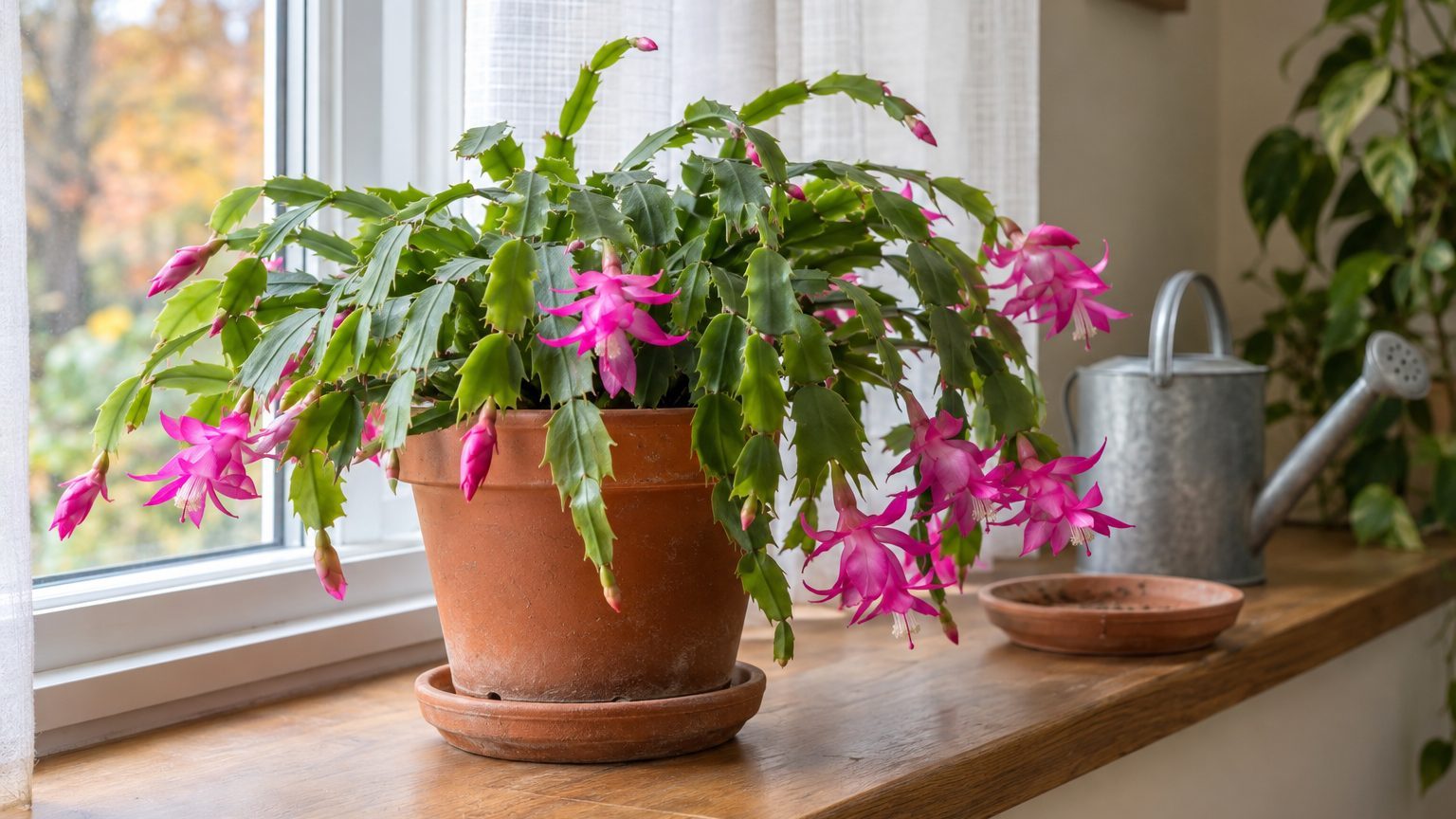
Give a Christmas cactus bright, indirect light, daytime temperatures of about 60 to 70°F, and a fast-draining mix in a pot with drainage holes.
Water thoroughly when the top inch or so of mix feels dry, then empty the saucer so the pot never stands in water. Feed lightly while the plant is growing. In fall, give it cooler nights and long, uninterrupted darkness so it sets buds. The rest of this guide explains each step, with a calendar and a symptom table at the end.
Christmas cactus care indoors
The name misleads.
The holiday cactus is native to southeast Brazil and grows as an epiphyte in humid rainforests, very different from the cacti of the Desert Southwest.
The Christmas cactus itself,
Schlumbergera x buckleyi, is an artificial hybrid
, and the flat, segmented stems (botanists call them cladodes or phylloclades) are what you water, light and protect.
Holiday cacti usually turn out to be either Christmas or Thanksgiving cactus
, and the everyday care below fits both. A separate page covers telling them apart.
Where to put it: window, room and spots to avoid
The target is bright light without hot sun.
These plants thrive in bright, indirect light but cannot tolerate direct sun.
Here is how that plays out in a typical US home:
- East window: the easiest spot, with gentle morning sun and no scorching afternoon.
- West window: works if a sheer curtain or a step back from the glass softens the late sun.
- South window: set the plant a few feet inside the room or behind a sheer, especially in summer.
- North window: the dimmest option. Fine in a bright room, but expect slower growth.
Avoid heating vents, radiators, fireplaces and the sill itself on freezing nights, where cold glass chills the stems. The kitchen and a bright bathroom are often good rooms for humidity.
Pot size and drainage: why a snug pot is better
Choose a pot with a drainage hole, only slightly bigger than the root ball.
Holiday cacti bloom well when their roots are a bit snug.
A roomy pot holds extra wet mix that stays soggy. Plan on repotting only
every three to four years, when the plant looks tired or roots poke through the drainage holes
. Our repotting and soil mix pages cover the how.
Using the 60 to 70°F comfort zone as your baseline
A normal living room already sits in range. Skip the cold porch and the sunroom that bakes at midday. Fall adds one twist, covered in the bloom guide linked below.
For a plant bought from a grocery store or garden center, use this first-week checklist. Shipping and cold store entrances stress these plants.
- Wrap it for the trip home in cold weather and unwrap it right away.
- Place it in bright, indirect light, away from vents and drafty doors.
- Check the pot for a drainage hole and empty any decorative sleeve or saucer.
- Do the finger test before watering, and don’t fertilize yet.
- Leave it in place. Moving a plant in bud invites buds to drop.
Christmas cactus care watering
How often should you water? There is no calendar answer.
NC State Extension suggests about every one to two weeks, or when the soil is nearly dried out.
Your pot size, mix, light and heating decide the real interval, so let the mix tell you.
The soak-and-partly-dry method in plain steps
First, push a finger into the mix. When the top inch is dry, it’s time. (Some growers wait until the top half is dry, which suits a cool, dim room.) Second, lift the pot when it’s dry, then again after watering. The weight difference becomes easy to feel. Third, water slowly with room-temperature water until it runs out of the drainage hole. Fourth,
remove all excess water from the saucer after 15 minutes.
Fifth, wait until the next finger test.
Underwatering gets less attention than it deserves. A holiday cactus tolerates slightly dry conditions, but
the soil should not become waterlogged, and it shouldn’t dry out completely either.
Water a little less in late winter, but never let it dry out completely.
Why a Christmas cactus is not a desert cactus
The mismatch explains many failures.
- Habitat: a desert cactus grows in sand and full sun; a Christmas cactus grows on tree branches and rocks in humid, shaded forest.
- Light: a desert cactus wants direct sun; a Christmas cactus gets scorched by it.
- Water: a desert cactus tolerates long dry spells; a Christmas cactus wants moderate moisture and light drying between drinks.
- Spines: a desert cactus has them; a Christmas cactus does not.
Is it a succulent? Sort of.
Holiday cacti belong to the cactus family but are treated as succulents.
Watering mistakes that cause root rot
Overwatering is the classic killer. Roots that evolved in airy bark suffocate in soggy mix, and fungi move in.
Healthy roots look white or tan, while rotten ones look brown and soft.
The usual causes are a saucer left full, a pot without a drainage hole, a pot far too big, and watering on a schedule instead of by feel. If you suspect rot, stop watering, slide the plant out and inspect the roots. Trim anything mushy and repot into fresh, fast-draining mix.
Christmas cactus care instructions
Think of the first year as three phases. In week one, set up the plant and change nothing. Over the next month, learn its rhythm with the finger test and the weight check. After that, follow the seasons: grow in summer, set buds in fall, bloom in winter, rest in late winter. Missouri Botanical Garden puts the growing season at
March/April to September.
Month-by-month care calendar
This calendar fits a typical US home in the Northern Hemisphere. Shift it a few weeks for very warm or very cold climates.
| Month or season | What the plant is doing | Watering approach | Light and temperature | Feeding and other actions |
|---|---|---|---|---|
| January | Bloom | Water when the top inch is dry, never soggy | Bright, indirect light; stable, cool room | No feeding; don’t move the plant |
| February | Bloom fades, rest begins | Lighter watering, never bone dry | Cooler spot, bright light | Remove spent flowers; no feeding |
| March | Rest ends, growth restarts | Water a bit more often as growth shows | More light, mild room | Light pruning after flowering; start light feeding when new segments appear |
| April to May | Active growth | Soak when the top inch is dry | Bright, indirect light; mild temperatures | Light feeding; repot only if due (every 3 to 4 years) |
| June to August | Active growth | Soak when the top inch is dry; check more often in heat | Shade outdoors once nights are mild, or a bright indoor spot | Light feeding; take cuttings if you want more plants |
| September | Preparing for bud set | Ease off slightly, no soggy mix | Cooler nights and long, uninterrupted darkness begin | Bring plants in before cold nights; taper feeding |
| October | Bud set | Keep the mix lightly moist | Cool nights; no lamps at night | No fertilizer; don’t rotate or move the plant |
| November | Buds develop, early bloom | Steady, even moisture | Bright light; keep away from vents | Keep conditions stable |
| December | Bloom | Water when the top inch is dry | Bright, indirect light; stable room temperature | Pause feeding while in bloom |
Dedicated pages cover the bloom trigger, fertilizer, light, repotting and propagation. The christmas plants guide covers care for other holiday houseplants too. As for the fall trigger itself, Missouri Botanical Garden recommends
night temperatures of 55 to 65°F and 13 hours of total darkness for 6 to 8 weeks, starting mid-September.
Quick symptom check: what your plant is telling you
Why is a Christmas cactus wilting? Check the soil before anything else.
| Symptom | Likely cause | First move |
|---|---|---|
| Limp, soft segments | Wet soil and rot, or a very dry pot | Do the finger test; check roots if the mix is wet; see the limp leaves page |
| Pale or bleached segments | Too much direct sun | Move to bright, indirect light |
| Red or purple tinge | Stress from strong light or cold | Soften the light; see the leaf color page |
| Dropping buds | Sudden changes in temperature, light or water | Hold conditions steady; see the bud drop page |
| No flowers | Night light or warm nights in fall | Read the bloom guide |
What temperature and humidity does a Christmas cactus need?
Day and night temperature targets
Aim for daytime temperatures of about 60 to 70°F, with nights a little cooler. Growers differ on the top end.
Missouri Botanical Garden lists ideal growth at 70 to 80°F during the April to September growing season
, so a warm summer room is fine. The danger is the extremes.
The RHS advises keeping these tender tropical plants above 50°F.
The plant is
frost-intolerant
. In the ground it needs
zones 10 to 12
, so most of us keep it in a pot. Once buds set,
avoid temperatures above 90°F.
Humidity: when it matters and easy fixes
Rainforest roots make this a moderate-humidity plant. Dry winter air matters most when buds are forming. Should you mist? Probably not.
Misting gives only a brief boost and can encourage fungal problems if water sits on the segments.
Better options are a pebble tray (water just below the top of the stones, pot sitting above the waterline), a cluster of plants, or a small humidifier. In a bright kitchen or bathroom, you may need none of them.
Drafts, heaters and vents
Sudden temperature changes, drafts, low humidity and improper watering can all cause flower buds to drop.
A vent blasting warm, dry air is as risky as a door that swings open in January. Place the plant where air is calm. On cold nights, slide it a few inches back from the glass.
How do you care for a Christmas cactus after the holidays?
The rest period after flowering
When the last flowers fade, give the plant a break.
The RHS recommends a cooler, drier spell after flowering.
Water a little less, hold off on fertilizer, and keep the plant in bright light in a cooler room. Don’t let it dry out completely. Trim straggly stems lightly once the blooms are done. Rest lasts roughly a month or two, not the whole winter.
Resuming growth in spring and moving outdoors for summer
New segments in March or April signal that growth has started. Water more often, begin light feeding, and repot only if it has been three to four years. For summer outdoors, wait until nights are reliably mild, then choose shade.
Bright sun in summer can make plants look pale and yellow.
Bring the plant back in before nights turn cold, ideally by early September, so the fall routine can start on time.
Frequently Asked Questions
How long does a Christmas cactus live?
Decades is realistic.
Some long-domesticated holiday cacti can live more than a hundred years when properly tended.
Actual lifespan depends on how well the plant is kept.
Should I mist my Christmas cactus?
It’s optional, and usually not worth the effort. The humidity boost fades within minutes and wet stems can invite fungus. A pebble tray, a group of plants or a humidifier does more.
Can a Christmas cactus go outside in summer?
Yes, in shade, once nights are mild. Full sun can bleach the stems. Bring it indoors before temperatures drop toward 50°F, and before the fall bud-setting period begins.
Is a Christmas cactus safe for cats and dogs?
The ASPCA rates Christmas cacti as non-toxic to cats and dogs.
Eating a lot of any plant can still upset a pet’s stomach. If a pet seems ill after chewing plants, call your veterinarian or
the ASPCA Poison Control hotline at 888-426-4435.
Sources: extension.psu.edu | ipm.missouri.edu | plants.ces.ncsu.edu