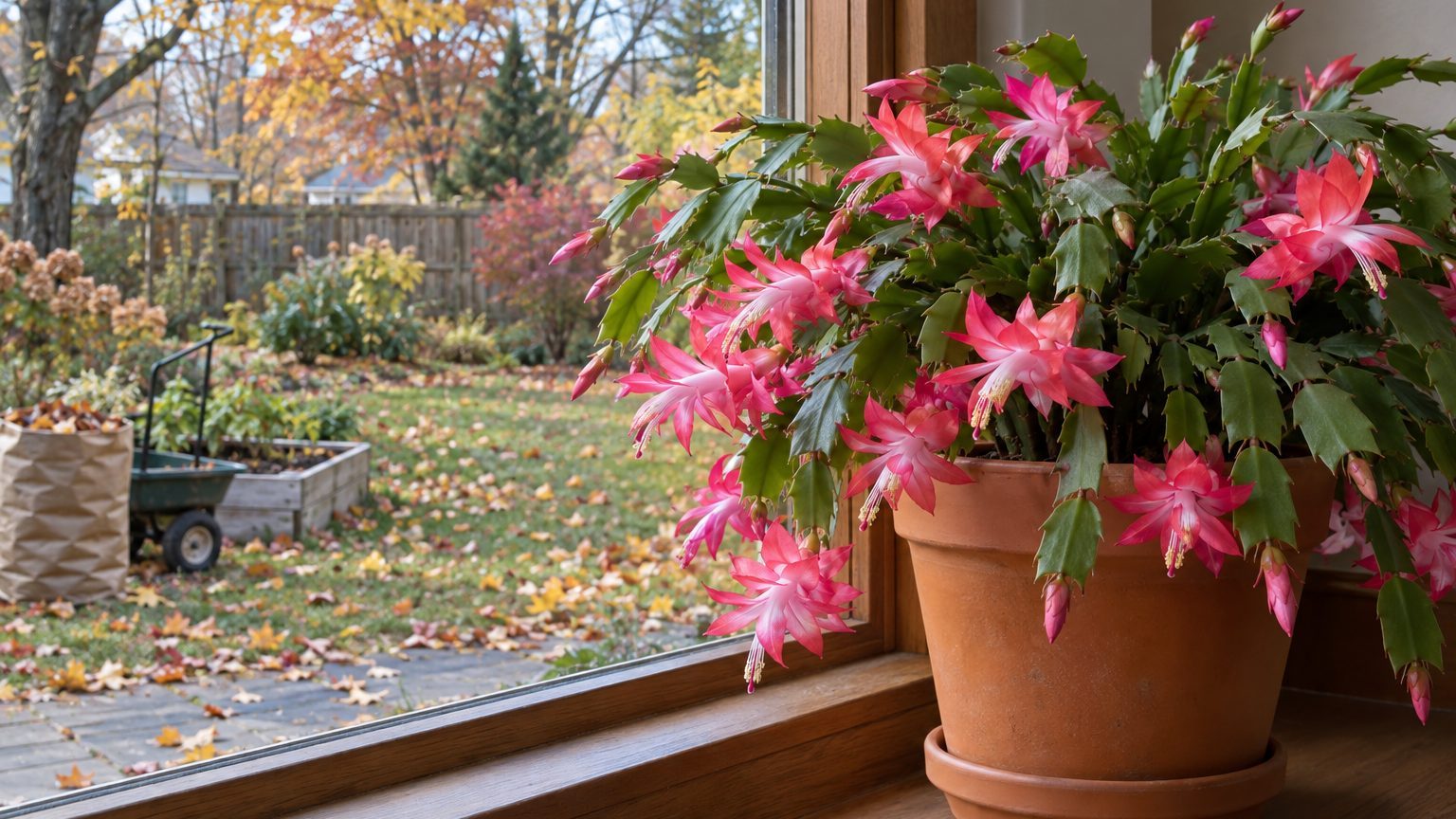
A mature Christmas cactus (Schlumbergera × buckleyi) sets flower buds after about six weeks of long, uninterrupted nights. Extension guidance puts that at 12 to 14 hours of darkness, with night temperatures around 50 to 60°F. Clemson and Missouri Botanical Garden start the clock in mid-September; starting in early to mid-October still aims at December flowers. Cool nights can do part of the job alone. Missouri Botanical Garden notes that outdoor plants in nights of 50 to 55°F usually form buds before coming indoors, and Clemson says nights of 50 to 59°F set buds regardless of day length. During the trigger, water a little less, stop feeding and keep bright indirect light by day. Flowers open roughly 6 to 8 weeks after the start.
The timing here is for the true Christmas cactus, which has scalloped, toothless segment edges. Clemson Extension notes that Thanksgiving cacti normally flower about a month before Christmas cacti. Identification and the full care routine are covered in separate guides.
Christmas cactus light requirements
Schlumbergera is a short-day plant: it reads the length of the night, not the brightness of the day. Extension figures differ slightly. University of Illinois Extension says at least 12 hours of continuous darkness for 5 to 6 weeks. Missouri Botanical Garden gives 13 hours, from 6 pm to 7 am, for 6 to 8 weeks. Clemson asks for 14 hours or more, continued for at least 6 weeks. A 6 pm to 7 am schedule sits in the middle of that spread. Interruptions matter, because light that breaks up the long night can prevent bud set; University of Illinois Extension cites interruptions of 2 hours or more.
The easiest setup is a room nobody uses after dark. A spare bedroom or basement with no artificial light at night works. A closet also works if no one opens the door at night. Otherwise, drape an opaque cloth or a cardboard box over the plant at the same time every evening and lift it each morning. Watch for light leaks. Street lights, car lights and indoor lighting can all disrupt the dark period, and a hallway light under a door counts too. Thin curtains do little against a streetlight.
Daytime light feeds the stem segments (cladodes, the flat green pads) that will carry the flowers. Give bright, filtered light. Full summer sun on container plants brought outdoors bleaches the foliage. A grow light works as the daytime source, but under artificial light the plant still needs at least 12 hours of darkness each day in fall.
Christmas cactus dropping buds
Buds are a fragile stage, and a plant that sets dozens can still lose some of them. Missouri Botanical Garden lists temperatures above 90°F, large temperature swings, improper watering and sudden changes in the room, including moving the plant, as causes. Clemson adds an excessive number of buds and a drying growing medium. Heat vents and cold drafts belong on the same list.
The rule once buds show is simple: change the routine, not the plant’s surroundings. Keep the darkness routine going for the full six weeks Clemson asks for, since that completes bud set; after that it can end, because photoperiod has no effect on flowering once the buds are set. Leave the pot where it is, do not rotate it toward the window and do not repot. The one adjustment worth making is water. Clemson says to increase water once flower buds form, aiming for even moisture, never bone dry and never waterlogged.
Christmas cactus fertilizer
Feeding builds the plant in spring and summer and should stop before the trigger begins. Clemson recommends a balanced liquid fertilizer monthly during the growing season, stopping in September. A balanced formula such as 20-20-20 works mixed at half strength about once a month. The three numbers are nitrogen, phosphorus and potassium. Making the last feed in August leaves a margin before the long nights start.
Nitrogen is the number to watch. Extra nitrogen late in the season pushes leaves, not flowers. The same reasoning applies to heavy feeding from bud set onward. Extension guidance differs slightly on bloom boosters. One guide suggests a phosphorus-heavy feed such as 10-15-10 in fall, while others say to feed nothing from bud set through bloom. The lower-risk route is no fertilizer until flowering ends and new growth appears. Slow-release granules are harder to stop on schedule, since they keep feeding into the bud-setting weeks.
How cold should it be for a Christmas cactus to set buds?
The workable window for nights is 50 to 60°F, with days around 65 to 70°F. University of Illinois Extension gives about 70°F days and 55 to 65°F nights for plants in bloom, and notes that nights around 55°F may induce blooming regardless of night length. At the cold end, Clemson found that nights of 50 to 59°F set buds regardless of day length, but growth is slower and bud drop may occur at 50°F. Below 50°F, buds may drop. The plant is frost-intolerant, so a cool bedroom, an enclosed porch or a window with the heat vent closed beats an unprotected patio.
Water a bit less, not drastically less. Let the top inch of soil dry before watering again, but never let the soil dry out completely. Bone-dry stretches can stall bud formation, while waterlogged roots cause limp segments and bud drop. Cool, dim conditions slow evaporation, so a pot that needed water weekly in August may need it far less often in October. Frequency, soil mix and repotting are covered in the full christmas cactus care guide.
How long does it take a Christmas cactus to bloom after you start the trigger?
Clemson says buds are normally visible in 3 to 4 weeks. Open flowers follow about 6 to 8 weeks after the start. For flowers in December, count back eight weeks from the date you want: a December 25 target means starting around October 30 at the latest, and early to mid-October leaves margin. Missouri Botanical Garden lists December to February as the flowering window. A plant started in mid-September, the date both Clemson and Missouri Botanical Garden use, flowers earlier.
| Timing | Light | Temperature | Watering | Fertilizer | What to avoid |
|---|---|---|---|---|---|
| Late summer | Bright indirect light, normal day length | Warm growing weather, 70 to 80°F | Regular, once the top inch dries | Last half-strength feed in August; stop by September | Feeding into fall, harsh afternoon sun |
| Early to mid-October (day one) | 12 to 14 hours of complete darkness; bright indirect light by day | Nights 50 to 60°F, days 65 to 70°F | Ease off; top inch dry between waterings | None | Lamps, hallway light, streetlight glow |
| Weeks 1 to 6 of trigger | Same dark routine, every night | Nights 50 to 60°F | Slightly drier until buds show, never shriveled | None | Missed nights, heat vents, soggy soil |
| Bud appearance (about weeks 3 to 4) | Keep the darkness routine going through week 6; keep the pot in place | Steady, no swings | Back to even moisture | None | Moving or rotating the pot |
| Weeks 6 to 8 | Darkness routine can end after week 6; bright indirect light, same spot | Steady, away from drafts | Evenly moist, not soggy or bone dry | None | Repotting, hot or cold drafts |
| December (full bloom) | Bright indirect light | Days around 70°F, nights 55 to 65°F | Water when the top inch dries | None until new growth in spring | Relocating the plant, dry air |
Why a healthy plant stays budless
- Stray light at night, such as a lamp left on for a while or a streetlight through a window.
- Nights too warm, with a heated living room never dropping into the 50s or low 60s.
- Too much nitrogen, or feeding that ran past August.
- A very young plant, or one stressed by a recent repotting, which may skip a year.
- Soggy soil during the trigger weeks.
- No rest after last year’s bloom: a period of less water and no fertilizer.
Frequently Asked Questions
Why is my Christmas cactus full of leaves but has no buds?
Leafy growth with no buds usually means the plant never got its night signal. Run the diagnostic list above in order: light at night, warm nights, late nitrogen feeding. Lack of flowering is often traced to light interrupting the long night, according to Clemson.
Can I make a Christmas cactus bloom in time for Christmas?
Yes, if the trigger starts early enough. Counting back 8 weeks from December 25 lands on about October 30. A plant started later usually opens after Christmas, still inside the December to February window.
Should I prune a Christmas cactus to get more flowers?
Pruning helps only at the right time. Flowers form at stem tips, and Missouri Botanical Garden notes the blooms are borne at the stem ends, so branching plants carry more of them. Trim after flowering and the rest period, not during the trigger or bud stage.
Does a Christmas cactus bloom more than once a year?
The plant normally has one trigger cycle a year, though flowers open in waves over several weeks. The Easter cactus, a separate plant, flowers primarily in spring.
Sources: extension.illinois.edu | hgic.clemson.edu | hgic.clemson.edu