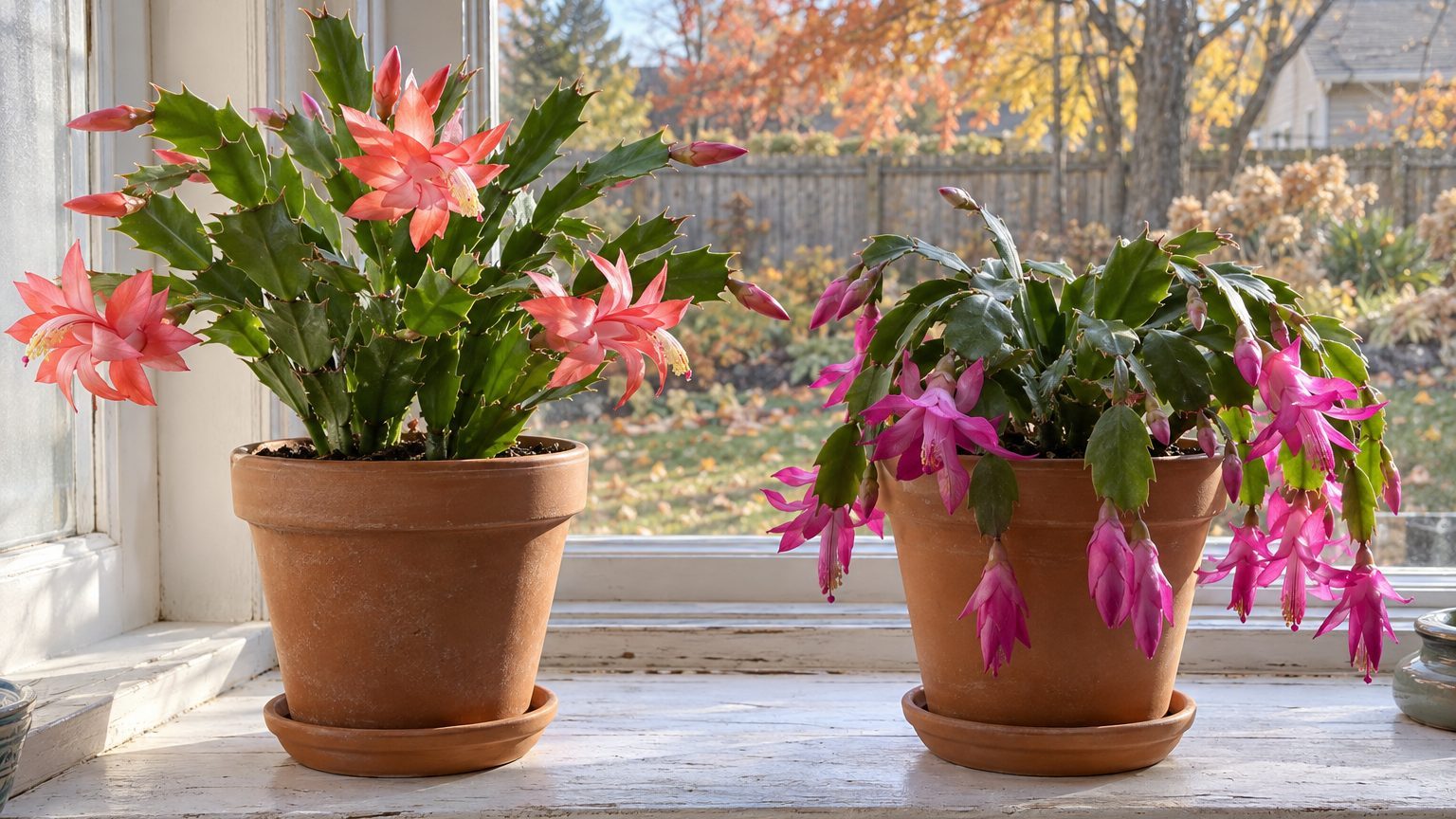
Two different species of Schlumbergera share the holiday-cactus shelf, and you can tell them apart in about thirty seconds with no tools: run a thumb along the edge of one flat stem segment. Pointed, claw-like teeth mean a Thanksgiving cactus (Schlumbergera truncata), which blooms first, usually October into November, with lopsided flowers held sideways or upward and yellow pollen. Smooth, rounded scallops mean a true Christmas cactus (Schlumbergera × buckleyi), which has drooping tubular flowers, purplish-brown pollen and typically opens from December. Thanksgiving cacti are often sold as “Christmas cacti,” according to UGA Extension, so the tag on the pot proves little. Care is nearly identical for both.
Christmas cactus care
Whichever plant you own, the routine is the same. Both are epiphytic cacti, meaning they grow on tree branches in the mountain forests of southeastern Brazil rather than in desert sand. Iowa State Extension lists the same indoor conditions for them: bright, indirect light, temperatures between 60°F and 70°F, and well-drained potting soil. Watering, feeding and repotting follow the same logic for each, and our christmas cactus care guide covers the full routine.
The one difference that touches your calendar is bloom timing. A Thanksgiving cactus sets buds about four weeks ahead of a Christmas cactus, so its fall cues (longer nights, cooler air) have to be in place earlier. Cold tolerance is shared, not split between the two: Illinois Extension advises bringing summered-outdoors plants inside once nighttime temperatures reach the low 50s°F in fall.
How to get christmas cactus to bloom
Both plants are short-day plants. They grow vegetatively in summer and form buds as days shorten in fall, and Iowa State Extension adds that temperatures above 70°F prevent flowering even with short days. The darkness requirement varies by source, from at least 12 hours of continuous dark for five to six weeks (Illinois Extension) to 13 hours nightly for eight weeks (Clemson Home & Garden Information Center). Clemson also warns that indoor lighting and even streetlights shining through a window can interrupt the dark cycle. The steps for forcing buds are in how to get christmas cactus to bloom.
A Thanksgiving cactus usually flowers first because it is the earlier-blooming species; it opens roughly one month before a Christmas cactus. The two respond to the same signals, only a few weeks apart. UGA Extension notes that the Thanksgiving species was a parent of the hybrid Christmas plant, which helps explain the shared triggers. If your “Christmas cactus” flowers in November on a bright windowsill, it is probably on schedule for what it is.
Christmas cactus leaves turning red
Red or purple tinge on the segment edges appears on both species, so it says nothing about which plant you have. It is a stress response. Direct sun is a frequent trigger, but heat, cold drafts, crowded roots and depleted potting mix can all produce the same blush. Some cultivars bred for pink and magenta flowers also carry reddish pigment in their stems year-round, which is a trait of the cultivar, not the species.
Look at texture before you worry. Plump, firm, slightly glossy segments with a light blush are fine, and a faint flush at the tips in autumn is a normal companion to bud formation. Thin, limp, deep-purple segments often point to light that is too strong, though dry or rotting roots can also cause limp stems. Pull the pot back from the glass or hang a sheer curtain, and the color usually fades as new green growth replaces the stressed segments.
How can you tell a Christmas cactus from a Thanksgiving cactus?
Run these four checks in order. The first works all year, with or without flowers, and each later check backs it up when the plant is mislabeled or the edges look ambiguous.
- Segment edges: run a thumb along the margin of a mature segment. A Thanksgiving cactus has two to four saw-toothed projections along each segment; a Christmas cactus feels smooth and scalloped. The flat segments are botanically called phylloclades (also cladodes), modified stems doing the work of leaves.
- Flower orientation: a Thanksgiving cactus holds lopsided flowers out sideways or slightly upward, while a Christmas cactus lets its more even flowers hang down. Treat this as typical, not absolute.
- Anther color: Thanksgiving cactus anthers, the pollen-bearing tips, are yellow, while Christmas cactus anthers are purplish brown.
- Bloom timing: flowers in November point to Thanksgiving, flowers from December onward point to Christmas. Growing conditions can shift both by weeks.
| Feature | Thanksgiving cactus | Christmas cactus | Easter cactus |
|---|---|---|---|
| Scientific name | Schlumbergera truncata | Schlumbergera × buckleyi | Hatiora gaertneri (also listed as Rhipsalidopsis gaertneri) |
| Segment edges | Two to four pointed, claw-like teeth | Smooth, rounded scallops | Rounded, with tiny bristles at the tips |
| Flower shape and orientation | Lopsided tube, held sideways or upward | More even tube, hanging down | Star-shaped, opening flat |
| Anther color | Yellow | Purplish brown | Not a reliable guide |
| Typical bloom window | Mid-October to late December, peaking near Thanksgiving | December into January, sometimes later | Spring, March to May |
| Usual store label | “Christmas cactus” or “holiday cactus” | “Christmas cactus,” though less common at retail | “Easter cactus” or “spring cactus” |
| Care differs? | No, same as Christmas cactus | No, same as Thanksgiving cactus | Basics similar; the fall bloom cue differs |
The Easter cactus looks like a third cousin at first glance. It belongs to a separate genus from Schlumbergera, and its naming has shifted over the years, so you will see Hatiora gaertneri and Rhipsalidopsis gaertneri on tags. Look for rounded segments with small bristles at the tips and star-shaped, daisy-like flowers that open in spring instead of long tubes in winter.
Which is better for your home: a Christmas cactus or a Thanksgiving cactus?
Neither wins on care, so the choice comes down to when you want flowers and what shape you like. Both are listed as safe around pets (see the FAQ below), and both want the same light and soil. The real decision is what the plant in your cart actually is.
Garden centers and big-box stores sell most holiday cacti under the single name “Christmas cactus,” even though the Thanksgiving species is the one often on the shelf. Breeders have also crossed the two, so some retail plants show intermediate traits. If the tag says Christmas cactus but the segments have teeth, treat the plant as a Thanksgiving cactus. If the edges fall in between, “holiday cactus” is the honest label, and bloom date is the better guide. A Latin name on the tag helps: S. truncata is Thanksgiving, while S. × buckleyi is Christmas. The ASPCA lists Christmas cactus under the older name S. bridgesii, which still turns up on tags and in older references. A gift plant that opens buds in November, whatever its card says, is almost certainly a Thanksgiving cactus.
For flowers before Thanksgiving, buy a Thanksgiving cactus, and check for teeth on the segments in the store. For color on the table at Christmas or into January, a true Christmas cactus is the better match, though it is the harder one to find. On shape, Thanksgiving blooms are angular and point outward, while Christmas blooms hang in neat pendant tubes from softer, arching stems, which show best in an elevated pot or basket. If you want both on the calendar, put one of each on the windowsill and the flowering stretches by about a month.
Frequently Asked Questions
Can a Thanksgiving cactus bloom at Christmas?
Yes. Its natural window runs into late December, and a warm room or lights on at night can push bud formation later. Iowa State Extension notes that temperatures above 70°F prevent flowering, so a plant kept too warm in fall may open late.
Why is my Christmas cactus blooming in November?
It is most likely a Thanksgiving cactus sold under the Christmas label, so check the segment edges for pointed teeth. A true Christmas cactus can also flower early if nights are cool, since Illinois Extension suggests nighttime temperatures around 55°F as an alternative to long dark nights for triggering blooms.
What is an Easter cactus, and is it the same as a Christmas cactus?
No. The Easter cactus (Hatiora gaertneri) is a separate genus with bristle-tipped segments and star-shaped flowers that open in spring. Iowa State Extension says it needs a more regimented fall sequence of long darkness followed by cool temperatures, unlike the other two.
Are Christmas cactus and Thanksgiving cactus safe for cats and dogs?
The ASPCA lists Christmas cactus as non-toxic to dogs and cats, and NC State Extension rates Thanksgiving and Easter cactus the same. Non-toxic does not mean harmless, since chewing any plant can cause vomiting or an upset stomach, and swallowed foil pot wrap can cause a blockage. Take the foil sleeve off before you display the plant.
Sources: extension.illinois.edu | extension.psu.edu | hgic.clemson.edu