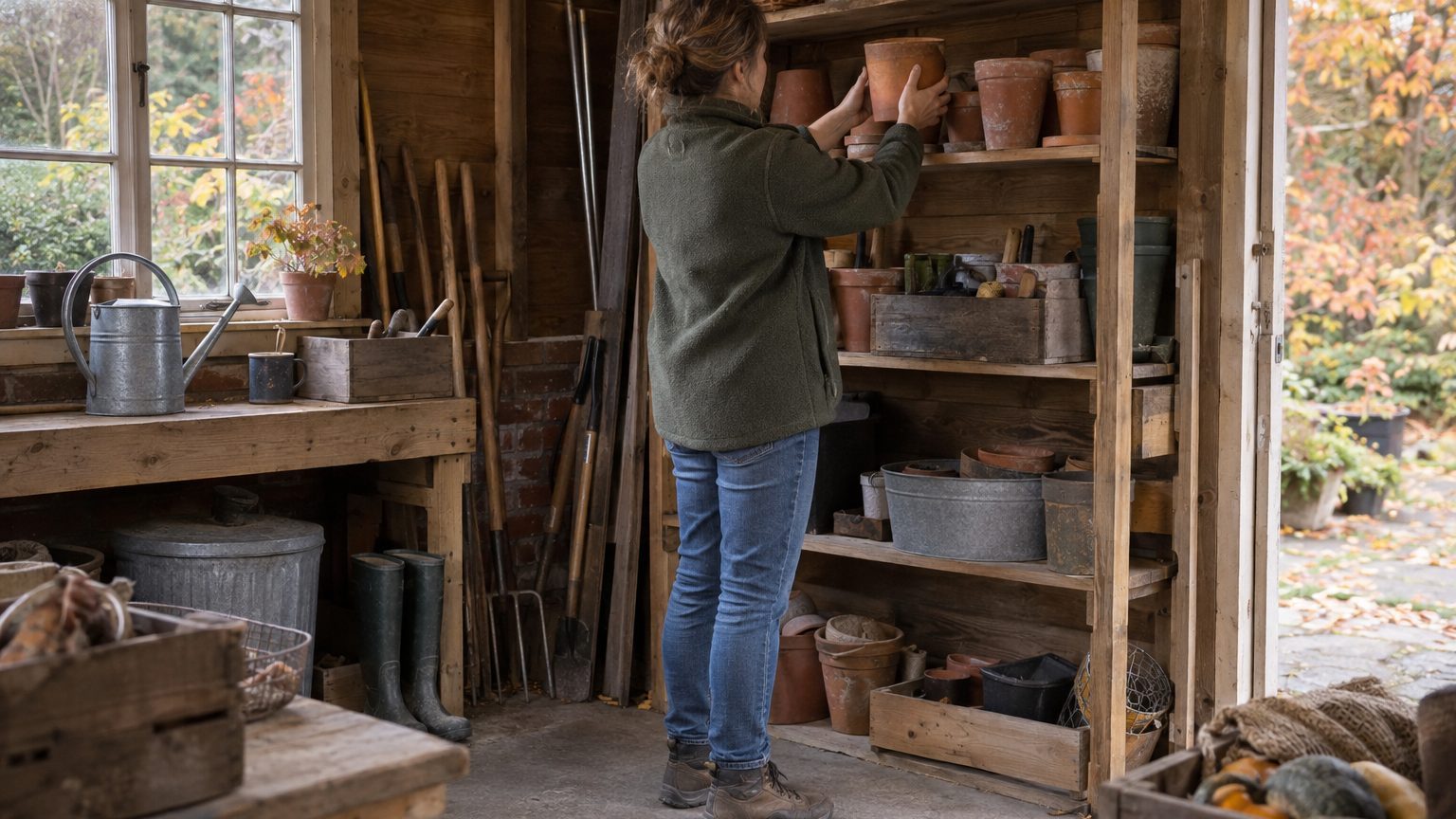
Terracotta is porous, so it soaks up water from the soil. When temperatures plummet, that moisture freezes and expands, and the pot can crack. That’s what happened to my favorite pot in January. It had spent the fall by the back steps, still half full of damp potting mix.
One hard freeze is all it takes.
- Terracotta is porous, so moisture soaks into its walls and freezes there.
- Repeated freeze-thaw cycles between 25 and 35°F do more damage than a single hard freeze.
- Empty pots crack too, because they still collect rain and snow in their walls.
Why a sturdy clay pot splits like a dropped plate
Unglazed terracotta behaves like a sponge made of fired earth. Its walls are full of microscopic pores, and every rain, watering and snowmelt pushes moisture into them. That moisture creates a freeze-thaw heaving that can break or chip the pot. Water turns to ice with real force, and fired clay has very little give.
The repetition does as much harm as any single cold snap. Damage is especially bad during repeated mild freezes between roughly 25 and 35°F, which describes much of winter across the Midwest, the Northeast and the mid-Atlantic. A pot can thaw at noon and refreeze by midnight a dozen times in a week.
The worst part is how quietly it happens. Small cracks might go unnoticed during the winter, but try to move the pot come spring and it may fall apart. A pot that sits on bare ground can also get frozen to it. If you try to move it later, it can crack or start to fall off in sheets.
Empty pots are not safe either.
Empty pots still absorb moisture and can crack even without soil inside. A bare pot left on a deck collects rain and snow in its bowl and in its walls. That is why the usual advice is to bring terracotta in, not just to dump the soil.
How to store terracotta pots in winter, step by step
Start by emptying the pot. Compost the spent annuals, knock out the soil, and scrub the inside to remove salt crusts and plant residue. A solution of one part bleach to nine parts water works for cleaning, and the pot should dry completely before it goes into storage.
Drying matters more than most people think. A pot that goes into the garage still damp holds moisture in its walls, and a cold snap in an unheated space can still hurt it. I leave mine in the sun for a few days in October, then check for any cool, darker patches that suggest dampness.
Next comes location. A basement or an attached garage works, and clay containers can go anywhere the temperature won’t fall below freezing. A detached shed is fine in mild climates. In a cold one, it can drop well below freezing, so it is only a good home for pots if nothing in there can get wet.
Pack them carefully. Wrap smaller pots in newspaper and nestle them inside larger ones. The paper cushions the rims, which are the first part to chip. Avoid stacking more than a few high, because the bottom pot carries the whole weight.
No indoor space at all? Turn the pots upside down so they can’t fill with water, and cover them with a tarp. Set them on a board or a few bricks rather than on soil, and tuck them against a wall or under the eaves. It is a second-best option, but it beats leaving them upright.
When the pots have to stay outside
Some pots are too big or too heavy to move, and some hold plants meant to stay out all winter. In that case, lift them. Pot feet raise the pot off the surface so water can drain out freely.
Drainage decides how much water is available to freeze. The more water stored in the soil, the more likely a freeze will cause a crack. Check that the drainage hole isn’t plugged with soil or sitting flat against a surface. Skip saucers too, since when the water in a saucer freezes, either the saucer or the container will crack.
There are a few other tricks, and they work best in combination. A plastic nursery pot that fits snugly inside the terracotta shell keeps the wet soil away from the clay, so there should only be a small gap around the edge. Wrapping the outside in bubble wrap slows the temperature swings that drive cracking. A clay pot sealant, sold at hardware and hobby stores, adds another layer, though it also takes away the breathability that makes terracotta good for roots.
No outdoor trick is foolproof.
Even a pot sold as frost-proof can fail in a hard winter. In the coldest winters, even frost-proof pots can be vulnerable, so preventative measures are still sensible. Treat the label as a head start, not a guarantee.
A spring check, and what to buy next
Before you plant in April, give each stored pot a quick test. Hold it up by the rim and tap the side with a knuckle. A clear ring means the clay is sound, while a dull, flat thud usually points to a hairline crack you can’t see. Cracked pots can still serve as decorations or as holders for a plastic liner, but I wouldn’t trust them with a prized plant.
If you are shopping for replacements, thickness and quality count for more than looks. Cheap, low-fired terracotta with no frost claim at all is the kind that splits every winter. Plastic and fiberglass are the easy choices for Containers that stay out year-round, since fiberglass pots are strong and don’t absorb water. Keep terracotta for the pots you are willing to carry in each November.
One last nuance for the heavy pieces. Moving a large container twice a year puts its own stress on it, and sometimes moving a container around is harder on it than leaving it in one place. For an oversized pot you can’t lift, the best approach may be to empty it, turn it upside down on pot feet, and leave it where it stands.
Sources : gardenscout.uk | willowridgegardencenter.com