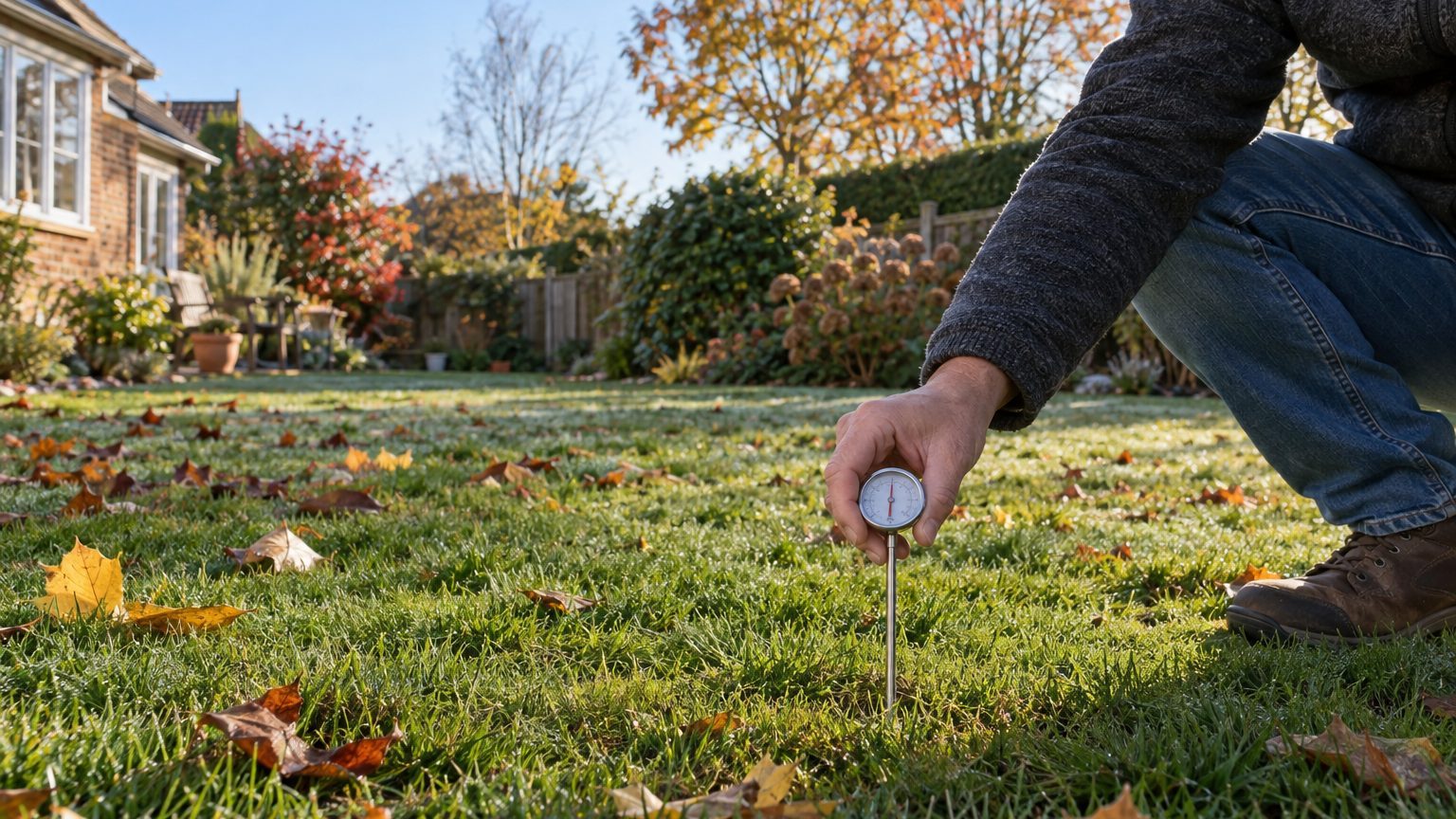
Stop mowing when the soil Temperature at a 2-inch depth settles near 40°F and the grass quits growing, which in most of the northern U.S. falls somewhere between late October and mid-November. Make your last pass at about 2 to 2.5 inches for cool-season grasses. The calendar matters less than the thermometer, and the thermometer is cheap.
Why soil temperature beats the calendar
Cool-season grasses such as Kentucky bluegrass, tall fescue and perennial ryegrass grow best when the soil sits between roughly 50°F and 65°F. Below 50°F, top growth slows sharply. Near 40°F, it essentially stops.
Growth is the whole point of mowing. No new blades, no need to cut them.
A lawn in Minneapolis may go dormant three weeks before one in Kansas City, and a warm autumn can stretch the season well past Halloween. A soil thermometer (a basic probe runs about the price of a latte) pushed 2 inches into the ground at mid-morning gives a far better read than the date on your phone. Check it a few days in a row, because one cold snap followed by a warm week can fool you. Many state extension services also publish regional soil temperature maps, which help you see the trend before you walk outside.
Warm-season lawns follow a different logic. Bermudagrass, zoysia and centipede grass go dormant earlier, often when soil falls below about 55°F to 60°F, and they turn tan after the first hard frost. Once that color change happens, mowing is done until spring green-up.
The right final cut height
Go too tall and you invite trouble. Go too short and you invite more.
For cool-season lawns, the target for the last mow is about 2 to 2.5 inches. Grass left at 4 inches or more heading into winter tends to flop over under snow, forming a matted layer that holds moisture against the crowns. That is exactly the environment snow mold likes, and the two common types, gray and pink, show up in spring as circular, crusty patches that can take weeks to recover.
Cut too low, say under 2 inches, and you strip away leaf surface the plant is still using to make and store carbohydrates. Those reserves carry the lawn through winter and fuel the first flush of growth in April. Scalped turf also exposes the crown to desiccating winds and lets weed seeds find bare soil.
Don’t drop the height in one dramatic move, either. The one-third rule still applies: never remove more than a third of the blade in a single mowing. If your grass is at 3.5 inches in early October, step down to 3 inches, then 2.5 inches over two or three mows, spaced as growth dictates.
Tall fescue, with its deeper roots and coarser blades, tolerates the upper end of the range. Fine fescues and bluegrass handle the lower end well.
Leaves, mulching and the last-mow routine
Your final mowing is also your best chance to deal with fallen leaves. A mulching mower (or any mower with the bag removed and the blade sharp) can chop a light leaf layer into pieces small enough to sift down into the turf. Research from Michigan State University found that mulched maple and oak leaves caused no harm to turf and even suppressed dandelion populations the following spring.
The limit is thickness. If you can’t see grass through the leaves after a pass, rake or collect the excess, because a heavy blanket will smother the lawn. Aim for a layer where the grass still shows through, usually around half an inch of leaf fragments.
Sharpen the blade before this last run. A dull blade tears grass rather than slicing it, leaving ragged, brown-tipped edges that lose water and give disease an easy way in. Late fall is when the lawn can least afford that damage.
Dry grass matters too. Mowing wet blades clumps clippings and compacts soil, so wait for an afternoon when the lawn has dried out.
What to do right after
Late fall is prime time for a fertilizer application, often called a winterizer, applied while the grass is still green but slowing down. Roots keep growing in cool soil even after the blades stop, so nitrogen applied then gets stored for spring rather than pushed into leafy growth. Many lawn programs time this for the period after the last mow, though you should follow rates on the bag and your local extension guidance.
Clean the mower before storing it. Drain or stabilize the fuel, scrape off caked grass from the deck, and sharpen or swap the blade now so spring doesn’t start with a chore.
Signs you mowed too early or too late
Stop too soon and the lawn may keep growing in a warm spell, leaving shaggy 4-inch grass that mats down later. Mow too late, into frozen ground, and you risk tearing frosted blades, which are brittle and snap rather than cut cleanly. Walking on frost-stiffened grass leaves footprints that turn brown and linger for weeks.
If a mild December pushes new growth after you’ve put the mower away, you can run it once more on a dry, above-freezing afternoon. Keep the height where you left it.
One more detail worth checking: pull the thermometer on a day when the lawn is also dry and the forecast is clear. Late-season mowing under those conditions leaves the turf at its tidiest, and the 2-inch mark you set in November is usually the same height the lawn wants to see again in early spring, when the first mow of the new year rolls around.