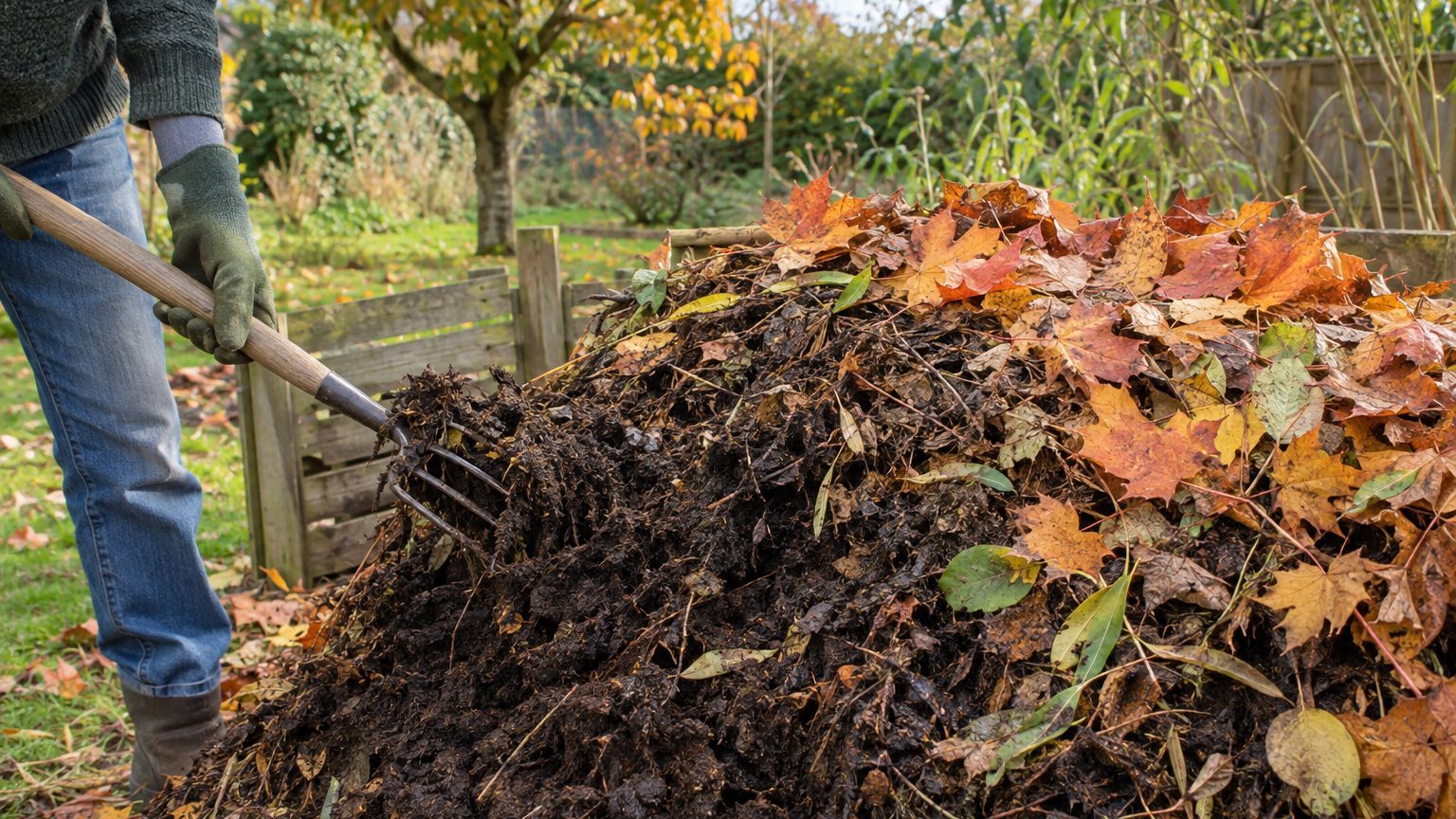
Maple, ash, willow, poplar and fruit tree leaves are the best leaves for compost.
They are lower in lignin and higher in calcium and nitrogen, and they typically break down in about a year.
At the other end of the scale,
beech, oak, holly and sweet chestnut are higher in lignin and lower in nitrogen and calcium.
The sections below sort common yard leaves into three speed tiers and explain how to handle each one.
Speed comes down to chemistry. According to UC Agriculture and Natural Resources,
the carbon-to-nitrogen ratio largely determines how fast leaves decompose, and oak leaves run around 60:1.
Decomposers do best near 30:1.
Oak leaves carry about twice the carbon the microbes can comfortably process, so the pile stalls until you add nitrogen. Lignin makes things worse.
The more lignin a leaf has, the harder it is to break down.
Best tree leaves for compost
Start with the fast tier, the leaves that turn to crumbly compost in roughly a year or less.
Maple is a common top pick on US lists.
Its leaves have higher levels of nitrogen and calcium
, and
their thin skins shred easily and break down quickly in a pile.
Fruit trees come next.
Apple, pear and peach leaves all work well
, and if you have an orchard corner, its leaf drop is some of the best compost feedstock you’ll get. Ash, willow and poplar belong in this group too.
Birch and cherry are also on the quick list.
Maple comes with a caveat, though. Not every maple behaves the same way.
Thinner-leafed varieties break down more quickly than thicker ones
, so a silver maple and a big, leathery Norway maple leaf won’t run on the same schedule. Judge by thickness as well as by name.
The middle tier is oak and, depending on who you ask, beech. Sources disagree on beech.
One US guide lists it as a quick breaker that makes fine-textured leaf mold
, while
others put it with oak as a high-lignin leaf that takes longer.
Treat it as medium speed and you’ll rarely be surprised. Oak is more clear-cut.
It’s slow to break down, though it makes a rich, long-lasting leaf mold
, and the same guide puts it in the 18-to-24-month group.
The slow tier belongs to waxy, leathery leaves.
Wax-coated leaves like holly are fine in the pile, but they break down more slowly.
Sweet chestnut goes here as well. None of these is off limits. They just shouldn’t make up the bulk of the pile if you want finished compost by next spring.
Leaves good for compost: how to handle each tier
Whole leaves fight you, even the good ones.
Unshredded leaves tend to mat, forming a barrier to air and water that slows decomposition significantly.
A mower pass over a leaf pile, or a few minutes with a shredder, is an inexpensive upgrade. Fast-tier leaves forgive a lazy approach. Slow-tier leaves don’t.
Next comes nitrogen. Leaves count as browns, and they need greens beside them.
One guide suggests 4 to 5 parts leaves to 1 part green material.
Fresh grass clippings are the easiest source because they’re sitting in your mower bag, and the exact blend is covered in how to compost leaves and grass clippings. UC ANR points to the same fix for oak,
blending it with high-nitrogen sources such as grass clippings and manures.
Oak needs a cap.
One gardening guide suggests keeping oak to about 20% of a pile’s makeup
, with the rest made up of thinner leaves. Say you’ve raked 10 bags of leaves and 4 are oak. Add about 1½ bags of oak to the 6 bags of other leaves (oak is then about 20% of the pile) and put the rest aside for leaf mold, which is the better home for slow leaves.
Leaf mold is less nutrient-rich than fully composted leaves, but it’s easier to make.
Bag the oak, keep it damp, and leave it alone.
If you’d rather push everything through faster, how to compost leaves faster covers shredding, moisture and turning in more detail. The full method, from bin choice to the first turn, is in how to compost leaves.
Best leaves for compost pile: a practical mix and the leaves to question
A workable pile for most yards looks like this: mostly fast-tier leaves, shredded, with greens mixed in and a capped share of oak or other slow leaves.
- Fast tier (maple, ash, willow, poplar, fruit trees): the bulk of the pile.
- Medium tier (oak, beech): shredded, up to roughly a fifth of the leaf volume.
- Slow tier (holly, chestnut, other waxy leaves): small amounts, or set aside for leaf mold.
A few leaves raise questions beyond speed. Black walnut is the best-known, and the advice is more settled than the folklore suggests. Oregon State’s Extension service says
you can apply compost made with black walnut leaves to your vegetable garden.
The bigger concern is the tree itself.
Juglone moving into the soil through the roots is the main worry
, so the distance between the tree and your vegetable beds matters more than the leaves in your bin.
Walnut leaves carry the most juglone in spring and less in fall
, which works in your favor when you’re raking in October. An Ask Extension response adds that
the science behind walnut toxicity isn’t solid
and that
leaves are low in the suspected chemicals and will be fine in compost.
Not every source agrees. Some popular gardening sites still tell readers to keep walnut leaves out entirely. If you have a heavy walnut canopy and tomatoes nearby, a cautious middle path is reasonable: give those leaves their own pile and let it finish fully before using it.
Eucalyptus is a different case.
Its aromatic oils can slow decomposition, and the advice is to compost it in small quantities mixed with other materials.
A handful per wheelbarrow of maple is fine. A whole pile of eucalyptus is asking for a very long wait.
Diseased foliage is the other exception.
Leaves from diseased plants should be discarded rather than composted.
Think black-spotted rose leaves or tomato foliage with blight. A cold backyard pile often won’t get hot enough to be a reliable fix, so bag them for municipal yard waste instead.
One last tip for walnut owners. An Ohio State University excerpt describes a simple check:
compost the leaves separately, then test the finished compost by planting tomato seedlings in it.
The same source says
the toxic effect can degrade in two to four weeks
, so a pile that has sat through winter should pass easily. If the seedlings stunt, you’ve lost a single tomato seedling instead of a bed.
Sources : compost.bc.ca