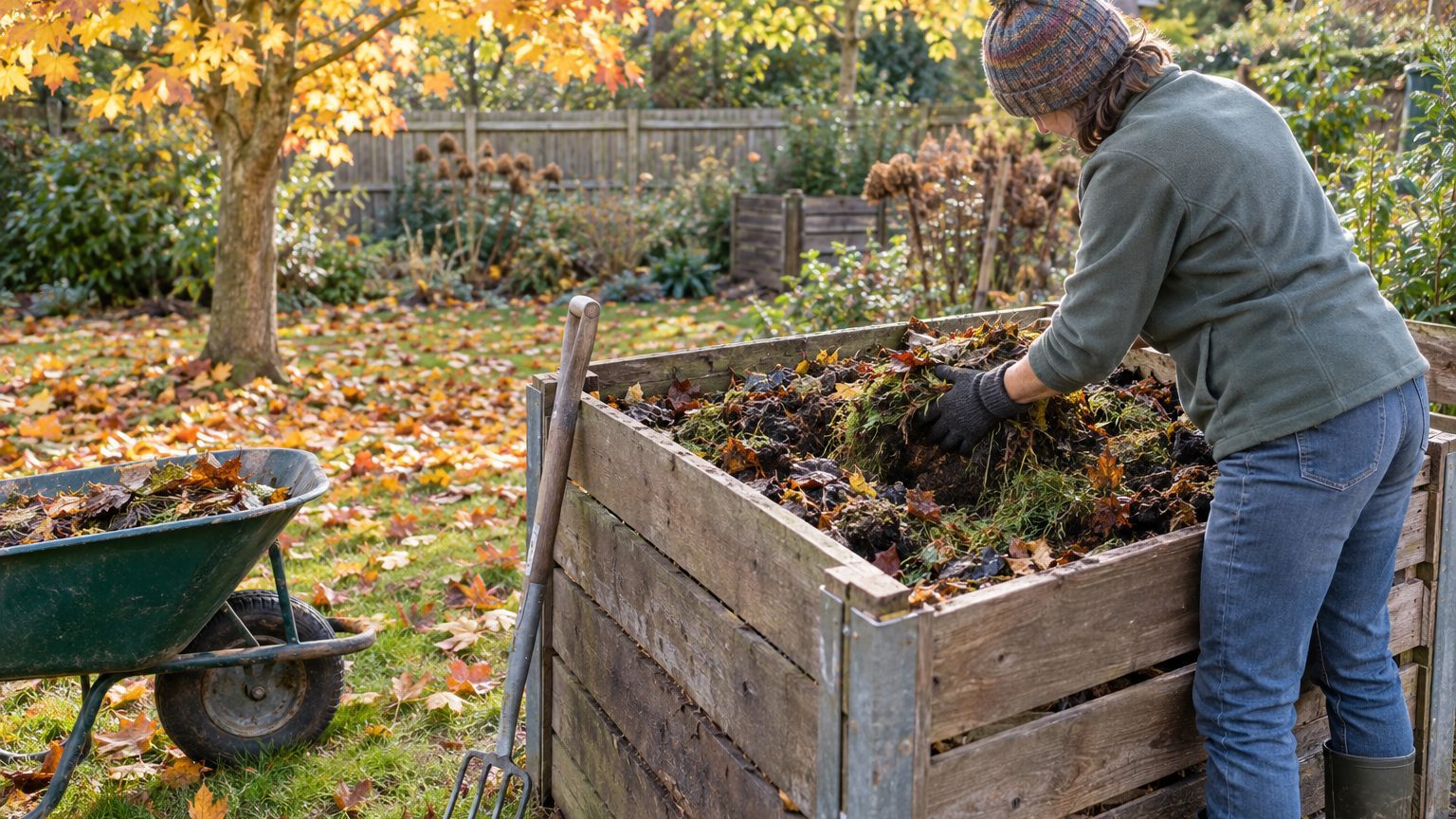
Shred the leaves, mix them with a nitrogen source such as grass clippings or kitchen scraps, keep the pile as damp as a wrung-out sponge, and turn it now and then. That’s the whole method. Everything else is detail. Leaves are not a perfect compost ingredient on their own, though.
Their carbon-to-nitrogen ratio typically runs 40 to 80 parts carbon for each part nitrogen, so they compost slowly by themselves
unless you add nitrogen. For a closer look at balancing the two, see How to Compost Leaves and Grass Clippings, or read about the Browns and Greens Compost Ratio.
The payoff is worth the effort. A single mature maple can drop a startling volume of leaves in October, and that’s free carbon you’d otherwise pay to bag and haul. Not every tree’s leaves break down equally (oak leaves in compost are a good example, and Black Walnut Leaves in Compost are another, since they need special care), so it helps to know the best leaves for compost and the leaves to avoid in compost before you start piling. If you’re still deciding whether composting is the right move, what to do with fallen leaves compares compost with mulch, leaf mold and leaving them in place. This guide covers the composting route from start to finish.
How to compost leaves quickly
Speed comes down to surface area. Whole leaves mat together, shed water, and block air. Shredded leaves stay fluffy and give microbes far more surface to work on. The EPA’s home composting guidance says to chop or break materials into smaller pieces because
doing so helps the materials in the pile break down faster
. For more tips on speeding up the process, see How to Compost Leaves Faster.
You don’t need a dedicated shredder. Run a lawn mower over a loose windrow of leaves a few times, or use a mulching blade with a bagger attached. A string trimmer in a tall trash can works for small batches. Shredding also saves space. Leaves that get chopped fine can shrink to roughly a quarter of their original volume, according to one home-composting resource. That means one fall’s worth of raked leaves may fit in a bin you thought was far too small, and if you have more than you can use right away, see How to Store Leaves for Compost.
Next, pick a spot. The EPA suggests
a dry, shady or partly shady location near a water source
. For size, it recommends
at least three feet wide, three feet deep and three feet tall (one cubic yard), which holds enough material and insulation to keep the organisms warm and working
. A smaller pile still works if you manage it well. A pile that’s too small, too dry, or short on nitrogen is a common reason compost fails to heat up.
Then add moisture as you build. The EPA’s advice is simple:
moisten dry materials as they go into the pile
. Dry leaves are the biggest offender here. They can look compost-ready and still sit inert for months because they never got wet enough. Squeeze a handful. A few drops of water means about right. A steady stream means too wet. Bone dry means keep watering.
Finally, turn the pile. Turning brings in oxygen and moves the cooler outer material toward the hot center. The EPA’s troubleshooting chart is blunt about this: when a pile smells like rotten eggs, the cause is insufficient air or too much moisture, and the fix is to
turn the pile and mix in coarse browns such as leaves or sawdust
. If you want to push the timeline harder, how to compost leaves faster covers the extra tactics, from pile size to turning schedules.
Leaves in a compost pile: building it layer by layer
Start from the ground up. The EPA recommends opening the pile with
a four- to six-inch layer of bulky browns such as twigs and wood chips, which absorbs extra liquid and lets air circulate at the base
. Leaves are too fine for that bottom layer. They’d compress under their own weight within weeks.
After the base, build like a lasagna. The EPA’s wording is
layer your greens and browns like lasagna
, and the point is to alternate materials of different sizes so air can move through the stack. A realistic leaf-based sequence looks like this:
- A thick layer of shredded leaves, wetted as you go
- A thinner layer of greens, such as fresh grass clippings, coffee grounds, or fruit and vegetable scraps
- A light sprinkling of finished compost or garden soil to introduce microbes, if you have some
- Another layer of leaves on top to cap it
That top cap matters more than it seems. The EPA advises burying fruit and vegetable waste
under 10 inches of compost material
. Leaves make an ideal blanket for that job, cutting down on odors and discouraging fruit flies and curious raccoons.
Not every leaf behaves the same. According to Epic Gardening, leaves lower in lignin and higher in calcium and nitrogen, such as
ash, maple, fruit tree, poplar and willow, typically break down in about a year
. Tougher, waxier leaves take longer and may work better shredded and mixed in smaller amounts. Check best leaves for compost before you pile on your whole yard’s worth.
Plan on a wait. Timelines vary a lot, and anyone promising finished compost in two weeks is describing ideal conditions. One guide that summarizes EPA advice puts a well-maintained pile at roughly three to five months, with a neglected one needing a year. A leaf-heavy pile that gets little nitrogen and little turning will sit at the long end of that range, and that’s fine. Slow compost is still compost.
Finished material looks dark, crumbly, and smells like forest soil. You shouldn’t recognize individual leaves anymore. A small caution from the EPA: the resulting compost works well on lawns and gardens, but
it should not be used as potting soil for houseplants because it may still contain vegetable and grass seeds
. Keep your indoor plants on commercial potting mix.
Browns and greens compost ratio for leaf-heavy piles
Here the advice gets confusing, because different sources give different numbers. The apparent contradiction mostly vanishes once you separate two measurements: the chemistry ratio and the bucket ratio.
The chemistry ratio is the scientific target. Cornell Cooperative Extension says
the ideal proportion is about 30 parts carbon to 1 part nitrogen by weight
, though that can shift depending on how available the carbon and nitrogen are. Leaves sit well above that line at 40 to 80:1, so they need a nitrogen partner. Grass clippings and kitchen scraps are the usual choices, with ratios around 15 to 20:1 according to one composting guide.
The bucket ratio is what you can actually do at home. Nobody weighs carbon in the backyard. The EPA’s current home guidance says to add
at least two to three times the volume of browns, such as dry leaves, to the volume of greens, such as food scraps
. An older EPA guide says to use
generally three parts browns to one part greens
, chopped or shredded. A still older EPA page recommended equal amounts of each. Those figures aren’t in conflict so much as they’re different starting points for different materials.
Cornell gives the most specific leaf recipe. For yard-waste composting,
adding one part grass clippings to three parts leaves, or two pounds of nitrogen fertilizer to a cubic yard of leaves, balances the nutrients and helps composting finish in the shortest possible time
. So for a pure yard-waste pile, 3:1 leaves to grass is a solid benchmark. The full breakdown is in how to compost leaves and grass clippings.
Shredding complicates the volume math. One home-composting resource points out that when leaves are shredded, a large volume gets cut to about a quarter of its mass. Two buckets of shredded leaves can then hold too much carbon for one bucket of wet greens, even though the same two buckets of whole leaves would be about right. A sensible approach is to start near two parts shredded browns to one part greens, then adjust by what the pile tells you.
Those signals are easy to read. The EPA’s troubleshooting guide ties an ammonia smell to too much nitrogen, with the remedy of mixing in coarse browns like leaves or sawdust. A pile that isn’t heating or breaks down slowly may be too small, too dry, or short on nitrogen. For the second case, the EPA suggests adding food waste, grass clippings, or manure from chickens, rabbits, cows or horses. The pile is a feedback loop. Your job is mostly to respond to it.
For a deeper look at the proportions and how to adapt them, see browns and greens compost ratio.
Common leaf-composting snags and how to fix them
Matting is the classic one. Whole oak, sycamore or maple leaves can fuse into a wet, slimy layer that blocks air. The fix is to shred before adding or to alternate leaves with a looser material like twigs, and to break up any mats when you turn the pile.
Dryness is the second. Because dry leaves are so absorbent, a pile can look full while the center stays bone dry. The EPA’s advice for a pile that won’t heat from lack of moisture is to turn it and add water. Water in layers as you build rather than trying to soak the finished pile from the top.
Cold weather is the third, and in October it’s relevant right now. Microbes slow down as temperatures drop. The EPA notes that a pile that doesn’t heat in cold weather can be helped by
increasing its size or insulating it with straw or a tarp
. A winter pile may do little visible work, then wake up in spring once it warms. That’s normal. It’s also why fall piles are often left for the following year.
If your leaves are too numerous to fit one pile, store the extra in bags or a spare wire cage and feed it into the compost through winter and spring. Dry leaves keep well, and they’ll be exactly what a kitchen-scrap pile needs in January when greens outnumber browns.
One last piece of context for leaf-heavy yards: a pile made of leaves alone, with no nitrogen added, doesn’t produce standard compost. It produces leaf mold, a slower, fungal-driven material that’s excellent as a soil conditioner and mulch. Plan Natural describes it as made much like compost but with little or no added nitrogen. Both are worth making, and many gardeners keep a separate bin for each.
Sources : joegardener.com | phsonline.org