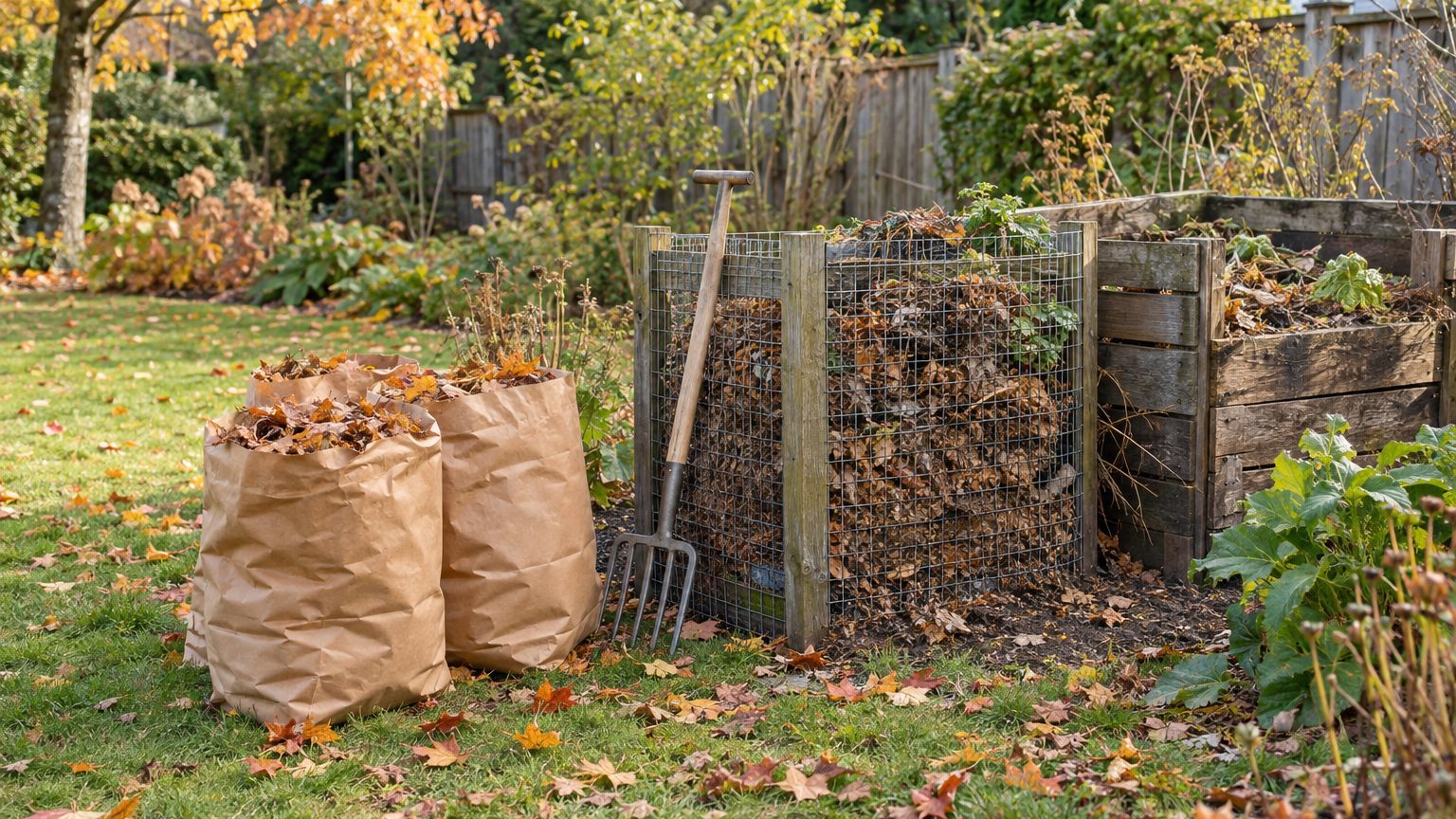
Keep the leaves dry, shredded if you can, and in something that breathes, such as paper bags, a wire-mesh bin, or a covered pile. Set it close to the compost and shield it from rain. That is the whole system. A common storage failure comes from one mistake:
wet leaves sealed in a container turn a useful reserve into a heavy, matted mass.
The rest of this guide covers how to avoid that, and how to store leaves for mulch instead.
Best way to store leaves for compost
Why store leaves at all? Because the supply and the demand arrive at opposite times. Leaves come down in a short burst in October and November. Your pile wants carbon all year, in summer when grass clippings flood in and in winter when kitchen scraps keep arriving with nothing dry to balance them.
Without a dry, carbon-rich material to layer with those scraps, a pile or bin can turn compacted, wet, and odorous.
University of Illinois Extension describes the simplest version of the idea.
Store leaves in garbage bags with small holes that let them break down naturally.
The partly decomposed result, leaf mold, can be used as mulch or saved as a carbon source for the compost pile in summer, when brown material is scarce.
One batch of leaves can do two jobs, depending on how long it sits.
There are four containers worth considering, and each has a trade-off:
- Paper or breathable bags:
easy to move, inexpensive, and useful for loose whole leaves.
They fill fast, so they suit small yards. - Plastic bags with holes: they hold moisture better, which makes them a better fit for leaf mold than for a dry reserve. Punch the holes before filling.
- Wire-mesh leaf corral:
a simple wire mesh enclosure that holds shredded leaves.
It is cheap, breathes well, and holds far more than bags. - Covered pile or bin:
bags, bins, and covered piles can all work when dry leaves are protected from rain.
Shredding changes the math on all of them.
Shredded leaves take up less space and break down faster once they enter an active compost pile.
One gardener who stockpiles for mulch packs shredded dry leaves into an 8 × 10 × 4-foot covered plank bin that
holds roughly 2 tons.
You don’t need that much, but the example shows how much volume shredding saves. Whole leaves fluff up in a bin and fill it quickly.
Two small precautions before anything goes in.
Separate diseased leaves from the ones you plan to recycle or compost.
And if food scraps go into your pile,
keep the dry leaf reserve separate from the active compost, use a rodent-resistant setup where needed, and follow local guidance for food scrap composting.
A warm, dry bag of leaves is an attractive winter home for mice, so a bag on the ground against the fence is not ideal.
How to store dry leaves for compost
Dry is the target, and timing matters more than equipment. Rake after a few rain-free days. Leaves that dry on the lawn are easy to handle, and
dry leaves are much easier to manage and shred than wet ones.
A pass with the mower, or a leaf shredder, takes care of the size.
Running over raked leaves with a lawnmower cuts them into smaller pieces.
If you use a string trimmer in a trash can, wear eye protection.
Next comes the container. Fill paper bags loosely and fold the tops over rather than sealing them. Use a lidded bin only if the leaves are bone dry when they go in, and think twice about stacking bags in a pile where rain can run down between them. In a wire corral, add a weighted tarp over the top. One grower who stores whole leaves this way reports that
a well-weighted tarp over a hex-wire enclosure keeps the leaves pretty dry until she can shred them the following spring or summer.
Placement is the part people skip, and it decides whether the stash gets used. Put it next to the compost.
Store in a breathable bag or container near your compost, protected from the rain.
For winter,
place a small bucket, lidded pail, or scoop of leaves on the path between the kitchen collection container and the compost.
The aim is to make “add a handful of browns” take about three seconds. If the bag is across the yard, you’ll skip it.
Using the stash later
The working ratio is simple.
The rule of thumb for compost is one-third green to two-thirds brown, so cover each addition of kitchen scraps with a few handfuls of leaves.
Leaves alone are lopsided.
Most deciduous leaves have a carbon-to-nitrogen ratio between 40:1 and 80:1,
while
active composting works best at roughly 25 to 30 to 1.
Greens close that gap. If your greens are mostly lawn clippings, the guide on how to compost leaves and grass clippings covers the mixing in more detail.
Stored leaves sometimes get rained on anyway. Don’t throw them out.
Leaves that have become wet and compressed into a solid mass can be broken apart with a fork before use.
Slightly damp is actually good:
they integrate easily and start decomposing as soon as they enter an active pile.
Soaked and slimy is the point to stop and let them dry or mix them with fluffier material. For the general method, see how to compost leaves, and if the pile stalls, how to compost leaves faster has the fixes.
One more option applies if you have more leaves than storage space. Bagging them moist, on purpose, turns the stash into compost. Nebraska Extension describes filling large black plastic bags, adding a nitrogen source like fertilizer or manure, then tying them closed and parking them in a corner.
The material takes 6 to 12 months to decompose,
and
the finished compost is dark, crumbly, and earthy-smelling.
That is a different goal from a dry reserve, so keep the two kinds of bag separate and label them.
How to store leaves for mulch
Mulch storage follows different rules, because the leaves are going on the soil, not into the pile.
Whole leaves mat when wet and keep moisture from reaching the soil below,
so shredding comes first.
Shredding speeds breakdown and keeps leaves from packing down and smothering perennials.
It also helps with a practical problem:
shredded leaves are less likely to blow away.
Once shredded, the options are the same as for compost:
bins, bags, or a pile until you’re ready to use them in vegetable and flower gardens.
A leaf corral works well here, since a plain ring of wire holds a lot and costs very little. If you’re short on space, even an empty trash can does the job.
Use anything that will hold the leaves and keep them from blowing around.
A pile of damp, packed leaves will start turning into leaf mold, so bear that in mind.
If you wait too long, mulch turns into leaf mold.
That is no loss, since leaf mold is a good mulch itself, just a finer one.
Whether the stash is a compost reserve or mulch comes down to moisture and time:
- Kept dry, shredded leaves stay loose and usable as mulch or as browns for a pile.
- Kept damp and packed, they become leaf mold.
Shredded leaves piled in a wire ring become dark and crumbly in six to twelve months. - Kept whole in a pile, they take longer but still get there.
Don’t worry if you can’t shred them; they still end up as leaf mold eventually.
Thick, leathery leaves are slower.
Magnolia, holly, and live oak shred fine but break down more slowly than maple.
Oak has an undeserved reputation for harming plants.
Oak leaves take longer to break down but make a fine mulch if you shred them first.
When spring arrives, apply the mulch at the right depth. Recommendations vary slightly, from
2 to 3 inches
to
2 to 4 inches around plants,
so aim for about 3 inches and adjust for how coarse the shreds are.
Keep the mulch about an inch away from plant stems and tree trunks.
That gap keeps moisture away from the bark and crowns. If you only managed to bag whole leaves,
use them as mulch in spring, after the soil has warmed.
Bagged leaves can also work right where they are over winter. Nebraska Extension suggests placing filled bags
around plants that need protection from winter wind, such as roses or broadleaf evergreens.
In spring, the same bags go straight to the compost bin as browns. One set of leaves does insulation, then carbon supply, with no extra work in between.
If you take one thing from this: use more bags than you think you need. A single mature tree can drop far more leaves than a typical bin holds, and shredded leaves compress to a fraction of their raked volume. Store the surplus as leaf mold, and what you thought was waste becomes a valuable soil amendment by next fall.
Sources : rhs.org.uk | gardenworld.co.uk