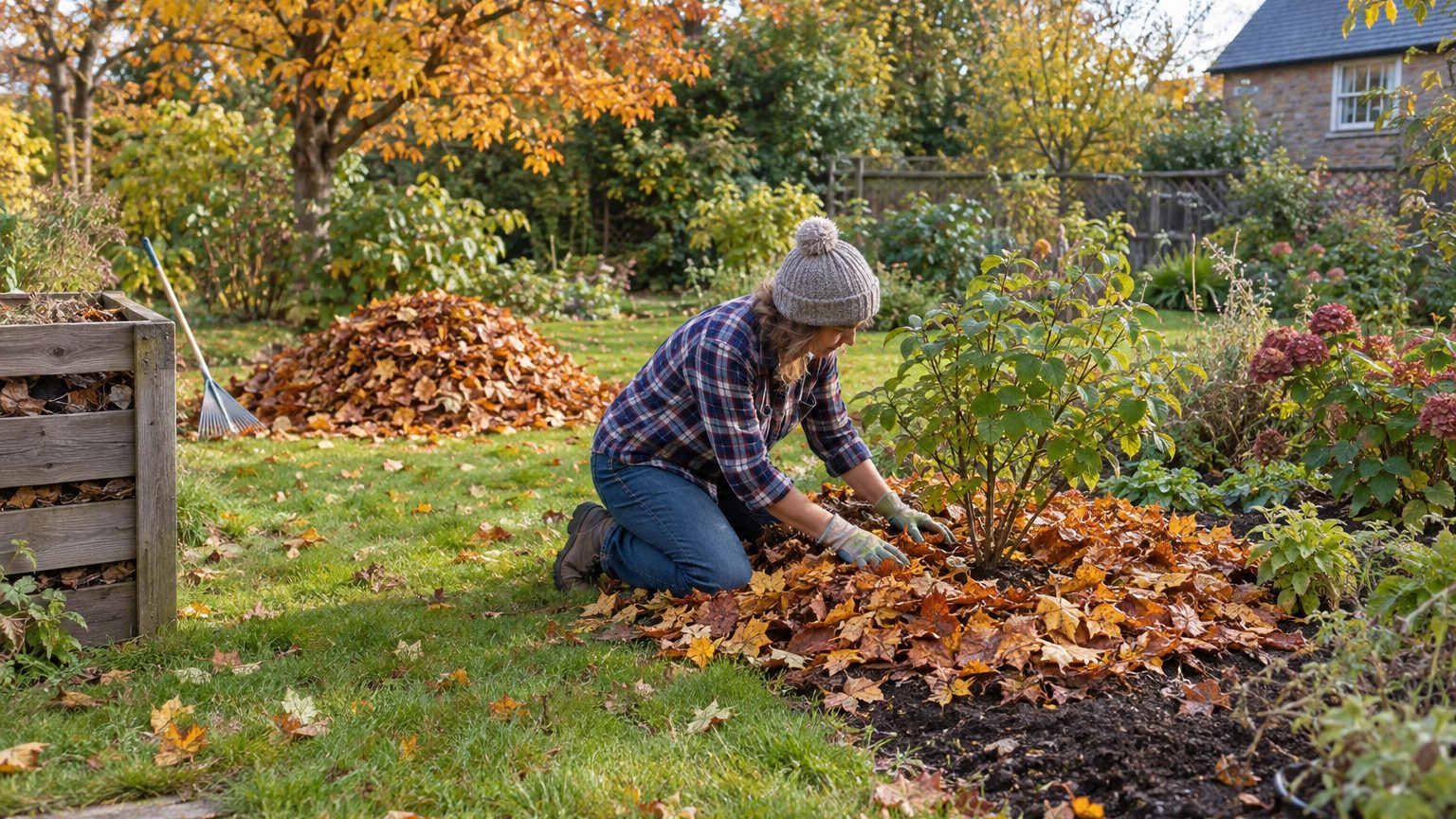
Keep them on your property. That’s the short answer, and nearly every university extension service gives it. Thin layers get mowed into the lawn (here’s more on mulching leaves into the lawn). Thicker drifts get raked into garden beds at roughly 3 to 5 inches. Whatever is left goes into a pile or bin to become leaf mold (here’s how to make leaf mold) or compost (here’s how to compost leaves). Leaves only leave the yard when they smother grass or carry disease.
Collecting and removing every leaf is not necessary, but simply ignoring them isn’t a good option either
, as Iowa State horticulturists put it. Where each leaf goes depends on what’s underneath it.
What to Do With Fallen Leaves in the Garden
Beds are the easiest place to put leaves, because they already want a mulch layer (here’s more on leaves in garden beds).
Leaves in perennial beds, under shrubs and in other mulched areas mostly don’t have to be removed, and even thick layers break down over winter into an inch or two of mulch by spring.
That’s free mulch, delivered by the nearest maple. For the lawn and the rest of the property, see What to Do With Fallen Leaves in the Yard.
Depth matters, and so does shape. Penn State’s Master Gardener coordinator for Franklin County recommends
whole or shredded leaves as mulch up to 4 inches thick around trees and shrubs, kept a few inches back from the trunk or stems
. Purdue’s urban forestry specialist gives a similar spec for trees:
at least a 3-foot radius from the trunk, with a gap of about 2 inches between trunk and mulch
. He adds,
“no volcano mulching.”
Wetting the leaves after you spread them
helps keep them in place
. Our guide to using leaves as mulch covers shredding and layering by bed type.
Perennial crowns are the exception to the “pile it on” rule.
A thick mat shouldn’t form over perennial crowns, and evergreen perennials such as creeping phlox and Lenten rose should stay clear of it, along with the base of shrubs and trees.
The fix is redistribution.
Move leaves from spots with thick layers to areas that have fewer.
Tender plants can use leaves as a blanket. University of Illinois Extension suggests that for tender perennials such as tea roses,
leaves can serve as insulation, held in a wire or burlap cage filled with them
. Remove the cage in spring once growth starts.
The vegetable garden
Vegetable beds call for a split decision. Penn State says that
fallen leaves can be rototilled in at the end of the season to decompose and add organic matter over winter
. University of Georgia Extension is more cautious. Because
tree leaves are high in carbon and low in nitrogen, with a ratio typically around 60:1
, it
does not recommend tilling freshly fallen leaves directly into soil
. Their reasoning:
soil microorganisms draw on the soil’s existing nitrogen to break the leaves down
. If you till, shred the leaves first. A safer route is to lay them on top as a winter mulch and let them break down in place.
Sanitation is the other half. Iowa State advises removing
plant debris from edible plants showing signs of disease, such as anthracnose-infected raspberry canes
. If a pest like the asparagus beetle was bad this year,
remove and destroy debris to reduce overwintering sites
. Healthy foliage on asparagus or rhubarb is different, since it
can provide protection from harsh winter conditions
. Watch strawberries, though, because
foliage can smother crops like strawberries
.
What to Do With Fallen Leaves in the Yard
The lawn is where the research is strongest, and where raking turns out to be unnecessary. In the late 1990s, Michigan State University set up a three-year study with
three leaf layer thicknesses (none, 3 inches and 6 inches) of mixed tree species, mulched in with a rotary mower every October
. Turf where leaves were mulched
was healthier than the lawn that received no pulverized leaves
. Virginia Tech’s summary of the broader literature is blunter.
Mulching leaves had no undesirable effects on turf quality or color, growth, thatch accumulation, soil pH, weed populations or disease pressure.
Then there’s the dandelion finding. Michigan State plots mulched with leaves showed
fewer perennial weeds like dandelions and annual weeds like crabgrass after three years
. The explanation is physical:
small leaf pieces sift down onto the soil surface and block weed germination from bare soil
. One caveat deserves a mention. The dandelion drop was
unrelated to the objectives of that initial research
, and the leaves came from a campus where
broadleaf herbicides were part of the turf program
. Researchers later reran the test with pesticide-free maple and oak leaves, so treat “fewer weeds” as a probable bonus. Don’t count on it. The proven benefits are healthier turf and no bagging. A related study reported
dandelion counts down by up to 84% with sugar maple leaves and 72% with red maple
, which suggests the species of leaf matters.
The technique decides the outcome. Washington State University’s extension materials describe the target:
sharp blades and slow passes, with pieces about the consistency of corn flakes
. Mow when
the layer is thin and dry, and mow often through the fall
. Wet leaves
strain the mower’s engine and don’t chop into small pieces that decompose easily
. How much can your mower swallow at once?
Michigan State research indicates up to 6 inches can be mulched at a time, depending on the mower’s size and performance.
A thick layer may need several passes.
A visual test saves guesswork.
If you can see ½ inch of grass through the mulched leaves, the lawn is getting enough sunlight for photosynthesis.
If the leaf layer is so thick it hides every blade, Penn State says
most of the leaves should be removed
. Very heavy drops, like those under a large silver maple, can overwhelm a mower, so rake part of the pile into beds first and mow the rest. Full instructions are in mulching leaves into lawn.
Raking and bagging has a cost beyond your Saturday. Reporting on EPA data notes that
in 2018, landfills took in roughly 10.5 million tons of yard waste, including grass clippings, leaves, and tree and brush cuttings
. The National Wildlife Federation goes further:
sending leaves to a landfill is the worst option, robbing your soil of natural fertilizer and contributing to greenhouse gas emissions
.
Should I Rake Leaves or Leave Them?
Both, in different places. The best-supported plan is selective. Leave leaves where they help, and move them where they cause damage. The National Wildlife Federation
recommends moving leaves off turf, pavement, driveways and other places where a thick or slippery layer would create problems
. From there,
rake them beneath trees or into garden beds at about 3 to 5 inches deep, and pile any extras in a little-used corner to become leaf mold
.
The wildlife argument is concrete.
Many insects Overwinter in leaf litter, including moths, butterflies and bees.
The National Wildlife Federation’s Garden for Wildlife program says
94% of moth species rely on the leaf layer to complete their life cycle
. Bumble bee queens
may Overwinter in piles of leaves
, and
woolly bear caterpillars spend winter snuggled under the leaves
. Fireflies are part of the picture too. Clemson Extension, as quoted by the Smithsonian Gardens, says they
live the bulk of their lives (95%) as larvae in leaf litter
. Bag those leaves and the next summer’s lightning bugs go with them.
A twist that many “leave the leaves” posts skip: mowing can hurt the insects you’re trying to protect. A Time feature quoting pollinator specialists says that if you shred leaves with a mower and leave the pieces on grass, do it
early in the season, before many insects have settled in for winter
. The reason is simple.
If you leave all those leaves and then start chopping them up, you’re chopping up lots of invertebrates too.
So the calendar matters. Mow lawn leaves in October and early November, and keep the undisturbed layers in beds. For those, Tufts University pollinator researchers advise
keeping leaves in place until the weather warms and any pollinators using them have emerged
.
Exceptions exist.
Diseased plant material and invasive plants may need to be removed; ask a local extension office how to dispose of them.
Region matters as well. Cape Cod’s town government, in an area with
one of the highest Lyme disease rates in the United States
, published a dedicated guide on balancing leaf litter and tick risk. If you live in tick country, check local health guidance before piling leaves beside play areas.
One persistent worry can be set aside.
University of Missouri Extension says black walnut leaves don’t need to be removed; studies show the amount of the toxin juglone left in fallen leaves is so minimal it’s no longer toxic.
The full decision guide is in should i rake leaves.
How to Compost Leaves
When the lawn is mowed and the beds are blanketed, you’ll still have leaves. That’s where the compost bin comes in. The catch is chemistry. Texas A&M AgriLife Extension puts the optimum for efficient composting at
a carbon-to-nitrogen ratio of 25-30:1
, while
leaves run about 40-80:1
. A pile of leaves alone will break down, but slowly.
Due to their high carbon content, leaves may take 5 months to 2 years to compost by themselves.
Adding nitrogen speeds things up. Texas A&M lists
grass clippings, plant wastes, animal manures and food scraps
as the high-nitrogen partners. Without turning and enough moisture, the pile stalls:
leaves will compost into a good finished product if moisture is adequate and the pile is turned frequently to supply oxygen
. Don’t overcorrect, though.
A lower ratio results in excess nitrogen loss and possible odors if the mix isn’t turned often.
Shredding first, even by running the mower over the pile, gives microbes more surface to work on. The how to compost leaves guide walks through the layering step by step.
Don’t want the work? Make leaf mold instead. University of Florida’s Leon County extension calls it
a cold process using only carbon-rich leaves decayed by fungi, with no flipping required, less labor-intensive than hot composting but slower
. The timeline is long:
anywhere from six months to two years, depending on leaf type, moisture and ambient temperature
. Moisture is the variable you control. A retailer’s guide notes that
an unattended pile of dry leaves could take three years or more, while a covered, moist (not wet) pile may be ready in a year
.
Leaf mold behaves differently from compost in the garden.
It’s not a source of nitrogen to be applied as a fertilizer.
Its job is structure. It
creates habitat for earthworms and other beneficial soil organisms like fungi, centipedes and beetles
. Use it as mulch or dig it in. The full method is in how to make leaf mold.
Which leaves go in? Healthy ones, mostly. Skip leaves with obvious disease, and keep in mind that some species break down faster than others. The weed-suppression study that compared
pesticide-free maple and oak leaves
is a reminder that the source of the leaves matters, since leaves from heavily treated lawns may carry residues. And if you’re comparing time to results, the mower wins. Mulched into turf, shredded leaves vanish in a day or two. In a pile, the same leaves take the better part of a year.
Last, if you truly have more than any of these methods can absorb, bagging is a legitimate fallback. Just check your municipality’s rules first, since many towns run separate yard-waste collection or drop-off sites that turn bagged leaves into municipal compost rather than landfill.
Sources : housebeautiful.com | joegardener.com | tfsweb.tamu.edu