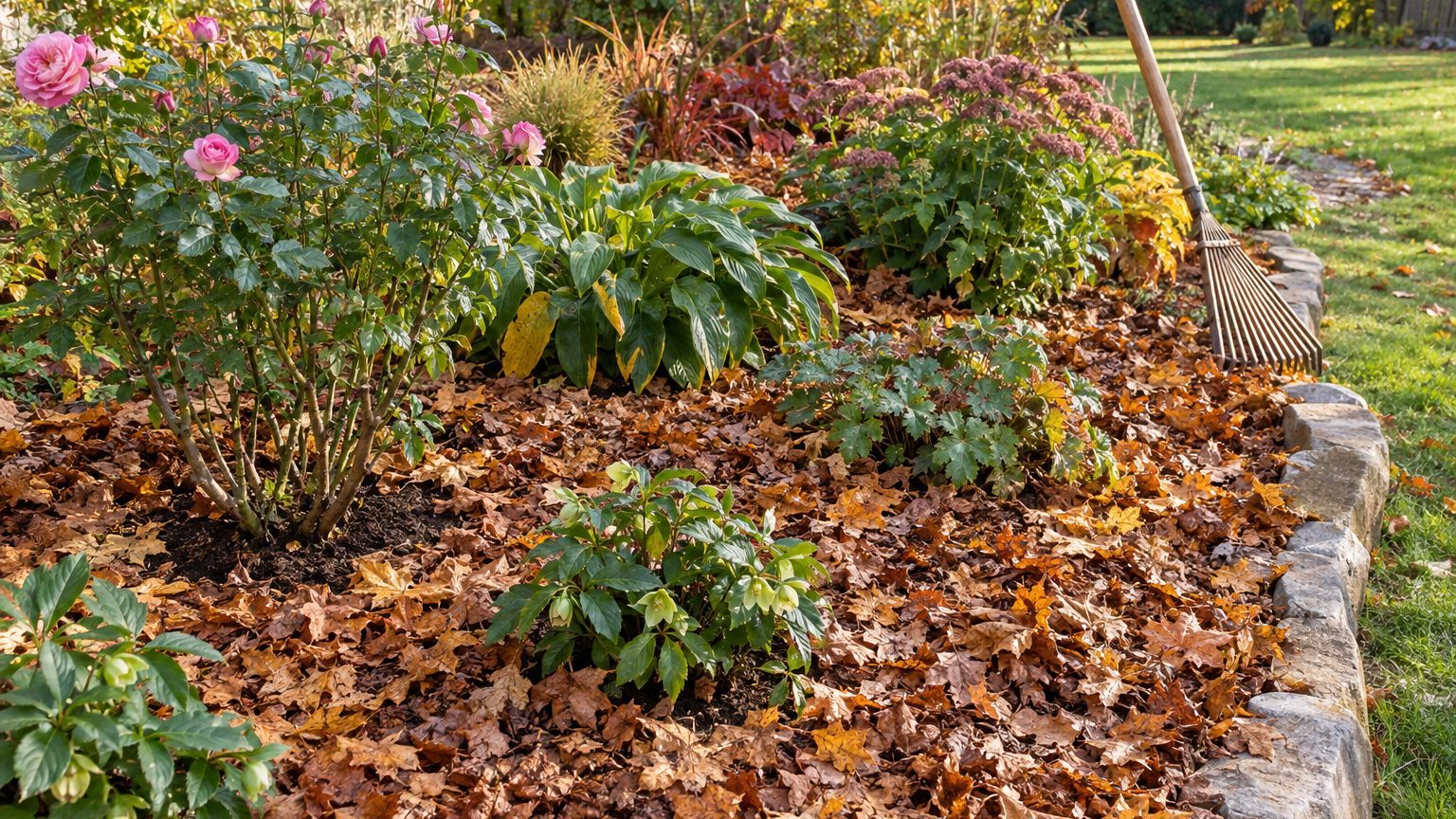
Spread two to three inches of shredded leaves over bare soil in perennial beds and around shrubs, and keep the mulch clear of stems and trunks. That’s the short version. Whole, unshredded leaves work too, but they go on thinner, at about two inches, because wet whole leaves pack down.
Rake or spread them to an even depth of about two inches. Thicker layers of whole leaves can block water and oxygen as they break down and compact.
Using leaves as mulch in garden beds
Beds are where leaves earn their keep. Bare soil in November is exposed to rain, wind and weed seeds, and a leaf layer covers it for free. The broader extension consensus on mulch depth is a range of two to four inches.
Coarser mulches such as wood chips sit at the higher end, and finer materials such as grass clippings at the lower end.
Shredded leaves behave like a fine, light mulch, so the lower half of that range is a sensible default.
Penn State’s guidance puts
shredded leaves as mulch at roughly two to four inches deep around trees, shrubs and perennial beds, where they moderate soil temperature, conserve moisture and suppress weeds.
Shredding matters because it makes the leaves
less likely to form heavy mats, and you don’t need a machine to do it (see How to Shred Leaves Without a Shredder).
Anyone who has pulled up a soggy, glued-together sheet of maple leaves in April knows the problem.
Placement matters as much as depth. UC Cooperative Extension advises leaving a gap of
a good four inches between mulch and stems or trunks to prevent rot.
Piling leaves against a trunk invites moisture and rot, the same mistake as the familiar “mulch volcano.” Pull the layer back so bare soil shows at the base of every woody plant, and keep it off the crowns of perennials too.
Not every leaf behaves the same way. Leaves from
evergreen broadleaf trees like Southern magnolia and California bay take longer to break down and should be shredded first (see How to Shred Leaves for Mulch for the easiest methods). Conifer needles are a different case altogether, and they are covered in Pine Needles as Mulch. Oak leaves also have a reputation for making soil more acidic, a question covered in Are Oak Leaves Acidic?
Under tree canopies,
a three- to six-inch layer of shredded leaves is optimum.
That is deeper than for flower beds, which makes sense: tree roots are not bothered by a thicker blanket the way a low perennial crown is.
Vegetable beds follow slightly different rules, and they get their own treatment in using leaves as mulch in vegetable garden. If the leaves are shredded, about three inches should be fine.
They know of no tree or shrub leaf used as litter mulch that would risk harming vegetable or other plants.
Black walnut is the one tree people worry about. Check with your local extension office if a walnut drops leaves in your yard.
Whole leaves, shredded leaves, or both
There is a real tradeoff here, and it isn’t only about looks. Shredded leaves may be easier to spread and look tidier, but whole intact leaves give more protection to organisms using them for shelter or food.
If a bed is tucked behind the garage, whole leaves at a modest depth do more for wildlife. Near the front walk, where a neighbor’s opinion counts, shredded leaves look intentional rather than neglected.
One more option exists for the lawn. Shredded leaves can go on turf
as a one-inch layer, spread thinly enough that the grass blades show through.
If the grass disappears, move the excess to a bed. A lawn that goes into winter under a solid lid of leaves tends to come out of it thin and patchy.
Leaves as mulch over winter
Winter mulch has a different job from summer mulch, and most gardeners get it backwards. It does not keep plants warm.
Purdue Extension describes its purpose as keeping plants dormant and preventing freeze-thaw heaving.
Repeated freezing and thawing pushes shallow-rooted perennials up out of the ground and exposes roots to dry air. A leaf blanket keeps the soil temperature steady, so the ground stays frozen once it freezes.
That has a direct consequence for timing. Apply winter mulch after the ground freezes and plants are dormant,
since mulch that goes on early can delay dormancy and leave plants more open to cold damage, and can smother them and encourage disease.
In much of Iowa, that is typically around late November. In colder parts of the Upper Midwest it may be earlier, and in the mid-Atlantic it may be January or never. Watch the soil, not the calendar.
Depth depends on how cold your winters are. In cold climates, University of Minnesota Extension recommends
five to six inches of whole or shredded leaves as one protective option for perennial and bulb beds, applied after the soil begins freezing.
For perennials that look rough in winter,
cutting shoots back to about 2-3 inches and mulching the crown with straw or chopped leaves to about 6-8 inches.
Milder regions need far less. For California-type climates,
two to three inches of shredded leaf mulch over planting beds in winter.
Some plants need extra help. Perennials set out or divided this fall have the shallowest roots and are the likeliest to heave. Two to four inches of loose material such as straw, pine needles or oak leaves, deeper for plants set out this fall, pulled back in spring.
Skip hay and soft maple leaves and use straw and stiff oak leaves instead. Stiff leaves stay fluffy under snow; soft ones collapse into a wet, airtight layer.
The word “loose” in all those recommendations is doing real work. A deep layer of wet, dense leaves against a rot-prone crown is how you lose plants instead of saving them. Lavender, pinks and other plants that dislike wet feet in winter do better with a light cover, or with pine boughs laid on top. That depth is not a rule for every plant, and wet, dense material should stay away from rot-prone crowns.
In spring, reverse the process. As growth starts, rake the mulch back from crowns so soil warms and shoots aren’t held under a soggy layer. Then reapply a thinner layer once perennials are several inches tall. You can’t use the same winter pile as a summer mulch without trimming it back.
Shredded leaves as mulch
Shredding is the step that makes leaves behave like a purchased mulch. A mower pass can turn a mountain of leaves into a pile a fraction of the size, which is why a recent Penn State-based summary describes
running dry leaves over with a mower as turning an enormous pile into a surprisingly compact supply of garden mulch.
Dry leaves shred better than wet ones, so pick a dry afternoon. Pieces about the size of a quarter or smaller spread easily and don’t mat. Full instructions are in how to shred leaves for mulch, and if you don’t own a shredder or a mulching mower, how to shred leaves without a shredder covers alternatives such as a string trimmer in a bin. The longer case for this mulch lives in shredded leaves as mulch.
Once shredded, how thick should the layer be? Here the sources agree more than they disagree, which is unusual in gardening advice:
- Perennial beds, shrubs, and trees:
about two to four inches
(Penn State). - Winter cover for planting beds in mild climates:
two to three inches
(UC). - Annual vegetable or flower beds in fall:
roughly one to two inches
(Oregon State, as reported secondhand). - Lawns: about one inch at most, with grass still visible.
The vegetable-bed number is lower than the perennial one for a practical reason. Vegetable beds get replanted, and you’ll be moving mulch aside for seeds and transplants. A thin layer in fall protects against winter rain and weeds. Leaves add organic matter,
protect against raindrop impact and help smother winter annual weeds.
In spring you can rake it aside to warm the soil, or work it in.
Layering also takes care of one common worry: that leaves rob the soil of nitrogen. Leaves are carbon-rich, and a thick layer buried in the soil can temporarily tie up nitrogen. Left on the surface, though, they decompose slowly from the bottom and the effect is small. A mulch sitting on top is not the same as a mulch tilled in, which is why the extension advice is always to lay it on the surface.
Top up as it breaks down, but measure first. Total mulch depth, old and new, should stay inside that two-to-four-inch window for most beds. A layer deeper than a foot will degrade greatly from autumn to spring, and the excess can be removed and used elsewhere or composted.
So a huge fall pile isn’t a lasting problem. It is a temporary one, and the surplus is raw material for a leaf mold bin, which you can read about in what to do with fallen leaves.
Before you rake the lawn bare, check what’s sitting in your beds already. A bed that has an inch of last year’s partly decomposed leaves needs a top-up, not a fresh three inches. The appropriate depth of mulch depends on the material: a coarse, fluffy layer can go thicker, and a fine, wet one needs to be thin. Press a hand into the layer. If water and air can clearly pass through, you’re fine. If it feels like a wet blanket, thin it out.
One last practical detail: tree leaves decompose faster in beds that stay moist. Oak leaves are tougher and last into the next season, while maple and birch break down over a single winter. If you’re mulching a bed you plan to dig in spring, soft leaves are fine. For paths and shrub borders where you want the layer to last, oak leaves mixed with softer ones give you both quick soil feeding and some staying power.
Sources : hortmag.com | chelseagreen.com | rhs.org.uk