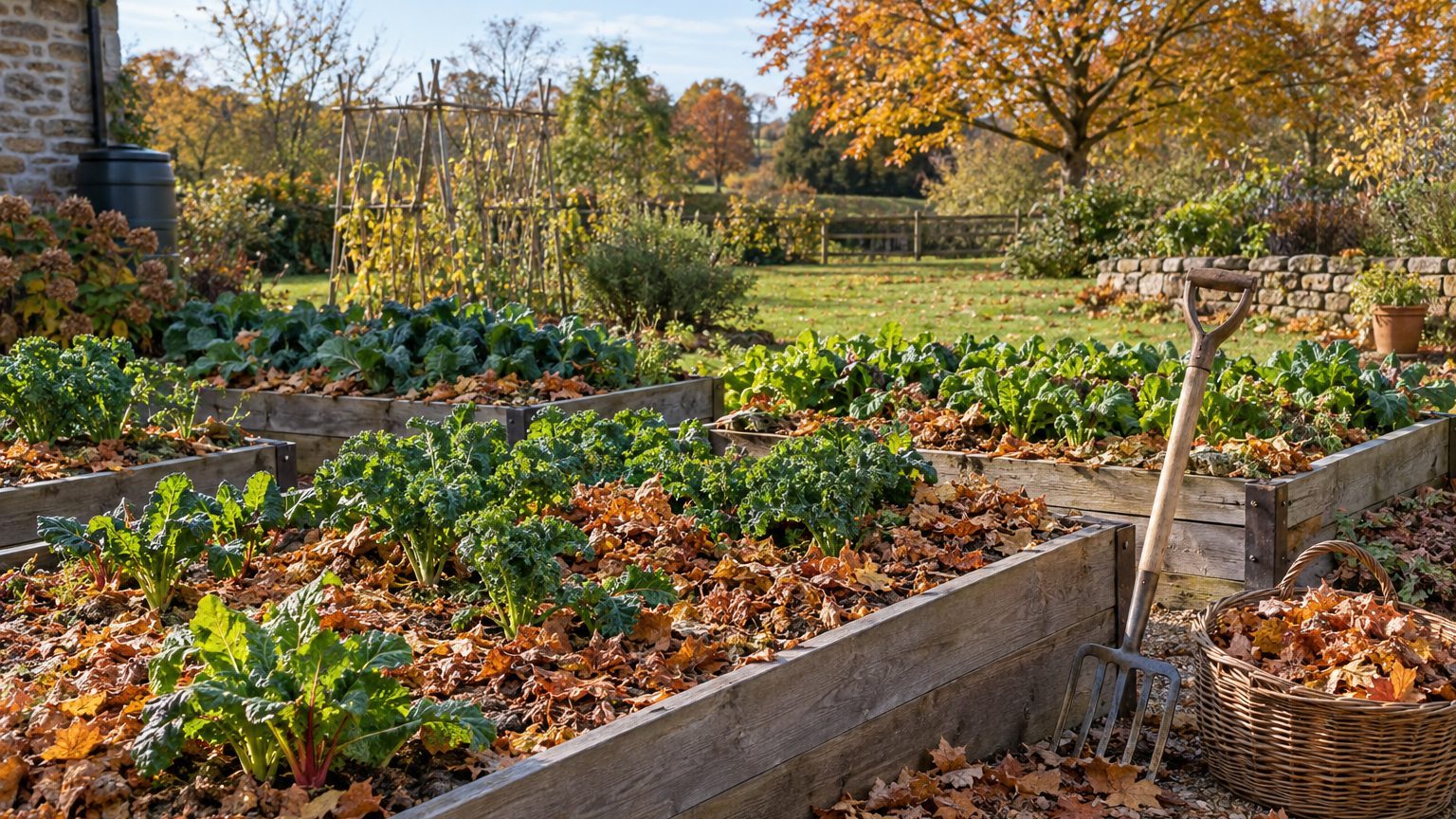
Yes, fallen leaves work well as mulch in a vegetable garden, with two conditions: shred them first, and keep the layer to roughly 2 to 3 inches. Extension specialists recommend shredding or composting leaves before they go on a bed, because whole leaves mat down, blow around, and break down slowly. Free, abundant and already sitting in your yard. For a vegetable patch, that’s hard to beat.
Leaves as mulch in the vegetable garden
A pass or two with the mower changes everything. Whole maple leaves fall flat and overlap like shingles, forming a water-resistant crust. A layer of whole leaves more than a few inches thick can block air and water from reaching the soil. Shredded leaves behave differently: they stay put, let rain through, and shrink fast (within about a week, according to University of Florida extension horticulturists, who also put the volume reduction from shredding and composting at around 90 percent). Twenty bags of raked leaves can become two.
Depth matters as much as shredding. An extension expert answering a gardener’s question put it plainly: leaf litter works around vegetables, and if the leaves are shredded, about 3 inches is plenty. A 2- to 3-inch layer also cuts weed seed germination in vegetable beds. If you’re working with whole leaves, spread them thinner, around 2 inches, and top up as the layer settles.
Our guide to how to shred leaves for mulch covers the tools. The short version is that a mulching mower does the job, and dry leaves chop far better than damp ones. Mow on a dry afternoon and make a second pass in a cross direction if the pieces still look big. Aim for fragments about the size of a dime.
Placement is the next detail. Spread the mulch between rows and around transplants, but pull it back a few inches from stems. Mulch piled against tomato or pepper stalks holds moisture against the bark-like base of the plant and invites rot. In a bed that’s already planted, think of the leaf layer as a blanket tucked in around the plants, not wrapped over them.
There’s also a second route for leaves you can’t use right away. Piled in a wire cage about 3 feet tall and wide, they turn into leaf mold in one to two years, faster when shredded. Leaf mold is mostly weed-free, unlike many composts and manures, which makes it a nice top dressing for seedlings. Both approaches are covered in more depth in using leaves as mulch, and the shredded route has its own page on shredded leaves as mulch.
Leaves as mulch: good or bad?
Mostly good, with a few real exceptions worth knowing before you start raking. The benefits are practical. A leaf layer holds soil moisture, moderates soil temperature, and suppresses weeds. As it decomposes, it feeds the soil organisms that build structure, so clay drains better and sandy soil holds more water. University of Minnesota Extension notes that decomposing leaves improve water infiltration, moisture retention and root growth. And you skip the cost of bagged mulch.
Leaves also carry nutrients. Trees pull minerals up from deep in the ground and park them in their foliage. University of Illinois Extension has estimated that a 2-inch layer of leaf mulch delivers roughly 150 pounds of nitrogen, 20 pounds of phosphorus and 65 pounds of potassium per acre. That works out to a modest but real contribution: about 3.4 pounds of nitrogen per 1,000 square feet, or roughly a third of a pound for a 100-square-foot bed. Not a fertilizer program. A slow top-up.
That brings up the first drawback. Leaves are carbon-heavy, with a carbon-to-nitrogen ratio typically around 60:1, and soil microbes borrow nitrogen from the soil to digest them. Spread on the surface, it’s rarely a problem, because the breakdown happens mostly at the interface and the soil below isn’t robbed. Tilled in fresh, it is a problem. University of Georgia Extension advises against tilling freshly fallen leaves straight into the soil for this reason. If you want to dig them in anyway, add a slow-release nitrogen source, or let them sit as mulch through winter and work in the softened remains in spring. University of Illinois Extension suggests a 6 to 8 inch layer of unshredded leaves if you till them in, and the leaves need months to break down.
The second drawback is which leaves you use. Black walnut leaves contain juglone, a natural compound that can stunt or kill susceptible garden plants, and tomatoes are among the best-known victims. English walnut has it at a much lower concentration. Pecan leaves have a similar reputation, and hickory to a lesser degree. Oregon State University Extension adds a useful nuance: walnut leaves carry the most juglone in spring and less in fall, and compost that heats up properly can break the compound down, so well-made compost containing walnut leaves can go on a vegetable garden. But the distance between the tree and your beds matters, since roots are the bigger delivery route. Where walnuts stand near the garden, skip the fresh leaves as mulch entirely.
Third, disease. Leaves showing powdery mildew should be removed rather than reused, since spores can overwinter and reinfect. If a plant in your garden had a serious fungal problem this season, the clean-up pile is the safer destination for its leaves, not the mulch bin.
Thick evergreen broadleaf leaves, such as Southern magnolia, break down slowly. They belong in the mulch pile only after thorough shredding. On balance, ordinary maple, oak, birch, linden and fruit-tree leaves are safe for vegetable beds, and an extension specialist who fielded this question said they knew of no common tree or shrub leaves that would harm vegetables, with the walnut family as the established exception.
Leaves as mulch over winter
Winter is where leaf mulch earns its keep. Bare soil in the vegetable garden takes a beating from rain and snowmelt, and nutrients wash out with it. A layer of chopped leaves over empty beds holds the soil in place through the winter. By spring, a 2-inch layer of shredded leaves on a bed has typically broken down into soft brown mulch. Whole leaves take considerably longer.
For the crops still in the ground, leaves act as insulation. Spread around the base of root crops and hardy vegetables in late fall, they offer protection against freezing, according to University of Illinois Extension. Carrots, parsnips, leeks and kale are the usual candidates. Pile them on after the soil has cooled, not during a warm spell, or you’ll give mice a cozy overwintering spot right next to your crops.
Garlic gets a heavier blanket. Colorado State University Extension suggests roughly 6 inches of leaves over fall-planted bulbs and garlic, which stabilizes soil moisture and temperature and keeps freeze-thaw cycles from heaving newly planted cloves out of the ground. Plant the garlic first, water it in, then add the leaves. In spring the shoots push through without any help, as long as the layer is loose and the leaves have been shredded.
Spring needs a plan, too. In a no-till bed, the partly decomposed mulch can stay where it is. University of Georgia Extension describes a 2-inch layer of leaf mold as an extremely effective mulch for no-till gardens, and it also slows nutrient and soil loss during heavy spring rains. In the cooler regions it’s wise to rake the mulch aside for a couple of weeks before planting warm-season crops so the soil can heat up, then draw it back around the transplants. Leftover whole leaves can go on the compost pile, where they supply the carbon that kitchen scraps and grass clippings lack.
A last point for wildlife-minded gardeners. Shredding can injure or kill the moth and butterfly caterpillars and cocoons that shelter in leaf litter, so extension experts say whole leaves are the more ecologically helpful choice. A sensible compromise: shred what goes on the vegetable beds, where matting is a genuine problem, and leave a loose pile of whole leaves at the edge of a hedge or under a shrub for the insects that winter there.
Sources : extension.illinois.edu | extension.oregonstate.edu | extension.psu.edu