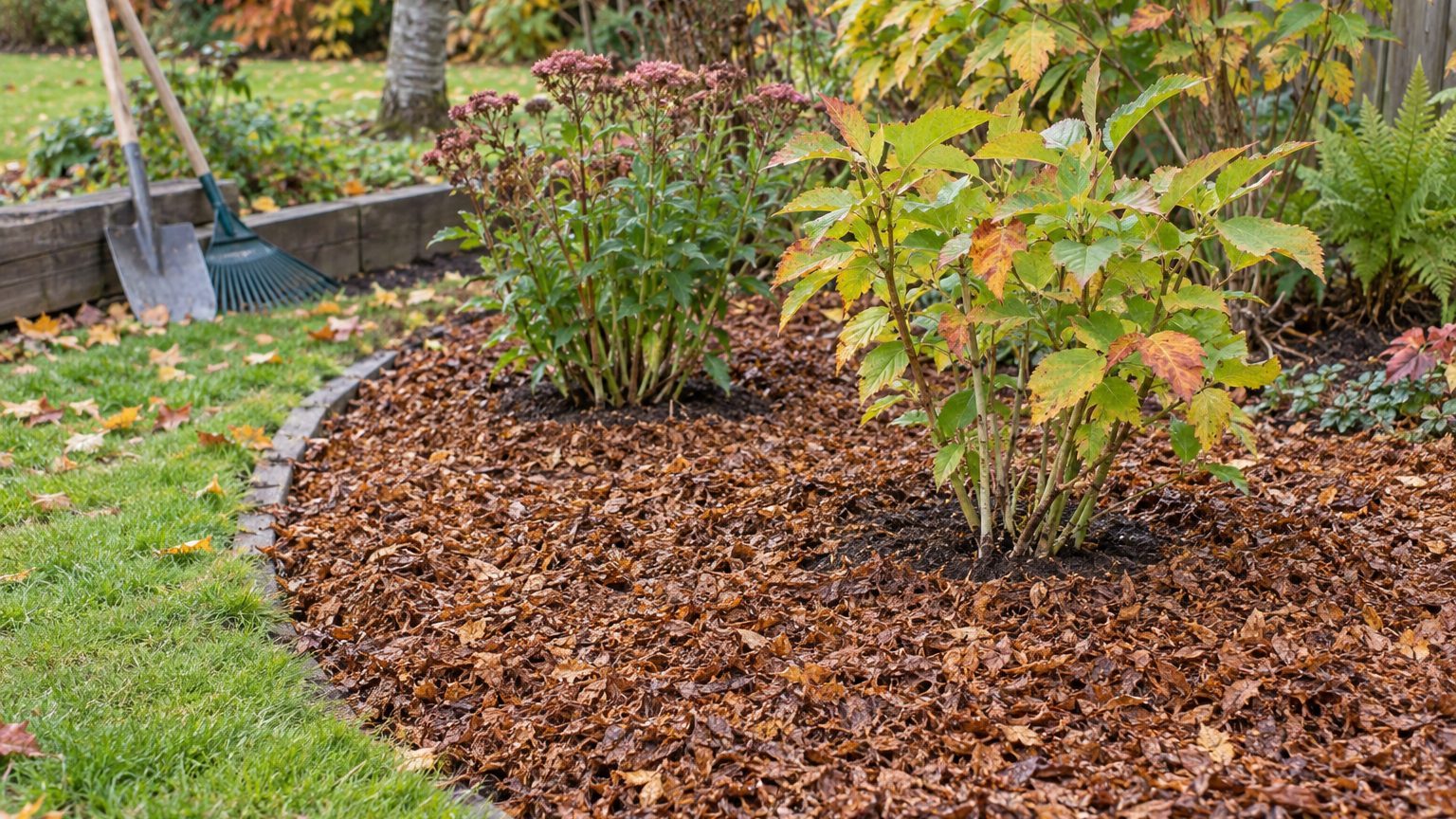
Spread shredded leaves 2 to 3 inches deep over beds. Keep the mulch about 4 inches off stems and trunks, and water it once so it settles. That depth works in most flower beds, vegetable plots and raised beds. Shredding is what makes it work.
Shredded leaves tend to mat down less than whole leaves
, and a mat is a common way leaf mulch fails.
Shredded leaves as garden mulch: depth, spacing and staying power
Whole maple or sycamore leaves behave like wet paper. They stack flat, dry into a crust, and shed water instead of passing it down.
Thicker layers of whole leaves can block water and oxygen as they break down and compact.
Cutting the leaves into small pieces breaks that seal and lets rain reach the soil.
Extension recommendations differ a little by planting. Penn State Extension suggests
a 2 to 4-inch-thick layer around trees and shrubs or on perennial beds
. Texas A&M’s Earth-Kind program says
3 to 6 inches around the base of trees and shrubs, and 2 to 3 inches in annual and perennial flower beds
. For most flower and vegetable beds, 2 to 3 inches is a safe starting point; go toward the thicker end around trees and shrubs. You can always add more later.
Spacing matters as much as depth. University of California advisors recommend
keeping the mulch a good four inches away from stems and trunks to prevent rot
. Leave a small bare ring around each crown and let the mulch fade out toward it, like a donut and not a volcano.
Then water the layer.
Watering the leaf mulch after application helps it stay in place.
On a windy site, gardeners often lay chicken wire or a few evergreen boughs across the top until the leaves settle. It looks improvised, but it beats chasing leaves across the yard.
The payoff is the standard mulch package.
Leaf mulch helps moderate soil temperatures, retain soil moisture and keep down weeds.
University of Florida extension specialists add that
a 2-3 inch layer in plant beds and vegetable gardens reduces weed seed germination
. You also get a quick return of nutrients to the soil. As the leaves decay, they feed earthworms and soil microbes and leave organic matter behind.
One caution from the ecology side. Extension experts note that
whole intact leaves protect more of the insects that shelter in them, and shredding can injure moth or butterfly caterpillars and cocoons
. A reasonable compromise: shred what goes on vegetable and flower beds, and leave a loose, unshredded drift under a hedge or in a back corner.
If you haven’t made the mulch yet, the process is simple. A mower with a bag does most of the job, and our guide on how to shred leaves for mulch covers the passes and settings. No mower, or no yard big enough to justify one? There are workable options in how to shred leaves without a shredder. For the bigger picture of leaves in all forms, see using leaves as mulch.
Shredded leaves in the garden: vegetables, flowers and lawn
Vegetable beds are where leaf mulch earns its keep. Extension answers on the topic say that
around vegetables, a few inches (about 3) of shredded leaves should be fine
, and the same experts are
not aware of any tree or shrub leaves that would harm vegetable plants
. That includes the oak worries that circulate in gardening groups. Black walnut is the possible exception, since its leaves contain juglone, which can harm sensitive plants such as tomatoes, so keep those leaves out of vegetable beds. Oak leaves do break down more slowly, but
they make a fine leaf mulch as long as they’re shredded first
.
Timing changes the depth. Between growing seasons you can go heavy. Colorado State University Extension suggests adding
a six- to eight-inch layer of leaves, chopped by a lawnmower if possible, directly into the vegetable garden, then moistening it and adding a bit of fertilizer to speed decomposition
. By spring,
you can till the leaves into the soil or plant directly into the enriched area
. That same office also warns that
it’s wise to test your soil first to avoid over-amending
.
Once plants are growing, the layer should be thinner. Keep the layer to about 3 inches around transplants, pulled back from their stems, and don’t bury seedlings. The walkways deserve some of the pile too. Texas A&M notes that
a thick layer of leaves between the rows works as a mulch and an all-weather walkway
, so you can work in the garden during wet spells without tracking mud.
Tender plants are another use. For a young shrub or a marginal perennial,
place a wire cage around the plant and pile three to six inches of shredded leaves inside it
. Remove the cage and leaves when growth resumes in spring. A wire cylinder holds the leaves in place and makes an insulating jacket that is easy to remove.
The lawn follows different rules. Here the layer should be nearly invisible. Penn State puts the beneficial range at
up to about one-half inch
, while University of California advisors say
about one inch, spread thinly so the grass blades show through
. A simple test from Colorado State:
if you can see some grass through the leaves, the layer isn’t too thick
. The research is reassuring.
A Michigan State University study found that mulching leaves into the lawn reduced dandelions and crabgrass after three years, and Purdue research found that high rates didn’t affect turf quality, color or soil pH.
Anything thicker than the grass can poke through should be raked into the beds.
Shredded leaves in raised beds
Raised beds drain fast and warm up early, which makes them dry out faster than ground-level soil. A mulch blanket helps with that. Like straw,
shredded leaves create a protective layer that conserves moisture, suppresses weeds and regulates soil temperature
. They’re also light and easy to spread by hand in a 4-by-8 frame, where a wheelbarrow of wood chips would be awkward.
For summer crops, mulch after transplanting, once the soil has warmed. A 2 to 3 inch layer is the right starting point for raised beds. Gardeners who mulch heavily report that
a 3 to 4 inch layer of shredded leaves saves hours of weeding and watering
, but in a small bed with tight spacing, 3 inches is plenty. Keep the leaves off crowns and stems, especially on tomatoes, squash and anything prone to rot.
Nitrogen is the common worry. Fresh leaves are carbon-rich, and microbes pull nitrogen from the soil as they work. In practice, the effect stays shallow. According to one raised-bed guide,
shredded leaves still draw some nitrogen, usually only from the top inch or so, which makes them less ideal for shallow-rooted plants but fine for deeper-rooted crops
. If your lettuce or radishes look pale under a leaf blanket, a side-dressing of compost or a nitrogen-rich fertilizer usually corrects it.
Fall is the other window, and it needs less precision. Empty beds benefit from a leaf blanket because
topdressing empty vegetable beds with shredded leaves in late autumn helps prevent winter soil erosion
. Come spring,
you can turn the half-rotted mulch into the soil or transplant seedlings through the layer
. Colorado State treats raised beds the same as in-ground gardens, advising that
leaves can be added to garden beds or raised beds, up to six to eight inches yearly, ideally shredded or chopped by the lawnmower
. That number sounds huge until you see it settle.
And it does settle. University of Florida specialists report that
shredded leaves shrink within a week and compost faster than whole leaves
, and that
shredding and composting can reduce leaf volume by 90 percent
. A pile that looks excessive in early November will sit noticeably lower by the time the ground freezes. That’s why University of California advisors say
you can add more leaves as the layer breaks down
. Top up through winter and spring rather than building one tall layer on day one.
Sources : aggie-horticulture.tamu.edu | cmg.extension.colostate.edu | extension.psu.edu