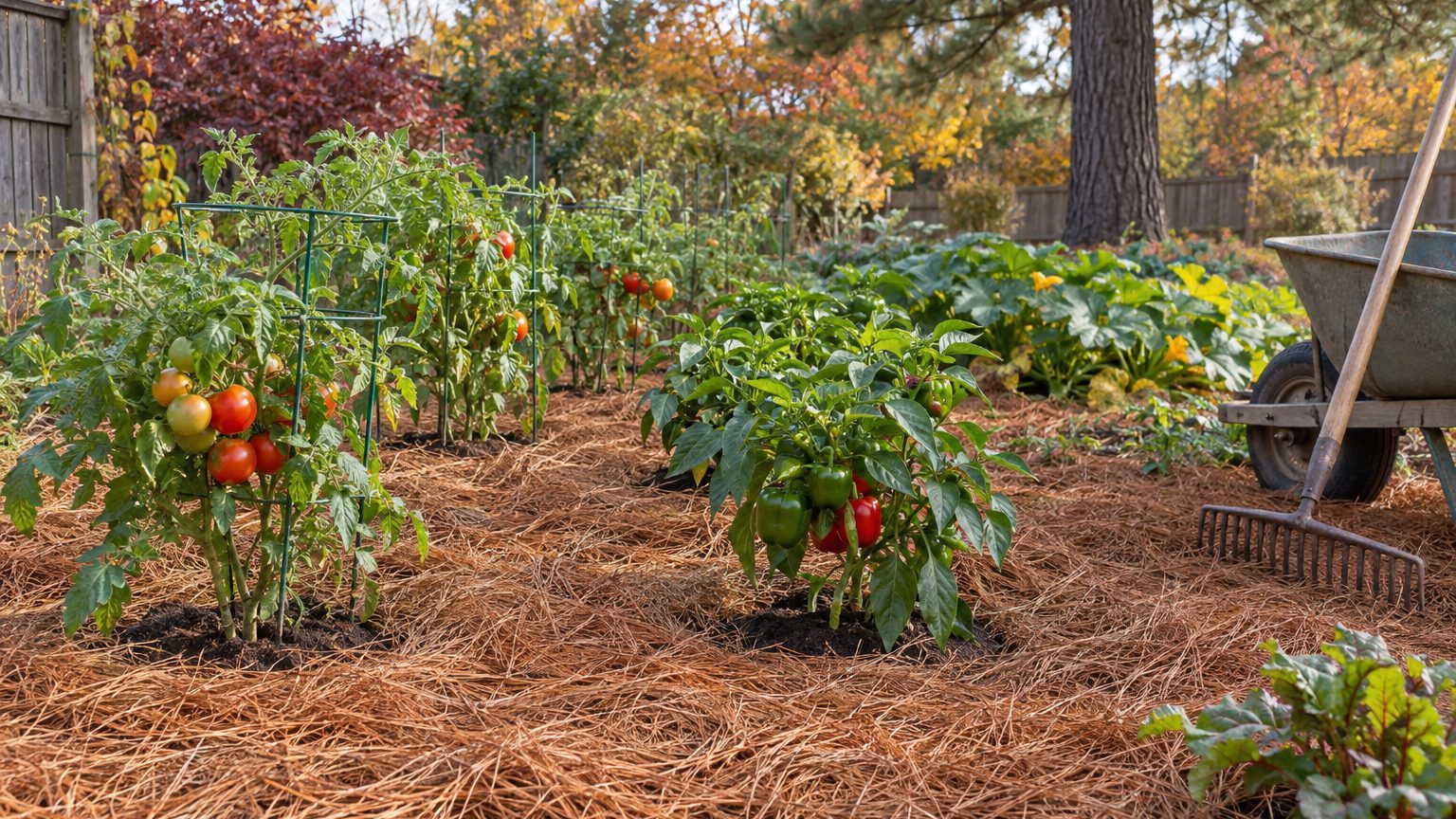
Yes, pine needles make a very good mulch, and the old warning that they will sour your soil doesn’t hold up.
Even a 2 to 3 inch layer of pine mulch will not change the soil pH enough to measure
, according to University of New Hampshire Extension. Rake them, spread them 2 to 4 inches deep, and keep them a few inches from stems and trunks. The rest of this guide covers the fine print: what pine straw does well, where it frustrates, and how to use it around vegetables and blueberries.
Pine needles as mulch: pros and cons
Start with the myth, because it decides whether most people even try. Fresh needles really are acidic.
Oregon State specialists put their pH at 3.2 to 3.8 when they drop from a tree
, against a neutral 7.0. The leap from that number to “they acidify my garden” skips a step, though.
As needles break down and are incorporated into the soil, decomposing organisms gradually neutralize them.
NC State soil scientists add that soils generally have more buffering capacity than a mulch layer can overcome.
So why does grass struggle under pines? Mostly it isn’t chemistry.
Difficulty growing under evergreens usually results from root competition and shade, not acidity
, says an OSU Extension horticulturist. And the acidic soil beneath old pines was there first:
the soil near pines is often quite acidic, but the tree did not determine the soil pH
.
One honest caveat.
Oregon State notes that fresh needles turned directly into the soil may cause a slight drop in pH
, but surface mulch in a real bed is a different situation. If you’re unsure where your soil sits, a soil test costs far less than guessing.
On the plus side, the list is long.
Pine needles conserve soil moisture, suppress weeds, add nutrients, moderate soil temperature and keep fruit clean during heavy rains.
They also behave differently from wood mulch.
They stay loose and light instead of forming an impenetrable crust
, so water gets through.
They can hold on slopes where other mulch washes away, and they last longer than most organic mulches.
A single pine in the yard can supply a surprising amount, and the price is a rake and a free afternoon.
The drawbacks are real, just not the ones people argue about. Needles are slow to decompose, which cuts both ways.
Slow breakdown means less need for reapplication
, but it also means they add organic matter to the soil more gradually than shredded leaves do. A garden library at the University of Washington also notes that
earthworms are not fond of them
. And in fire country, a dry carpet of needles against the house is a liability. Oregon State’s advice to leave needles where they fall comes with the qualifier
“if you’re not in a wildfire prone area”
. Keep needles away from siding, decks and vents in dry regions.
Appearance is a matter of taste. The fine, russet texture looks tidy against shrubs and perennials, though some gardeners find it too uniform for a flower border. Short needles also pack down more densely than long ones, so loosen the layer with a rake if it starts to mat after heavy rain. It’s the same trade-off you’ll find with the using leaves as mulch approach: coarse and airy beats fine and flat.
Pine needles as mulch in the garden
Where do needles earn their keep? Shrub borders, perennial beds, paths and slopes are the easy wins.
UNH Extension says there is no harm in using them to mulch shrub borders, flower beds and vegetable gardens.
Under shrubs and trees, a layer of 2 to 4 inches is a reasonable target.
NC State Extension says that most perennials, trees and shrubs’ roots are well insulated from winter cold under a 2 to 4 inch layer of mulch in North Carolina.
That makes late fall a good moment to spread it, since you’re probably raking anyway.
Thickness matters more than most people think. Needles let light through gaps, so a thin skim won’t stop weeds. A thicker layer will block light, although a University of Washington library answer, citing a mulch handbook, mentions as little as 1 to 1.5 inches for some plants. If weeds are a problem, start at 3 inches, pull what pokes through, and top up in spring. Whatever you choose, don’t pile needles against trunks or stems. Leave a few inches of bare ground around each plant so moisture doesn’t sit against the bark.
Vegetable beds are where opinions split, and the practical downside is annual replanting. Annual beds get disturbed constantly, and needles tangle around seedlings, hoe blades and transplant holes. A workable compromise is to mulch only after seedlings are established, or to use needles on paths and between rows where nothing gets turned over. For tomatoes, peppers and squash, the payoff is clean fruit. Mulch keeps soil from splashing onto the plant in a downpour, which is the same effect UNH Extension notes for
keeping plants and fruit clean during heavy rains
.
Needles also work well mixed with other materials. Many gardeners layer them over compost or blend them with shredded leaves, since oak or maple leaves break down faster and feed the soil sooner, while the needles hold the structure open. If you go that way, the guides on shredded leaves as mulch and how to shred leaves for mulch cover the leaf side of the recipe. You can chop needles too. A shorter cut breaks down faster, which the University of Washington reference suggests when you want quicker decomposition. A pass with a mower on a high setting, or a few runs of a shredder, is enough.
Pine needles can go in the compost pile as well. Add them in thin layers alongside greens like kitchen scraps or grass clippings, so they don’t form a dry, springy mat that takes years to rot.
Pine needles as mulch for blueberries
Blueberries are a crop where pine straw has a loyal following. The belief behind it is the very myth above: that needles lower pH. Blueberries need strongly acidic soil, and
NC State Extension wants the pH at 5.0 or below for highbush and 5.3 or below for rabbiteye
. An extension answer on the subject is direct:
pine needles do not add much acidity, so don’t look to them to acidify; for blueberries, you usually mix sulfur or sphagnum peat into the planting area.
That sets the order of operations. Test the soil first, then correct the pH before planting, then mulch. If you start at pH 7 and spread needles on top, you’ll most likely still be near pH 7 two years later, and the bushes will show it with yellowing leaves. Pine straw is a maintenance mulch here, not a fix.
It’s still a good choice for blueberries, for practical reasons. Blueberry roots are shallow and sensitive to heat and drought, and NC State Extension says that
a 3 to 4 inch surface mulch of organic material such as bark, wood chips, sawdust or pine straw gives more uniform soil moisture, lowers soil temperature and generally promotes better bush growth and survival
. Needles are lightweight and won’t crust over, so rain and irrigation reach the roots. In the Southeast, where pine straw is commonly baled and sold, it’s a standard material for home blueberry plantings.
For application, one extension specialist recommends keeping the mulch flat and spread around the plant, not heaped up.
The mulch should be flat in this area, not piled up higher around the plant, and you should not see a “volcano” of mulch.
That same specialist suggests adding another 2 to 3 inches every couple of years as the layer breaks down. For a young bush, spread the needles in a circle roughly 2 feet out from the base, or lay a wider strip along a row. Pull the layer back from the canes by a couple of inches so the crown stays dry.
If you’re buying bags instead of raking your own, look for long-needle pine straw. It knits together, which keeps it in place in wind and rain, and it breaks down more slowly than short needles. Southern longleaf pine needles are the ones prized in the trade. NC Cooperative Extension notes that
there is a large industry in North Carolina to produce this product
.
Pine bark is the other common blueberry mulch, and the two aren’t rivals. Bark chips and sawdust from pine have a lower pH than hardwood equivalents. NC State Extension puts
pine bark, chips or sawdust at pH 3.5 to 4.5, more desirable than hardwood mulches with a pH above 5.0
. A layer of bark with needles on top gives you a mulch that’s both attractive and slow to wash away. Avoid mulching only with compost or manure. One extension reply warns that
such products can have a pH of about 7 to 8 and shouldn’t be used alone as mulch
around blueberries.
Mid-winter brings a small bonus: a bare Christmas tree can supply needles in January (many are fir or spruce rather than pine, and flocked or treated trees should be skipped), though you’ll need to strip them by hand and spread them promptly. Fresh needles are acidic, but the same buffering logic applies at mulch rates. The change in pH would be modest, so keep sulfur and a soil test in your plan.
One last practical point on timing: needles settle over the first few weeks, so apply a little more than your target depth and check it by spring. A 4-inch layer in November may be 3 inches by March, which is right where the blueberries want it.
Sources : content.ces.ncsu.edu | depts.washington.edu | extension.oregonstate.edu