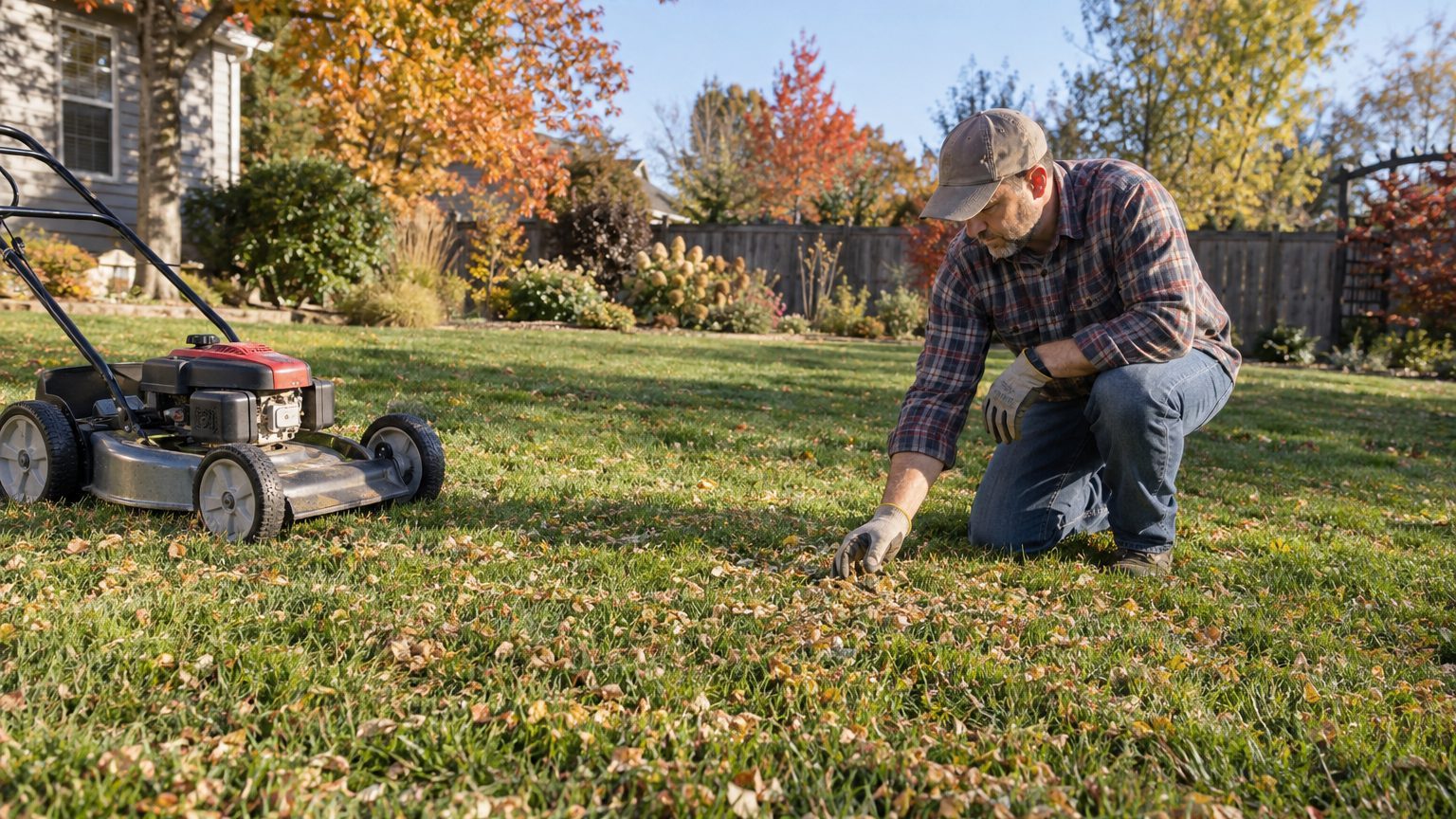
Set the mower deck to its highest position, wait for the leaves to dry, and mow over them until the pieces look like corn flakes. Then leave the shreds on the lawn. Colorado State Extension recommends
setting the mower’s deck to the highest setting
. Washington State University’s master gardener guidance adds that the cutting height should be
no lower than 3 inches, with dry leaves
. The same fall rhythm of mulching leaves with a mower works for most yards with a few free hours each week.
Mulching leaves with a mower: settings, timing and number of passes
Most of the work happens before the engine starts. Dry leaves chop cleanly. Soggy ones don’t. Virginia Cooperative Extension says moist leaves keep dust down, but
leaves that are too wet strain the mower’s engine and don’t chop into pieces small enough to decompose
. If it rained yesterday, wait a day. The leaves will still be there.
Blade condition matters more than most people expect.
Sharp blades and slow passes shred leaves better, which speeds up decomposition
. The target is the same corn-flake texture, or roughly
half-inch pieces, about the size of a dime
. A dull blade tears leaves into ragged strips that mat together. A sharp one slices them into fragments that fall between the grass blades.
How deep a layer can you tackle? Michigan State University research indicates that
up to 6 inches of leaves can be mulched at a time, though this varies with the size and performance of your mower
. Treat that as a ceiling, not a goal. A walk-behind mower with a basic deck will struggle long before a heavy-duty rider does. If the layer is deeper than your machine likes,
multiple passes may be needed to chop the leaves thoroughly
.
The easiest check takes five seconds. After mowing, look down.
If you can see ½ inch of grass through the mulched leaves, the lawn is getting enough sunlight for photosynthesis
. If you only see brown, make another pass or two, crossing your first direction.
Frequency is where most people go wrong. Waiting until every leaf is down and then facing a knee-deep carpet invites trouble. One Washington State University gardener’s guide notes that leaves should be mowed regularly,
perhaps as often as every 3-4 days
at peak drop. Pennington’s lawn guidance is gentler, suggesting
at least once a week, twice if needed
. Pick whichever matches your tree canopy. A single maple keeps you busy for two weeks. A yard ringed with oaks keeps you busy into December.
Equipment doesn’t have to be fancy. Virginia Cooperative Extension calls a mulching mower
an effective tool to chop leaves directly back into the turf canopy without negatively impacting the turf
. A regular mower can do the job, though
it may require a few trips back and forth
. If your mower has a bagging attachment, MSU suggests a hybrid approach:
alternate between mulching into the turf one week and collecting the ground leaves
for use in landscape beds and the vegetable garden. For a deeper walkthrough of equipment and technique, see mulching leaves with mower.
Two small habits protect your machine. Keep the blade sharp, and clean the air and fuel filters. Virginia Cooperative Extension notes that
repeated fall mulching goes better, and your engine lasts longer, when blades are sharp and filters are clean
. Leaf dust is hard on an air filter.
Leaves that collect in planting beds, along fences or against the garage don’t have to be handled separately. MSU’s turf bulletin says you can
rake leaves from beds, fence lines and other areas out into the lawn and mow them
. That turns one scattered cleanup into a single mowing job.
Why mulched leaves are good for the lawn
The research history is a little ironic. In the 1990s, a ban on yard waste in landfills pushed Michigan State turfgrass specialists to study what happens when you leave the leaves in place.
They noticed several benefits, including needing less fertilizer to get spring green-up
. The researchers were trying to solve a disposal problem and ended up with a lawn-care technique.
The headline result is about weeds. MSU Extension reports that
dandelions and crabgrass can drop by nearly 100 percent after three years of mulching leaves
. The mechanism is physical, not chemical.
The decomposing leaf pieces cover the bare spots between grass plants, which are where weed seeds like to germinate
. Colorado State Extension describes the same effect:
the small pieces sift down onto the soil surface and prevent germination from bare soil
. That figure is a best-case result from long-running turf plots, not a promise for a thin, patchy lawn in its first fall. Even so, a layer of free mulch that works while you do nothing is hard to argue against.
Feeding the soil comes next. Tree leaves carry nutrients the tree pulled up from deep in the ground. A Colorado State blog post summarizing the MSU work says
most leaves contain 1-2% nitrogen
, and notes the effect shows up as quicker spring green-up. Beyond nitrogen, Colorado State Extension says
mowing leaves in raises soil organic matter, and its nutrients become available to the lawn over time
. That same organic matter
is the base of the soil food web
. Washington State’s guidance adds that
mowing leaves into the lawn returns nutrients to the soil, provides food for earthworms, and increases moisture for the turf roots
.
Don’t cancel your fertilizer order on this alone, though. Virginia Cooperative Extension’s review found that
the leaves did not prove to be a substitute for appropriate nitrogen fertilization, although mulching was very positive and economical overall
. Think of leaf mulch as a supplement that trims the bill over the years.
What about the usual worries? Turf damage first. Purdue University found that
mulching leaves into the lawn at high rates did not affect turf quality, color or soil pH
. MSU’s bulletin says
more than 6 inches of leaves were mulched into turf in its studies, including oak and maple, with no adverse effects
. A three-year New York study published in 2024
reported advantages in overall turfgrass quality and soil health compared with leaf removal
.
Thatch comes up too, since the pile of brown shreds looks like the start of a spongy mat. Colorado State Extension says plainly that
mulching leaves into the lawn does not lead to thatch accumulation
. The shreds also don’t stay visible for long. MSU says the residue
will sift into the turf within a few weeks and be unnoticeable in the spring
. In rainy weather,
visible shreds can settle within a day or two
.
Mulching vs. bagging: where the line falls
Mulching wins for most yards, but it isn’t unconditional. Whole or poorly chopped leaves are the real hazard. Virginia Cooperative Extension warns that
a thick layer blocks sunlight and reduces turf growth, and it also traps moisture in the canopy, which raises the chance of turf disease
. MSU adds a winter scenario:
piles of leaves under wet, heavy snow can spell disaster for the turf plant below
. A matted blanket of whole oak leaves is the outcome you are trying to avoid.
So the practical rule is simple. If the mower can chop the leaves and you can still see grass afterward, mulch. If the leaf layer is too deep for your machine, too wet to chop, or still lying whole after several passes, rake or bag the excess. A few situations demand removal anyway. Virginia Cooperative Extension notes that for some turf uses, such as
golf courses where finding or playing a ball in leaves is next to impossible
, blowing, raking or vacuuming is the sensible choice. Most backyards don’t have that problem.
Cost and waste matter as well. MSU Extension points out that
in fall, your trash can be as much as 50 percent yard waste in some areas
. Every bag you don’t fill is a bag you don’t haul. The full comparison, including time, cost and what each method does to the soil, is in mulching leaves vs bagging.
Bagging doesn’t have to mean the curb. Leaves you collect can go to better uses. The most flexible is a compost pile, where shredded leaves supply the carbon-rich “brown” material. Our guide on how to compost leaves covers ratios and timing. If you have space and patience, leaves can also sit in a simple pile for a year or two and break down into dark, crumbly leaf mold, which is explained in how to make leaf mold. MSU suggests using ground leaves in beds because
covering bare soil with them prevents winter annuals from germinating and adds organic matter to the garden
.
The right mix depends on your yard. Some owners mulch the lawn’s share, bag the overflow for the vegetable beds, and compost the rest. For a wider view of the options, see what to do with fallen leaves.
One last nuance on thatch. Colorado State horticulturists point out that it depends on grass type, not on leaves.
Bluegrass and bentgrasses are thatch formers, while tall fescue and perennial ryegrass are not
. A bluegrass lawn
will build thatch whether or not you collect clippings or leaves
. If your lawn already has a thick mat, deal with it separately, and don’t blame the leaves.
Sources : scottsmiraclegro.com | monroe.cce.cornell.edu | pennington.com