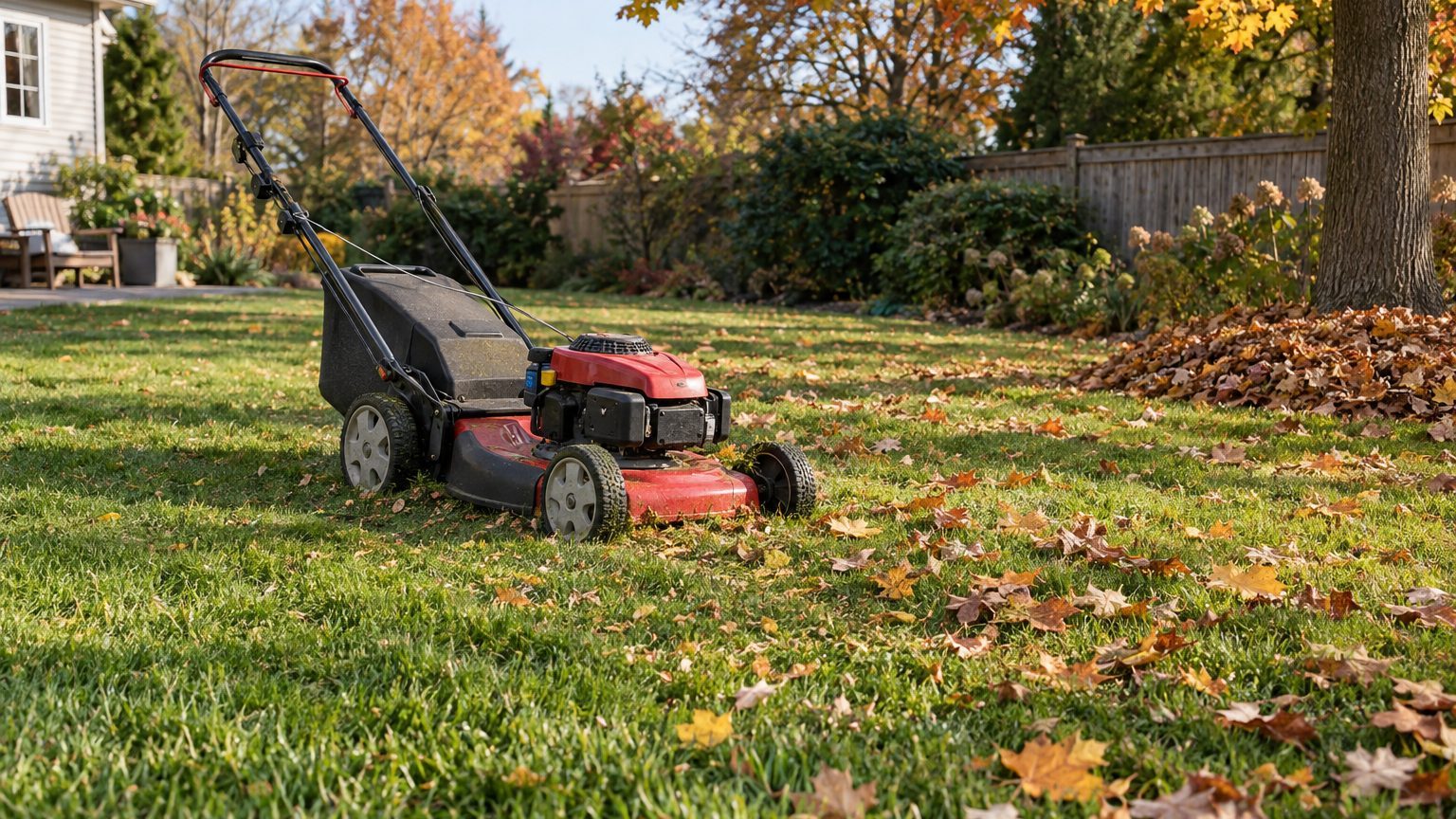
Yes, a regular mower can mulch leaves. Run it over dry leaves, ideally with a mulching blade or mulch plug fitted, until the pieces are about the size of a dime or smaller and you can see grass through them. Thin to moderate layers don’t need raking first. Deep, matted or wet leaves do: rake some off, mow in lighter passes, or wait for a dry day.
Mulching leaves into lawn
Mower mulching works when the chopped bits are small enough to sift down between grass blades. Leaves cut to dime size or smaller drop into the canopy and rot there. Bigger flakes sit on top, mat together and block light. That’s the whole difference between feeding turf and burying it. For the lawn-health reasoning behind the practice, see our guide to mulching leaves into lawn. This page covers the machine and the procedure.
The research is reassuring. Michigan State University researchers mulched oak and maple leaves into Kentucky bluegrass at about 100 pounds of dry leaves per 1,000 square feet. MSU Extension says up to 6 inches of leaves can be mulched at a time. A Virginia Cooperative Extension summary of that work adds that the ceiling depends on the size and performance of your mower. MSU’s long-running leaf-mulching trials found no change in soil pH after six seasons of mulching leaves into turf. Penn State Extension notes that the small pieces add organic matter and return nutrients the grass can take up. Treat that as a modest bonus, not a replacement for fertilizer.
Should I rake leaves before mowing
Raking first is a judgment call based on leaf depth. It isn’t a rule.
Skip it when grass blades still show through the leaves. A single pass handles that, and so does a second one at right angles if the first leaves visible flakes. Michigan State’s turf research used two passes with a mulching mower to grind leaves finely enough to sift into the turf. During heavy drop, mow weekly, or twice a week after a windstorm, so the layer never gets deep.
Rake, blow or spread leaves out first in three cases. The first is wind-drifted piles against a fence or bed edge, where the mower would bog down. The second is leaves so deep the grass has vanished. The third is a soggy mat that has been lying there for days. Pick up sticks, stones and wire either way, since the blade can throw them. Move a few wheelbarrow loads off the worst spots and you’ve usually solved the problem.
Should I rake leaves or mow them
Mow when the layer is light to moderate and the leaves are dry. Rake when they’re deep, wet or matted. The table below sorts the common situations.
| Leaf condition | What it looks like | Rake first? | Mowing approach | Check afterward |
|---|---|---|---|---|
| Light, scattered | Grass clearly visible | No | One pass with the mulch plug or mulching blade, at your normal fall height | Leaf bits mostly gone from sight, grass showing |
| Moderate layer | Grass partly hidden | No | Two passes, the second crisscross, at a slow pace | Pieces dime-sized or smaller, grass visible through them |
| Heavy or deep | Grass buried, leaves piled up | Yes: rake, blow or spread some off | Several lighter passes, crisscross, slow speed | No clumps or windrows; the deck isn’t packing |
| Wet or matted | Leaves stuck together in a soggy layer | Rake off the worst of the mat | Wait for a dry day, then mow in lighter passes | No clumps left on the turf, no buildup under the deck |
| Large-leaf trees (oak, maple) | Big whole leaves overlapping | Only if the layer is deep | Extra crisscross pass with a mulching blade | No whole or half leaves on the surface |
Mowing is also the easier choice in yards with a few big trees, since the leaves arrive over weeks and a weekly mow keeps ahead of them. Raking makes more sense around dense evergreens or on steep slopes. The full mulch-versus-bag comparison lives on a separate page.
How do you mulch leaves with a mower step by step?
Set up the mower and check the area
Walk the lawn first and pick up sticks, stones, wire and toys. Fit the mulching blade or mulch plug, and remove the bagger. Check that the blade is sharp. A dull one tears leaves instead of cutting them, so you need more passes and the engine works harder. Wear eye and ear protection, plus a dust mask if the leaves are dusty.
Mowing pattern and number of passes
Mow forward at a walking pace and overlap each row by about a third. Vary the direction on the second pass, because crisscrossing sends fragments back under the blade. Light layers need one pass and moderate ones two. Deep layers may need three lighter ones. Extension guidance generally calls for at least two passes, with more for heavy coverage.
How to check the results before you put the mower away
Look back across the lawn. You should see grass blades, pieces about the size of a dime or smaller, and no clumps or windrows (the long ridges the deck leaves when it can’t keep up). If you can’t see grass after two passes, rake some off and go over it again.
Before you store the mower, run through this checklist of common mistakes:
- Scalping the lawn by dropping the deck too low
- Mowing too fast for the blade to recut the leaves
- Leaving windrows instead of spreading them
- Skipping blade sharpening
- Ignoring safety: clear debris, push forward only, and stop the engine and disconnect the spark plug before clearing a clogged chute
On slopes, follow your manual. Walk-behind manuals generally say to mow across the face, while riding-mower manuals often say up and down. Many manuals say not to mow slopes steeper than 15 degrees.
What mower blade and settings work best for mulching leaves?
Mulching blade vs. standard blade
A mulching blade has extra cutting edges and a curved profile that keeps leaves circulating under the deck for repeated cuts. A mulch plug does the same by closing the discharge opening. Virginia Cooperative Extension notes that mulching mowers are preferred, but almost any rotary mower will do. A sharp standard blade can handle light layers with extra passes. A dull one just tears.
Riding mowers and lawn tractors often accept a mulch kit. Check your manual before buying one. Electric mowers vary, so follow the manufacturer’s mulching and wet-grass instructions. Some manuals say to remove the plug when you switch to bagging, and others say never to remove it at all. If a deep layer overwhelms the mower, a bagger attachment is the fallback.
Cutting height, speed, and discharge setting
Keep the deck at your normal fall height or nudge it up slightly. A little extra height gives the chopped pieces room to drop into the grass instead of sitting on top, and it prevents scalping. The one-third rule still applies: don’t remove more than a third of the grass blade in one mowing. A manual for one mulching mower says to avoid cutting more than 1.5 inches off at a time.
Go slowly so the blade can recut the leaves. Close the side discharge, or use the mulch setting, so the leaves stay under the deck. Side discharge flings leaves out in a line, which means windrows.
Can you mulch wet leaves with a mower?
Why wet leaves clump and clog the deck
You can, but it’s the worst time to try. Manuals say it plainly: wet grass and leaves tend to clump and can plug the mower or stall the engine. The wet pieces stick to the underside of the deck instead of circulating, so the mower leaves soggy lumps that smother the turf. Wet ground is also slippery, and several manuals warn against mowing wet grass for safety reasons.
What to do if you can’t wait for a dry day
Wait for a dry afternoon when you can. If you can’t, rake off the worst mats and mow the rest in lighter passes at a slower pace, with the deck a bit higher. Stop when the deck starts packing, tip the mower safely (engine off, spark plug disconnected) and scrape the underside clean. If it keeps clogging, quit and try again when things dry out.
Frequently Asked Questions
Will mulching leaves with a mower hurt my grass?
Not when the pieces are small and the layer is manageable. MSU’s multi-year trials found no negative effect on turf quality, and some found fewer weeds. Harm comes from thick mats of coarse or wet leaf pieces that block light.
Can a regular mower without a mulching blade chop leaves?
Yes, with limits. A sharp standard blade can handle light layers if you make extra passes and close the side discharge. Mulching blades chop finer in fewer passes.
Can you mulch large leaves like oak or maple with a mower?
Yes. MSU’s research used oak and maple leaves. Large leaves usually need a second crisscross pass, and a mulching blade helps.
Is it OK to mulch leaves with a mower every fall?
Yes. MSU’s multi-year trials found no harm to turf quality and no change in soil pH after six seasons of mulching. Mow regularly through the drop so the layer never gets deep.
How do I know if I’ve mulched the leaves enough?
Look for grass blades showing through, pieces about dime-sized or smaller, and no clumps or windrows. If the grass is still hidden, rake some off and make another pass.
Shredding is a different job from mowing. If you want leaf pieces to spread in beds instead of settling in the lawn, see shredding leaves for garden mulch.
Sources: archive.lib.msu.edu | cfaessafety.osu.edu | ext.vt.edu