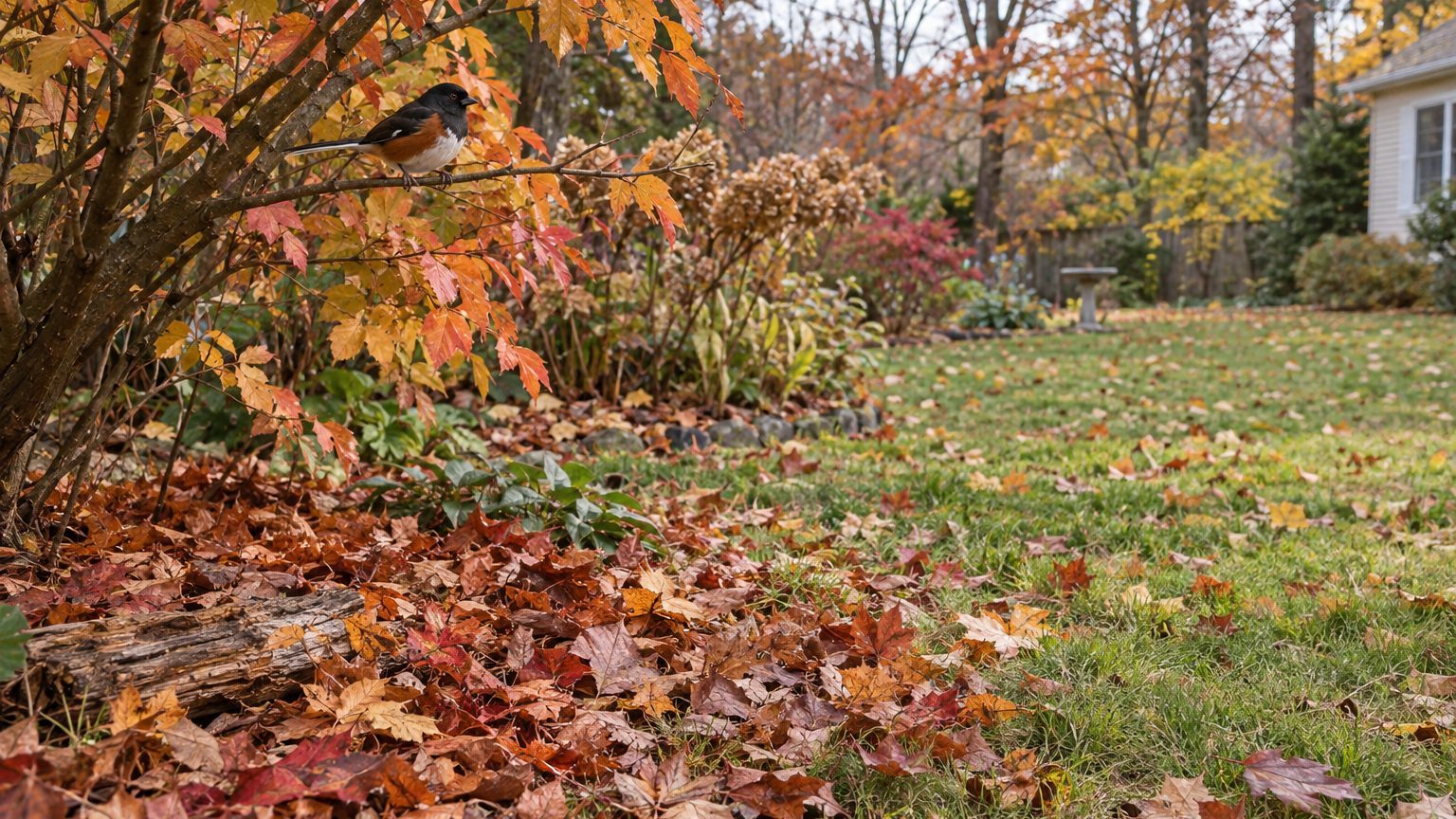
Leaving the leaves means keeping fallen leaves on your property instead of bagging them for the curb. That can be as hands-off as letting a thin layer lie, or as hands-on as raking them into beds and under shrubs. It does not mean abandoning the lawn.
The advice is not to abandon every lawn: Xerces recommends leaving leaves where practical, or raking them intact into garden beds, beneath trees or into designated piles.
Where it collides with turf, the lawn usually wins.
What leaves actually do for wildlife
Start with what’s under the leaf layer, because that is the whole argument.
A layer of leaves is vital insulation from the cold for the many animals that hide within it, or in the soil beneath, like quite a few butterflies.
Fritillary and woolly bear caterpillars shelter in leaf litter, luna moths and swallowtails disguise cocoons or chrysalises as dead leaves, and mated bumble bee queens burrow only an inch or two into soil, where leaves provide insulation.
An inch or two. Leaves on top add welcome extra protection.
Fireflies belong on the list too, and most people never connect them to the rake.
Many fireflies spend their larval stage beneath a layer of fallen leaves or even under the soil.
The summer evening show in your yard may depend on what you did in November.
Birds are the visible half of the story.
Many bird species, such as the eastern towhee and ovenbird, forage in leaf litter.
Amphibians and reptiles, such as salamanders and eastern box turtles, hibernate under leaf litter.
A feeder gets the attention, but the National Wildlife Federation points out that
most of a backyard bird’s food comes from foraging in the natural environment.
One caution on the bat angle, since it shows up in a lot of social posts.
Eastern red bats may temporarily use leaf litter to keep warm in winter, but it is unlikely you’ll encounter them outside forested settings.
A suburban lawn is unlikely to offer much bat habitat. The insects are the stronger reason.
The campaign also has a surprising finding about where leaves matter most. Xerces staff reported that
it was more beneficial to leave leaves in a high-maintenance area, such as the front yard where you mow and usually rake, than in an area that’s more unmaintained.
The reasoning is straightforward: the back corner nobody touches already has plenty of leaf cover. The mowed, raked front yard is where the habitat is missing. For a deeper look at species and habitat, see leave the leaves for wildlife.
Should you rake before winter? The lawn says yes, partly
Here is where the slogan runs into grass biology. Some people argue leaves insulate turf through hard freezes. Mississippi State Extension’s turf specialists disagree:
leaves left on turf can damage your lawn’s health
, and they recommend that you
periodically rake leaves from your lawn or mulch them down instead of letting them pile up.
The National Wildlife Federation, which runs the annual Leave the Leaves Month every October, says the same thing in its own FAQ.
A light scattering of leaves on grass is fine, but a thick layer blanketing the turfgrass will smother the lawn.
It also asks you to
rake leaves from sidewalks, driveways and turfgrass lawn and use them elsewhere in your garden.
Leaves on pavement are slippery, and a slick walkway is a poor advertisement for the movement.
So the practical answer to “should I rake before winter?” is a sorting exercise rather than yes or no:
- Thin, dry, scattered leaves on grass can stay where they land.
- Thick or wet mats on turf should come off before they lock out light and air.
- Walkways, driveways and steps should be cleared.
- Planting beds, the area under shrubs and the base of trees are where the leaves should go.
Timing matters as much as technique. Raking once at the end of the season is the hardest version of this job, because wet leaves pack down and get heavy. One lawn-care site suggests mulching light, dry drops as they fall and
raking when leaves get wet, thick, or matted.
That is a commercial source rather than a university one, but it matches what the extension specialists describe: don’t let the mat form.
The mulch-mowing catch
Mulch-mowing is the standard lawn-care workaround, and it works. Scotts, for one, says to
keep mowing over the leaves until you can see about half an inch of grass blade through the shredded leaf pieces.
Mowers shred leaves into pieces that break down and feed the soil. Great for turf.
Xerces sees it differently. The group
discourages shredding because mowers can destroy insects, eggs and cocoons inside the leaves.
Those are two reasonable positions pointing in opposite directions, and you have to pick based on your priorities. If you want the best lawn with the least work, mulch-mow. If you want to protect the overwintering insects, rake the leaves intact and move them to a bed instead of running the mower through them. A compromise many gardeners land on: mulch-mow the open lawn where leaves are thin, and rake the heavy drifts intact into beds and under trees.
What to do with fallen leaves in the yard
Once leaves are off the grass, you have a few good places for them, all of which keep them out of the trash.
Leaves are excellent mulch and compost for your landscape.
A loose layer in perennial beds
can suppress weeds, retain moisture and return nutrients as they decompose.
The NWF suggests
moving leaves off paths and lawn to create a beneficial leaf layer in garden beds and around the base of trees.
A few leaf types need extra thought. Oak and magnolia leaves are slow to break down, and one lawn-care guide recommends raking them rather than mulching them into the lawn. Leaves from diseased trees are the exception to the whole philosophy:
the advice is to bag leaves from diseased trees and dispose of them properly, not to mulch or compost them.
If a tree had a leaf spot problem or another serious disease this year, check with your local extension office before reusing its leaves.
Whole leaves, spread thick, can also mat.
Whole leaves can mat together, so spreading a loose layer or shredding first gives water and air more paths through it.
Spread the leaves loosely, not in a heavy blanket, especially over small perennials and crowns.
For the leaves you can’t use right away, you have two slower routes. Piling and composting them gives you a dark, crumbly amendment by next season, and the steps are in how to compost leaves. A dedicated wire bin and patience will give you leaf mold, a fungal-driven soil conditioner that needs almost no effort beyond moisture and time. If you’re weighing all the options side by side, the full comparison is in what to do with fallen leaves.
Not every leaf has to stay. The point of the campaign is landfill avoidance and habitat, and the NWF says so plainly:
although it’s best to let leaves lie, the most important thing is keeping them out of the landfill, which you can do by using leaves as mulch, in compost piles, or by relocating them to another area of your yard.
The scale of the problem is not small.
According to the U.S. Environmental Protection Agency, leaves and other yard debris account for about 12 percent of the nation’s municipal solid waste.
In the NWF’s 2025 survey,
a third of respondents (32 percent) were still throwing away six or more trash bags of leaves per season.
Spring cleanup, neighbors and HOAs
Leaving leaves through winter only works if you don’t undo it in March. Xerces recommends
delaying spring cleanup until overwintering wildlife has emerged.
Cold snaps in early spring can catch insects that have started to wake up, so wait for the weather to warm consistently before you clear beds. When you do, rake gently and, if possible, move leaf piles to a back corner or under a shrub instead of bagging them.
Then there is the practical reality of living near other people. The NWF acknowledges that
HOA or local requirements may prevent homeowners from leaving leaves where they fall.
Check your covenants before you commit. If a rule says leaves can’t sit on the lawn, you can still hold on to the habitat value by relocating leaves into beds, under hedges and into a leaf bin at the edge of the yard.
The neighbor question is easier to deal with than it sounds. The NWF’s guidance is that
avoiding the yard waste bags doesn’t mean your garden has to look messy.
A crisp edge along the lawn, clean walkways and leaves tucked tidily into mulched beds look deliberate. A sign helps, too: Xerces makes available, in exchange for a donation,
Leave the Leaves signs
that homeowners have used to explain the practice to people walking by.
Participation is growing, slowly.
In the NWF’s 2025 survey, 18 percent of respondents said they don’t collect or remove fallen leaves, up from 15 percent in 2024.
Most of the people in that survey were still raking, which means the opportunity is mostly in the middle: keep the leaves, just put them somewhere better. One more practical detail worth remembering is that the NWF’s 2023 survey found that
82 percent of people are open to leaving leaves to benefit wildlife in the future
, so your neighbors may be more receptive than you expect.
A last nuance on lawns: if you’ve just seeded in fall, the leaf-free rule is stricter. Seedlings are far less tolerant of a leaf blanket than established turf, so rake those patches clean, and save your leaf experiments for the beds.
Sources : xerces.org | nwf.org | homegrownnationalpark.org