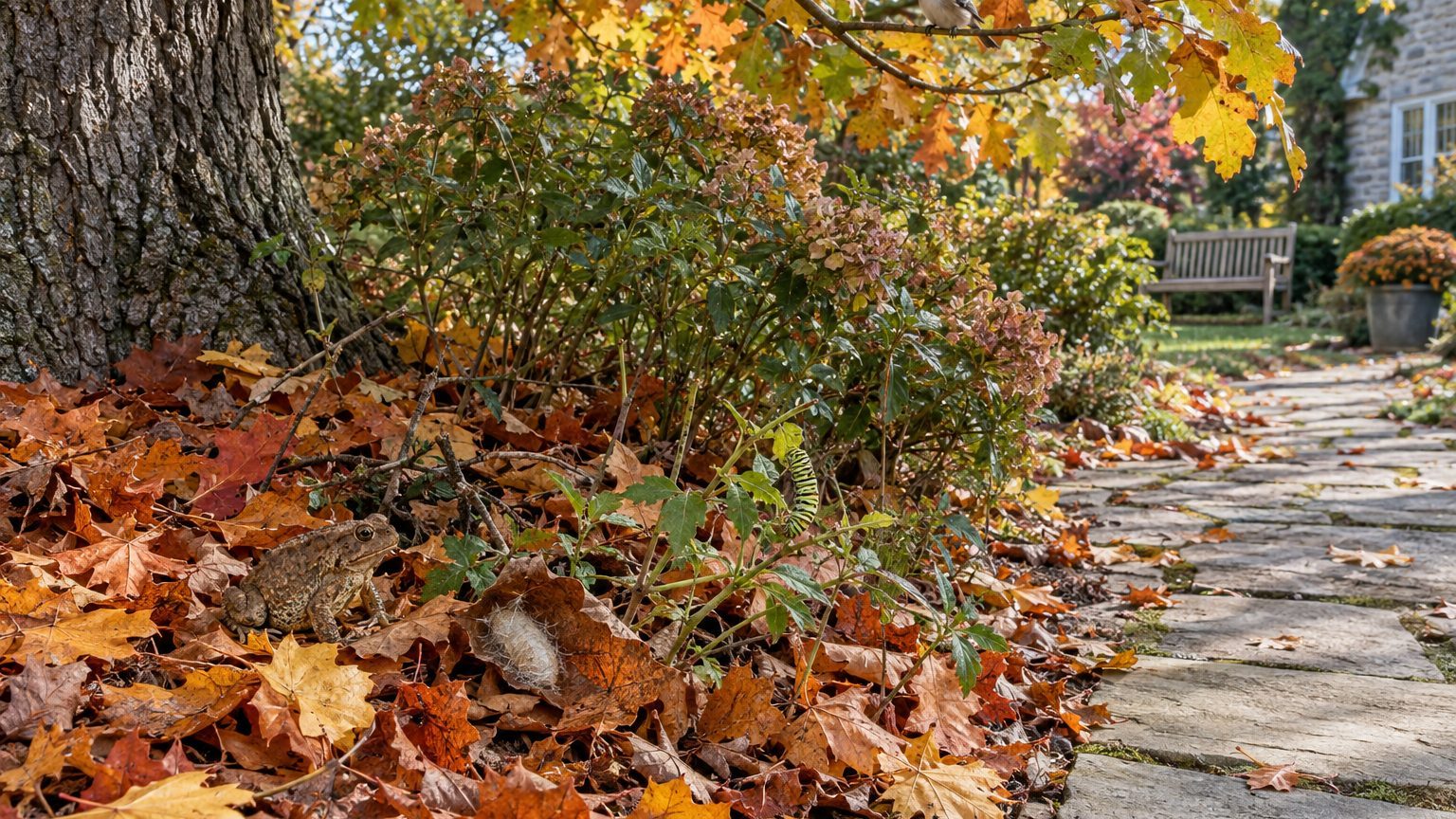
The Leave the Leaves campaign
Turtles, toads, songbirds, mammals and invertebrates rely on leaf litter for food, shelter and nesting material, and many moth and butterfly caterpillars overwinter in fallen leaves.
Luna moths and swallowtails disguise their cocoons and chrysalises as dried leaves.
Raking and bagging removes the animals along with the leaves. But you don’t need to keep every leaf. Keep them under trees, shrubs and in beds. Clear walkways, drains and thick mats on turf. Hold heavy cleanup until spring warmth has settled in.
Two conservation groups drive the message.
The Xerces Society’s campaign asks homeowners, grounds crews, municipalities and campuses to rethink removing every fallen leaf and dead stem.
The National Wildlife Federation treats October as National Leave the Leaves Month.
This page covers the wildlife case only. The broader idea sits on the leave the leaves page, and the should I rake leaves before winter page covers whether and where to rake.
Why does a bug hotel matter to a bird?
About 96 percent of North American terrestrial bird species feed insects, primarily moth and butterfly caterpillars, to their young during nesting season.
Entomologist Doug Tallamy’s count for one chickadee family:
parents feeding for 16 to 18 days, 350 to 570 caterpillars a day, roughly 6,000 to 9,000 per clutch.
Those chickadees weigh about a third of an ounce.
A bagged pupa in November is a missing meal in June.
What the Xerces Society says about leaves
Xerces puts the logic plainly.
Invertebrates rely on fallen leaves and other organic debris to cover and insulate them from the elements.
Important invertebrates will find a home in leaves a couple of inches thick, which mimics natural ecosystems.
Red-banded hairstreaks lay their eggs on fallen oak leaves, which become the first food of the caterpillars.
Stick insects drop more than 100 eggs from treetops that overwinter in the litter until spring.
The group also draws a line on technique.
Shredded leaves won’t give the same cover as whole ones, and a mower can destroy eggs, caterpillars and cocoons, so use a rake or blower instead.
The same logic covers bagging for curbside pickup: whatever is in the bag leaves with it. For wildlife, the trade-off is simple. Whole leaves, moved a short distance, keep the occupants alive.
A raked-bare yard removes more than leaves.
Fritillary and woolly bear caterpillars shelter in leaf litter, and mated bumble bee queens burrow only an inch or two into soil, where leaves insulate them.
Honey bees winter as a colony inside a hive, so the leaf-litter story belongs to native species. Remove the cover and those queens, which start next year’s colonies, lose their blanket.
Leaves in flower beds over winter
A perennial bed is the easiest place to say yes. Spent stems, seed heads and a leaf blanket give shelter on the ground and above it.
About 30 percent of native bees nest in tunnels and may use hollow stems, dead wood or brush piles.
Cut everything to the ground in October and you cut those nurseries too.
When spring temperatures hold above 50 degrees, trim last year’s stems to about 15 inches
, leaving stubs for bees emerging from them.
How deep should the layer be? Xerces points to leaves a couple of inches thick, and
the National Wildlife Federation notes that a leaf layer several inches deep is natural wherever trees grow.
Lawn is stricter.
Too many leaves smother grass, though a thin layer over 10% to 20% of a lawn is fine.
My own caution, not a published rule: pull leaves back from the crowns of low evergreen plants like heuchera so they don’t sit wet against the foliage. Beds also gain.
Many spring wildflowers need a good layer of leaf litter to emerge.
Which animals use fallen leaves for food and shelter?
Dozens. The table sorts them by what they take from the leaf layer, and what a rake, bag or shredder takes back.
| Animal group | How it uses leaves | When it matters | What raking, bagging or shredding takes away |
|---|---|---|---|
| Butterflies and moths | Cocoons and chrysalises camouflaged as leaves; caterpillars shelter in litter | Fall through spring | The hidden pupae and caterpillars; shredding destroys them |
| Bumblebee queens | Hibernate an inch or two in soil, insulated by leaves | Winter into early spring | The insulating cover over the burrow |
| Fireflies | Burrow into the leaf layer for winter; some lay eggs there | Fall through spring | Eggs and larvae, so fewer lights next summer |
| Beetles and other beneficial insects | Ladybugs and assassin bugs shelter in leaf matter | Winter, emerging in spring | Natural pest-eaters that would have hatched in your garden |
| Toads and salamanders |
Warmth, moisture and prey ; toads hide and hibernate |
Winter, plus cover year-round | Moist cover and the invertebrates they eat |
| Box turtles | Sleep, hibernate and travel in leaf litter | Fall through spring | Hiding cover during dormancy |
| Ground-feeding birds | Chickadees search litter for seeds, insects and larvae | Winter, when food is scarce | A winter pantry of insects and larvae |
| Small mammals | Chipmunks and shrews use the leaf layer for food and habitat | Cold months | Foraging ground and cover |
The decomposers matter too.
Most millipedes feed primarily on decaying leaves, recycling nutrients into the soil.
Spiders, snails, worms, beetles and mites support the chipmunks, turtles, birds and amphibians that eat them.
Pull out one layer of that food web and the rest wobbles.
Where can you leave leaves if you don’t want them everywhere?
Xerces says
you absolutely do not have to leave all the leaves on your property.
Its recommendation is to leave leaves where practical, or rake them intact into garden beds, under trees or into designated piles.
Leaves can also go around the base of a tree or along a border at the back of the yard.
A simple decision guide for a tidy-minded yard:
- Leave: under trees and shrubs, bed edges, back corners and fence lines.
- Thin: lawn areas with a light scatter, since
a thin layer over 10% to 20% of the lawn is acceptable. - Clear: walkways, driveways, storm drains and any thick mat sitting on turf.
Ticks deserve an honest word. A Connecticut Agricultural Experiment Station handbook warns that
woodland edge and leaf litter are high-risk areas for nymphal blacklegged ticks
, and it advises removing
leaf litter accumulations around the house and lawn perimeter, and in frequently used areas.
The National Pesticide Information Center likewise says to keep leaf litter away from areas you use regularly.
So keep leaves away from patios, play areas and paths, and consider
a 3-foot barrier of gravel or wood chips between lawn and woods.
Wildlife zones go farther out.
A leaf pile is the compromise for the truly neat.
Move leaf piles to a corner of the garden and leave them undisturbed for a while.
A wire-mesh cage around the pile keeps it contained and tidy (my suggestion, not a published method). Brush piles do double duty:
one Xerces staffer has had spotted towhees nest in hers.
When is it safe to clean up leaves without harming overwintering insects?
Use a thermometer, not a calendar.
University of Missouri Extension says to hold off until temperatures are consistently above 50 degrees Fahrenheit.
Another county-level guide puts it as
daytime temperatures consistently in the 50s.
One warm March afternoon doesn’t count.
Plants and insects are still asleep and aren’t fooled by teasing temperatures.
Many gardeners add a margin of about a week of steady days.
Some insects keep developing in leaf litter through spring and summer
, so a patch left all year gives them more secure habitat.
The sequence matters as much as the date:
- Before the threshold, clear only hazards: paths, steps, drains and any smothering mat on turf.
- After sustained warmth,
gently rake excess leaves into flower beds as free mulch, keeping them whole. - Loosen what remains:
fluff dense layers so light, rain and emerging plants can get through. - Trim stems last, to the roughly 15-inch stubs noted above.
- Add fresh mulch late.
Wait until temperatures are above 50 degrees and the soil dries a little, so insects can emerge.
Moving leaves rather than discarding them keeps the insects in your yard instead of in a landfill truck.
Frequently Asked Questions
Do fallen leaves attract ticks or mice?
They can shelter both. Blacklegged ticks favor leaf litter, particularly at woodland edges, which is why extension and public health guidance says to clear it near the house, patios and play areas.
Keeping woodpiles and stone walls free of leaf litter reduces mouse nesting sites.
Leaves in beds and back borders, away from where people spend time, are a reasonable trade.
Do I have to leave every leaf in my yard for wildlife?
No. Xerces itself says you don’t have to leave all of them. Concentrate leaves in beds, under trees and shrubs, and along borders. Clear paths, drains and thick turf mats.
Will an HOA or city let me leave leaves in my yard?
Local ordinances or homeowner’s associations often require the removal of fallen leaves,
so check your rules (this is a general caution, not legal advice). A short script helps: “I’m moving leaves into beds and under trees, which keeps them off the lawn and gives butterflies and bees winter habitat. It also gives me free mulch.” Rules on bagging vary, so ask whether leaves kept on your own property must be bagged.
Is it okay to leave leaves that are diseased or covered in fungus?
Not always.
Xerces advises removing fallen leaves and standing stems from plants infected by fungi or pathogens.
In vegetable gardens, removing or mulching leaves and stems prevents garden pests from overwintering.
Healthy tree leaves elsewhere can stay.
Can I move leaves to another spot instead of leaving them where they fall?
Yes. Xerces recommends raking leaves intact into beds, under trees or into piles. Rake gently, keep them whole, and don’t shred them. Moving them a short distance keeps most of the occupants nearby.
Sources: extension.uconn.edu | maine.gov | newtown-ct.gov