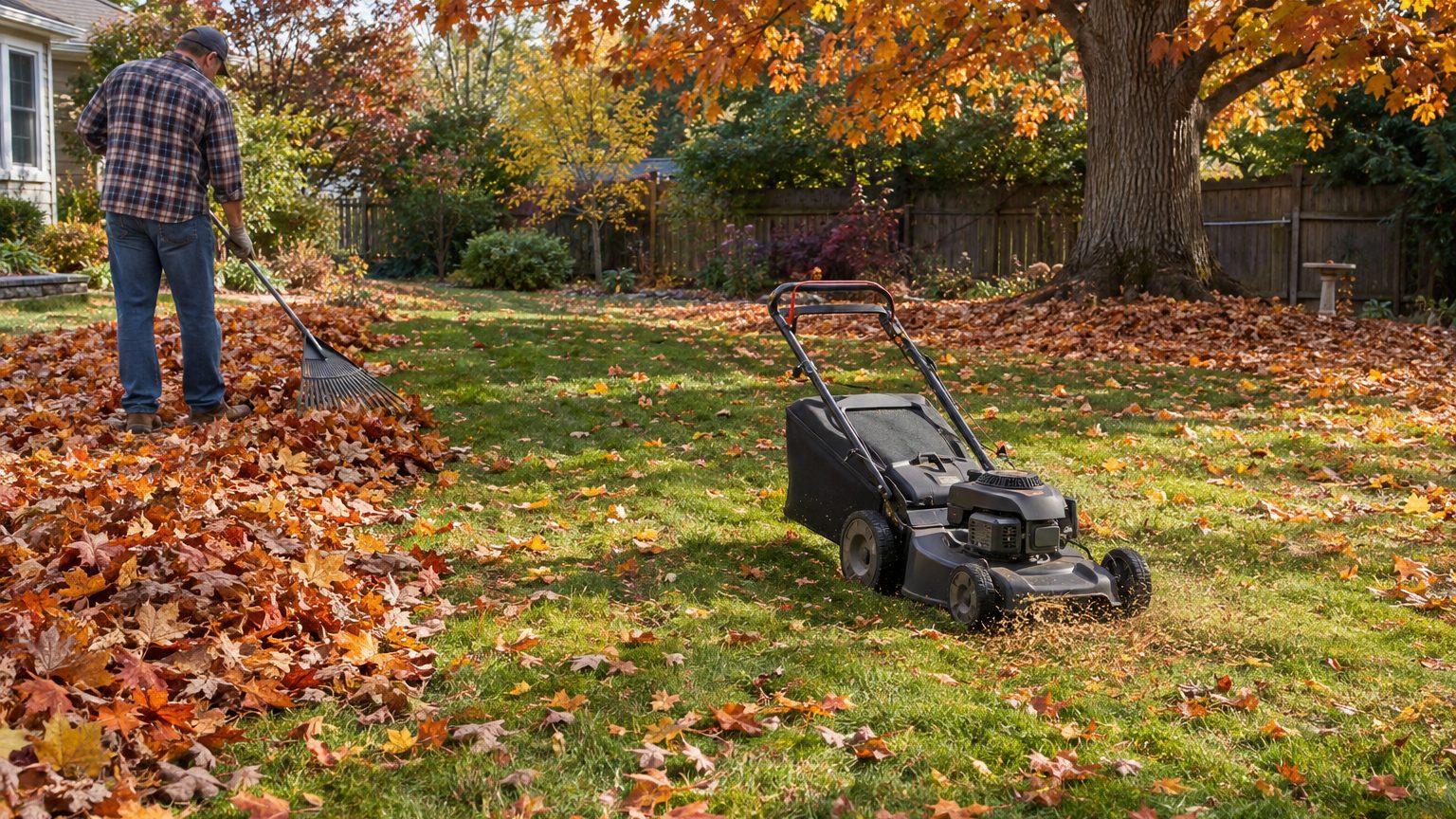
Don’t treat every leaf the same way. Mow thin layers into the lawn with a mulching mower, and rake off any layer deep enough to bury the grass. Under trees and along shrub borders, leave the leaves or pile them as natural mulch. Clear walkways, steps, gutters and storm drains. Send whatever is left to a compost or leaf mold pile, then to local yard-waste collection if your city offers it.
What to do with fall leaves in yard
Walk the property and treat it as separate zones. The lawn is especially sensitive, because grass needs light and air. Tree bases and shrub borders are very forgiving, since leaves are what those soils get in a forest anyway. Hard surfaces and drainage are where leaves cause real trouble. This table gives each zone a default action, a trigger to switch, and the guide to read for the method.
| Yard zone | Default action for typical leaf fall | Trigger to switch to removal | Guide to read |
|---|---|---|---|
| Turf lawn | Mow in with a mulching mower | Leaves cover the grass fully, or are wet and matted | how to make leaf mold (for raked-off layers) |
| Under trees | Leave in place | Diseased leaves, such as apple scab | what to do with fallen leaves |
| Shrub borders | Pile as mulch | Diseased leaves, or a heap pressed against stems | what to do with fallen leaves |
| Paths, steps, driveway, deck | Sweep or blow | Slippery when wet | how to compost leaves (for the leaves you sweep up) |
| Gutters and storm drains | Clear regularly | Blocks drainage | how to compost leaves (for the leaves you clear out) |
| Pond | Clear regularly | Leaves sinking and piling up | how to make leaf mold (for the leaves you skim out) |
Not sure which row an area belongs in? Run a two-minute check, with four yes/no questions:
- Can you still see grass through the layer?
- Are the leaves wet and matted?
- Do they come from a disease-prone tree, like an apple or crabapple?
- Are they near a drain, gutter or step?
“No” to the first question or “yes” to any of the others moves that patch from “leave or mow in” to “move or remove.”
Should i rake leaves off my lawn
Often, no. A thin, dry layer can stay if you chop it. Extension guidance from Colorado State says
if you can see some grass through the leaves, the layer is not too thick to mulch
. Treat that as a rule of thumb, not a law. The same advice stresses shredding, since whole leaves sitting on turf are a different matter.
Whole leaves are what you rake. A blanket that hides the grass blocks light, and wet leaves compress into a mat that holds moisture against the turf. University of Wisconsin research on winter coverage found that
accumulated leaves of a four-inch depth are highly likely to lead to winter damage issues on the lawn
, and it suggests leaving no more than two inches of shredded leaves. The results are preliminary. Under snow, a soggy mat is also the kind of hideout snow mold likes.
Wet leaves also defeat the mower. They
clump under the deck instead of shredding
, which can smother grass as effectively as leaving them alone. If the layer is wet, matted or deeper than the mower can chew, rake it off and put it to work elsewhere.
Mulching leaves into lawn
Michigan State’s Hancock Turfgrass Research Center ran three studies starting in 1990 on exactly this.
By 1998 the university concluded that turf quality improved on plots with maple leaf mulch, with fewer broadleaf weeds.
Extension summaries add that
after three years, mulching leaves into the lawn reduced dandelions and crabgrass
. Purdue research found that
mulching leaves into the lawn at high rates did not affect turf quality, color, or soil pH
.
The heavy-load study is the interesting one. It mulched mixed leaves at
roughly 6-, 12- and 18-inch layers, at mower deck heights of 1.5 and 3 inches
. Most extension advice stays conservative, though. The layer shown to be safe in the earlier studies was about six inches, and deep layers need several passes.
For a typical yard, the working rule is simple. Set the deck high, remove the bagger, and
make at least two passes
so the pieces are small enough to sift down between the blades. Mow every few days during peak leaf drop rather than waiting for one big session. Dry leaves shred best. Oaks, with their tougher leaves, take more passes than maples.
Which leaves should I remove from the yard?
Start where people walk and cars drive. Wet leaves turn slick, and a city public works department warns that
leaf piles can hide depressions, potholes or storm grates
. Sweep or blow steps, walkways, driveways and decks as they fall, not once at the end of the season. A leaf layer on a deck can keep the boards damp and slippery.
Gutters and storm drains come next. Shredded leaves are less likely to clog gutters, and
leaves decomposing in storm sewers release nitrogen and phosphorus that can feed harmful algal blooms
. A garden pond has the same problem on a smaller scale. Leaves that sink and rot use up oxygen fish need, so skim or net them out.
Diseased foliage is the third category.
The apple scab fungus overwinters on fallen diseased leaves
, so removing them cuts next spring’s infection. Washington State advice is to
rake and destroy leaves and not put them in a compost
. Oregon State extension allows a pile if the
leaves decompose completely before spring
, and a California extension program accepts disposal or thorough composting. In practice, bag them for yard-waste pickup or hot-compost them. Your state extension office can name the diseases common in your area.
Where can I put leaves in my yard instead of bagging them?
Under trees and along shrub borders, nothing needs to move far. Shredded leaves can go on as
a 2 to 4-inch-thick layer of mulch around trees and shrubs or on perennial beds
. The Xerces Society prefers whole leaves for wildlife, and says
important invertebrates will find a home in leaves a couple of inches thick
. It suggests raking them intact into beds, beneath trees or into designated piles. Keep any layer a few inches off trunks and stems so bark doesn’t stay damp.
A leaf corral handles the surplus. A ring of wire fencing or a simple three-sided bin in a back corner holds whole leaves while they break down. Penn State extension calls piling whole leaves into leaf mold the lower-effort route and
better than removing the leaves from your property
. Step-by-step builds are in how to make leaf mold and how to compost leaves.
Placement matters if ticks are a concern. Xerces advises that in tick regions you can
rake leaves away from where pets and people are likely to encounter them
. Put the corral at the back of the yard, away from play areas and the house foundation.
What is the easiest way to move leaves around the yard?
Match the tool to the volume and the surface, not to what’s in the shed.
A tarp and a rake win for piles. Rake onto the tarp, drag it to the corral or bed, and tip it out. It’s quiet, it keeps leaves whole for wildlife, and it works on wet leaves a blower can’t shift. A blower suits beds, hardscape and tight corners. Push leaves inward toward your own beds or the pile, never toward the street. Xerces lists raking or
blowing (electric) as alternatives that keep leaves whole
.
The mower covers lawn-wide jobs. Use it when leaves are dry and the layer is thin enough to leave visible grass. A mulching mower or a mulching blade chops better than a standard blade, but one failure is common:
too many wet leaves get sticky and clog the mower
. If the deck keeps bogging down, switch to the tarp.
A workable sequence: blow hard surfaces first, mow the open lawn second, rake the heavy drifts under trees last. Bag size is worth knowing before you start, because many cities cap bag size and weight. Janesville, for example, allows up to 35 gallons.
What do I do with leaves I can’t use in my yard?
Work down a ladder. First use them on site: lawn, beds, corral. Then go to curbside yard-waste collection or a municipal drop-off site. Yard trimmings made up about 12 percent of US municipal solid waste in 2018, roughly 35.4 million tons, and
had the highest composting rate of any category at 63 percent
. Collected leaves usually become municipal compost.
Rules vary by city, so read yours. Many require paper bags. Baltimore
asks residents to use brown paper lawn and leaf bags and does not accept plastic
. Janesville, Wisconsin,
takes paper bags or reusable containers up to 35 gallons
. Drop-off sites often charge fees or want paper too. Check collection dates and bag limits on your public works page.
Burning is the rung to skip. Illinois has no statewide ban, but
local governments can impose a total ban on leaf burning
. Some cities do. Check before you light anything.
And never push leaves into the street. They clog drains, and
it violates ordinances and can threaten drainage
in some cities. Street sweepers also
are not designed to pick up piles of leaves, and leaves can damage the equipment
.
Frequently Asked Questions
Do leaves in the yard attract ticks and rodents?
Ticks can. A 2020 study found
about three times as many blacklegged (deer) tick nymphs in New Jersey forest-edge plots where raked or blown leaves had been added than in natural edge and forest plots
. Keep leaf piles away from play areas and paths. Small animals will shelter in a heap against the house, so keep corrals toward the back of the yard.
Is it legal to burn leaves in my yard?
It depends on where you live. Some states restrict it and many cities ban it outright, and open burning can
send aloft millions of spores
that trigger allergies. Check your city, county and state air agency before burning, and skip it during any burn ban.
Can I dump leaves in the woods behind my house or on a vacant lot?
Usually not. A vacant lot belongs to someone, and woods behind you may be a neighbor’s, a park’s or a protected buffer. Leaves dumped near a creek add the same nutrients as leaves in a storm drain. Use your compost corral, curbside pickup or a municipal drop-off site instead.
Can wet leaves left in the yard kill plants or shrubs?
They can harm turf and small plants. Wet, matted leaves can smother grass and hold moisture against low crowns, which invites disease. Established shrubs usually tolerate a loose layer around them. Pull leaves back from stems and trunks, and clear any mat from low perennials.
Sources: 19january2021snapshot.epa.gov | archive.lib.msu.edu | baltimorecity.gov