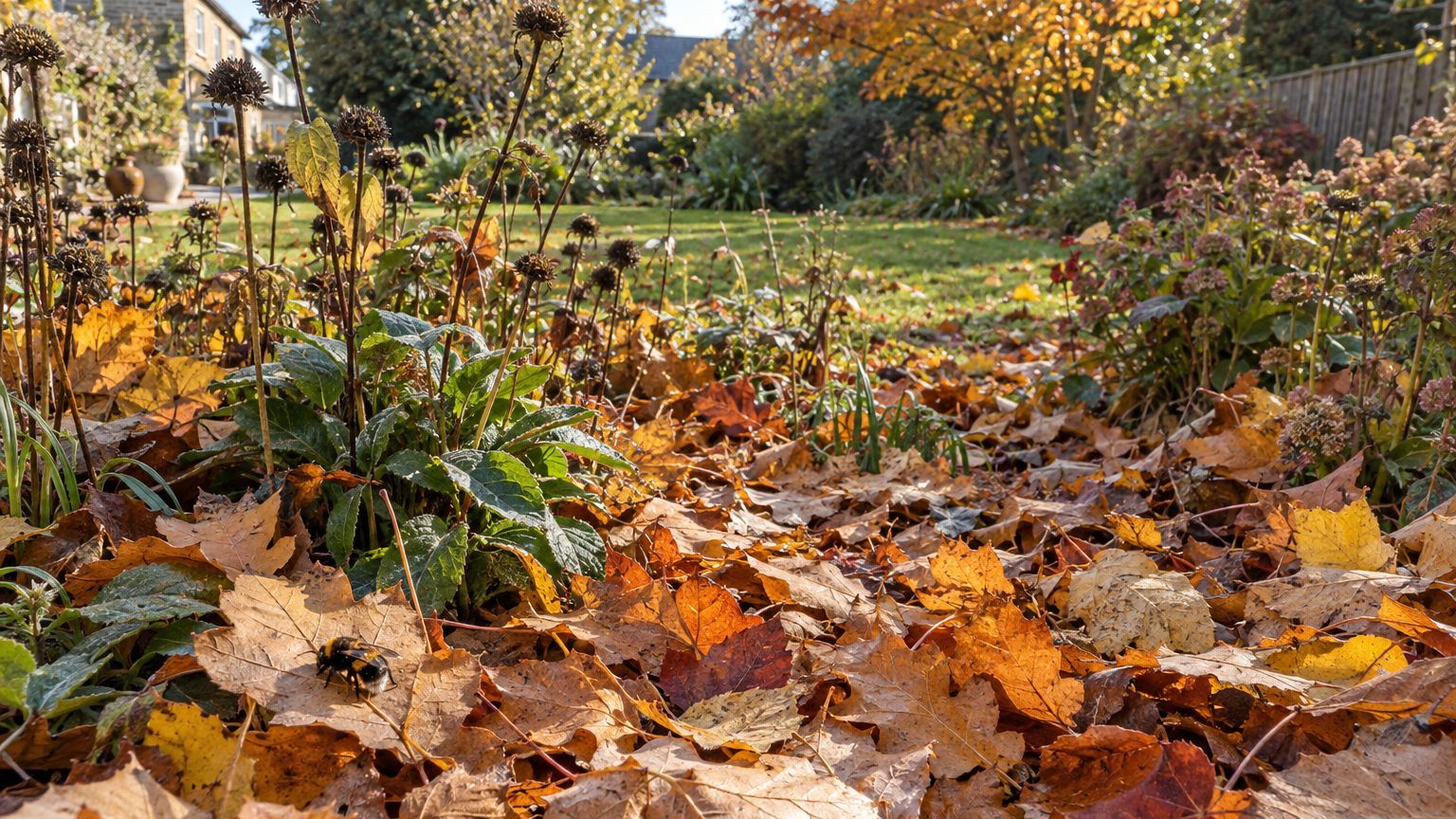
Leave them, mostly. Fallen leaves belong in garden beds as long as you match the treatment to the bed. Flower beds can keep whole leaves all winter. Vegetable beds do better with shredded leaves worked into the soil. Anywhere you spread leaves as mulch, keep the layer to 2 to 3 inches and pull it back from stems and crowns. That covers the practical core of what to do with fallen leaves, and the details below show how to apply it bed by bed.
Leaves in flower beds over winter
Flower beds are where leaving leaves in a garden bed over winter pays off most. A University of Missouri Extension specialist put it plainly: the value is greatest here, because the leaves shelter beneficial insects, protect soil from erosion and buffer plants against extreme weather.
Leaving the leaves has the greatest added value in the flower beds, providing habitat for beneficial insects, protecting soil from erosion and sheltering plants from extreme weather.
Iowa State’s horticulture team takes the same relaxed view.
For the most part, leaves in perennial beds, under shrubs and in other mulched areas don’t have to be removed, and even thick layers break down over winter to leave an inch or two of mulch by spring.
A thick layer of leaves in November is typically an inch or two of soft mulch by spring. Nature does the volume reduction for free.
Who is using that layer? More creatures than most gardeners assume.
Swallowtails and luna moths overwinter in leaves, and bumble bee queens may use them too.
Mated queen bumblebees burrow only an inch or two into the earth to hibernate, relying on natural leaf litter for insulation.
Rake that litter into the curb bag and you are throwing out next summer’s pollinators along with it.
One detail separates this from the vegetable patch: don’t shred. Missouri’s advice is to leave flower-bed leaves intact so overwintering eggs and larvae aren’t damaged.
It also says to hold off on cleanup until spring temperatures reach 50°F.
A calendar date won’t tell you when that is. A thermometer on the patio will.
Where flower beds are the exception
Not every plant gets the blanket treatment.
Iowa State recommends removing plant material in fall from perennials that had disease or insect problems during summer.
The Old Farmer’s Almanac adds that bearded irises, lilies and peonies are better cut back in fall, so pests and diseases don’t overwinter in their stems and foliage.
Leave the leaves on the ground around those plants, but clear the sick or pest-prone foliage itself.
Tender perennials need a different approach. Many gardeners pile whole leaves over borderline-hardy plants. Iowa State advises against it for protective cages, because
leaves tend to mat down over winter and can smother the plants
; straw or pine needles work better there. Where frost heaving is the worry (shallow-rooted perennials getting pushed out of the soil by freeze-thaw cycles),
Iowa State suggests about four inches of mulch over the crown once the ground freezes, typically by late November in much of Iowa.
Timing matters more than thickness. Mulch laid too early can keep plants from going fully dormant and leave them more vulnerable to cold damage. The same mulch laid after the freeze simply keeps the soil frozen. The dedicated page on leaves in flower beds over winter goes deeper on plant-by-plant choices.
Fall leaves in garden beds
Vegetable beds follow different rules, and the reason is simple: the pests are different. Missouri Extension warns that
letting leaves decay naturally in the vegetable garden risks carrying insect problems over from one season to the next.
Its recommendation is to
chop or shred the Leaves With a Mower or leaf mulcher and till them into the ground in late fall, which reduces overwintering pests while the garden still benefits from the nutrients.
Clean the bed first.
After the first killing frost, annuals and vegetable plants should come out, since two common tomato diseases, early blight and Septoria leaf spot, overwinter in crop debris.
Squash bugs and other pests can overwinter as well, bridging this year’s crop and next year’s.
Shredded leaves go on bare, tidy soil, not over last summer’s tomato vines.
Once the bed is clear, the leaves do real work.
Chipped leaves make a wonderful mulch for annual, perennial and vegetable gardens, and a thick layer of them can suppress weeds and conserve moisture as well as bark mulch, usually breaking down within a season.
If you grow cold-hardy crops, there is a bonus:
leaves insulate carrots, kale, leeks and beets stored in the ground, so covering them can help you keep harvesting well into winter.
Where do the leaves come from if your beds are small and your trees are big? From the lawn, mostly.
When only 10 to 20 percent of the lawn is covered, leaves can stay put, but with more coverage, University of Illinois Extension suggests raking them into garden beds or other areas where they serve as mulch.
Think of beds as the lawn’s overflow parking.
Raised beds work on the same logic, with a few extras because of the contained soil. See leaves in raised beds for the specifics. And if the pile outgrows what the beds can absorb, how to compost leaves covers turning the surplus into something you can spread next year.
A word on diseased leaves
Most leaves are fine. The exceptions are ones from plants that showed obvious disease, such as leaves with heavy fungal spotting, and those belong in municipal yard-waste collection or a hot compost system, not on a vegetable bed. When in doubt about where a leaf came from, treat it as suspect.
Leaf mulch in garden beds
Depth is a question that trips up many gardeners. Sources differ, and the differences are worth understanding rather than averaging out.
Clemson’s Home and Garden Information Center says mulches of grass clippings or shredded leaves should never exceed 2 inches, because they mat together and restrict water and air to the roots.
Penn State Extension allows 2 to 4 inches of shredded leaves around trees and shrubs or on perennial beds.
UC Agriculture and Natural Resources suggests 2 to 3 inches of shredded leaf mulch over planting beds in winter, held a good four inches away from stems and trunks to prevent rot.
The overlap is the sweet spot. Two inches is safe everywhere, and three is fine for most beds. Go beyond that only if you are working with coarse, loose material in a climate that drains fast. Since winter mulch also compresses, a bed that looks puffy in November will look sensible by February.
Shredding changes the math.
Shredded leaves mat down less than whole leaves, and watering the mulch after application helps it stay in place.
A pass with the mower over a windrow of leaves does the job, and a lightweight mulching blade turns dry leaves into dime-sized pieces fast. Whole leaves can mat into a wet layer.
UC ANR warns that thick layers of whole leaves can block water and oxygen as they compact while breaking down.
Shredding has a cost.
An extension expert at Ask Extension notes that whole leaves are more ecologically beneficial, since shredding could injure or kill moth and butterfly caterpillars or cocoons sheltering in them.
A practical compromise that many extension sources endorse: shred for vegetable beds and for mulch around plants you want tidy, and leave whole leaves in back borders, under shrubs and in out-of-sight corners. Nobody needs to apply one rule to the entire yard.
What leaf mulch does that bought mulch doesn’t
It costs nothing, obviously. It also feeds the soil in a way bark often doesn’t.
Leaf mulch moderates soil temperature, holds moisture and suppresses weeds, and the weeds that do appear are easier to pull because the soil stays soft.
UC ANR points out that wood chip, straw and cedar shaving mulches are expensive and release only minor amounts of nutrients as they decompose.
Leaves, by contrast, are already full of the minerals the tree pulled up all summer.
There is one more trick, for gardeners who dislike the rumpled look of leaves in a front bed. Leaves can sit on top of existing wood-chip mulch with no harm to it. A certified horticulturist quoted by Yahoo Lifestyle says
leaves won’t reduce the effectiveness of existing mulch
, so you can keep the tidy surface and still let them accumulate. If appearance matters, you can rake off the excess before heavy rain or snow settles it into a mat.
For the broader picture of a bed that stays covered from first frost to spring thaw, the leaves in garden bed over winter page covers timing, thickness and what to expect as the layer decays.
Taking the leaves off in spring
Winter mulch has a shelf life. As the weather moderates, pull it back. A North Dakota extension columnist advises that
winter mulches should be pulled to the side by early April, but kept handy in case a few days of frigid weather return.
That is about protecting new growth: early shoots and small bulbs shouldn’t be smothered, but they shouldn’t be caught bare in a hard freeze either.
Leaves that matted down over winter should come off first, since a flat, wet layer is the hardest for emerging plants to push through. Leaves that are still loose can stay and become the first layer of spring mulch. If you do clear them, there is a use for the excess.
Ask Extension suggests that anything over a foot deep, which will have degraded greatly by spring, can have the excess removed and used elsewhere, or composted.
Last, mind the insects. Spring cleanup that starts too early can interrupt the very creatures you protected.
Beginning too early risks removing stems in which pollinators are still nesting.
The Missouri threshold of 50°F is a decent signal. Wait for a week or so of steady mild weather, then work in sections, saving the oldest, most densely layered corners for last.
One honest caution to end on: leaf litter is not harmless everywhere. Ticks overwinter in leaf litter in wooded and grassy areas. If your beds back onto woods in tick country, keep the leaves in beds a few feet from paths and the house, and keep the lawn mown short between the two. Most yards can take the benefits without the risk. Yours will tell you which kind it is.
Sources : torontomastergardeners.ca