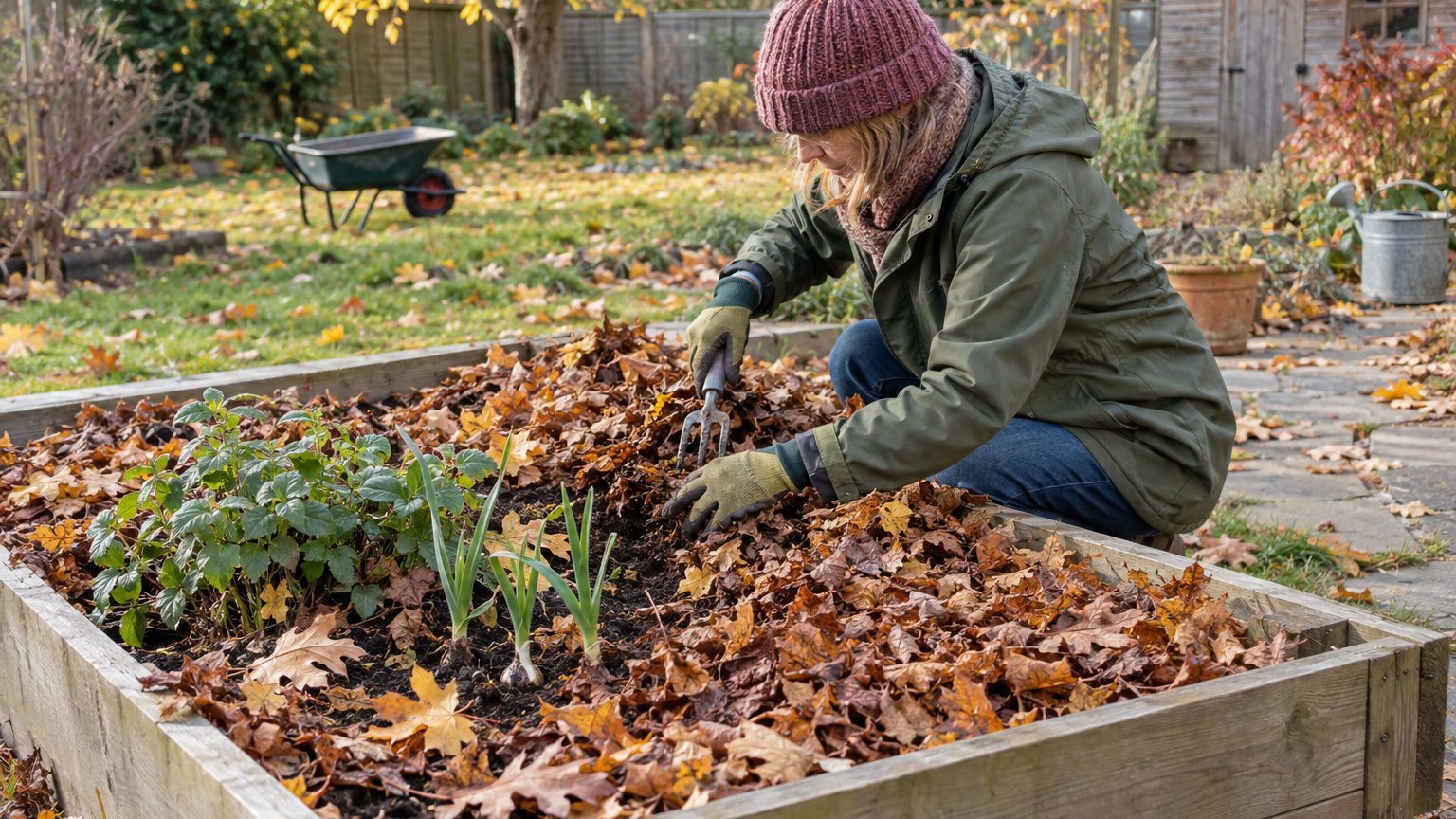
Yes, leaves are one of the best free materials you can put in a raised bed. In fall, spread 2 to 4 inches of shredded leaves over empty beds, or tuck whole leaves loosely around garlic and perennials. Shredding keeps leaves from matting and helps them break down by spring. Oak leaves work too once they are shredded. They rot more slowly, and the idea that they sour the soil is largely a myth. In spring, rake what’s left aside so the soil can warm, plant, then reuse the leaves as mulch or work the crumbly remains into the bed.
Putting leaves in raised beds
A raised bed is a small, enclosed box of soil, often planted shoulder to shoulder, so a sealed leaf layer or a nitrogen dip shows up fast. Advice for open ground is covered in leaves in garden beds.
Whole leaves as a fall blanket on top of the soil
Whole leaves can work as a winter cover, but they are the riskier choice. Piled thick and wet, they can seal the surface like a damp tarp and hold moisture against stems. Test for it by lifting a corner. A healthy layer is loose and airy, and you can see air gaps between leaves. A matted layer is damp, slick and stuck together, and it needs fluffing with a fork or a pass through the mower.
Layering leaves with greens when you build or refill a bed
Lasagna layering, also called sheet mulching, suits a new or topped-up bed. Fresh leaves are carbon-heavy, roughly 50 parts carbon to 1 part nitrogen, so alternate them with nitrogen-rich greens such as grass clippings or kitchen scraps, then cap the stack with finished compost or soil. Expect the stack to settle as it rots. Plan to top the bed off before planting.
Empty vegetable beds vs. beds with perennials or garlic
Empty beds are the easy case: a shredded blanket covers the bare soil. Garlic goes in during fall (October in many climates), and a loose layer of whole leaves over the bed afterward is fine. Around perennials with crowns, such as rhubarb or strawberries, go thinner and keep leaves a few inches off the stems so moisture doesn’t collect there.
| Method | Best timing | Suggested depth | Best for | Main risk |
|---|---|---|---|---|
| Whole leaf blanket | Fall, after the bed is cleared or the garlic is planted | Loose and thin, a couple of inches at most | Perennial bed, garlic | Matting |
| Shredded leaf top dressing | Fall, or as mulch around established plants | 2 to 4 inches (thinner in wet climates) | Empty bed | Slow breakdown if leaves are tough, such as oak |
| Dug-in or tilled leaves | Fall, so they rot before spring planting | Extension guidance for vegetable beds runs up to 6 to 8 inches, chopped | Empty bed | Nitrogen tie-up if done at planting time |
| Layered fill with greens | When building or refilling a bed | Layers a few inches thick, alternated with greens | New bed build | Settling |
Shredded leaves in raised beds
Shredded leaves are the safest default. They resist matting, stay put in wind and break down faster than whole leaves. Run a mower over a dry pile a few times, or use a shredder, and the pieces should be about the size of a quarter or smaller.
Top-dressing vs. digging shredded leaves into the soil
Top-dressing leaves the work to earthworms and soil microbes, which pull material down gradually. Maine’s organic farming association points out that nitrogen tie-up isn’t a worry with fall mulch, especially shredded, because the leaves move into the soil slowly. Digging in is faster but riskier. Colorado State University Extension suggests working 6 to 8 inches of chopped leaves into vegetable beds each year. New York’s environmental agency advises adding a slow-release nitrogen source, such as composted manure, before planting into turned-in leaves.
Why shredded leaves suit the small footprint of a raised bed
Whole leaves can blow off an open-topped box in a windy spell, while shredded ones lock together just enough to stay. They also shrink as they rot, so a 2-inch layer in fall is a soft brown mulch by spring. For more on the payoff, see the benefits of shredded leaf mulch.
Oak leaves in raised beds
Oak gets a bad reputation it mostly hasn’t earned. The real drawback is speed, not acidity.
Why oak leaves break down slowly and how to speed them up
Oak leaves are tough, waxy, high in carbon and loaded with tannins, so they rot more slowly than soft maple or fruit-tree leaves. Whole oak leaves can still be recognizable well into the next season, so shred them. Wet the pile before spreading, and mix in grass clippings or other greens. Blending oak with quicker leaves also helps.
On acidity, fresh oak leaves do run mildly acidic, around pH 5. But Texas A&M AgriLife Extension notes that researchers haven’t been able to significantly acidify soil with oak or pine mulches, and any shift stays in the thin layer right under the leaves. If the pH worries you, a soil test is the answer, not skipping the leaves.
Which crops and beds do well with oak leaf mulch
Slow breakdown is a feature when you want long-lasting cover. Garlic, strawberries, rhubarb and other perennials hold a shredded oak layer well. A bed you’ll replant within weeks is a different story, because the leaves won’t have rotted enough to improve the soil. Black walnut leaves call for particular caution (see the FAQ below).
How thick should a layer of leaves be in a raised bed?
Aim for 2 to 4 inches of shredded leaves. Some extension guides allow 3 to 6 inches around established plants, and others go to 6 to 8 inches for beds you’ll dig over, but a raised bed’s drainage and tight spacing argue for the middle of the range. Go thinner, about 2 inches, around crown-forming plants and in rainy climates. Keep whole leaves looser and shallower than shredded ones, and never let the layer touch stems.
Do leaves rob nitrogen from raised bed soil?
Mostly no, as long as they stay on top. Microbes digesting carbon-rich leaves pull in nitrogen, and the damage comes when a lot of fresh, dry leaves are mixed into the root zone right before planting. Fresh leaves sit near 50:1 carbon to nitrogen, well above the roughly 30:1 that composters aim for. Mixed into soil, that gap draws nitrogen away from seedlings, which turn pale and stall.
The fixes are simple. Dig leaves in during fall, not spring. Add greens or a slow-release nitrogen source if you must incorporate them. Otherwise let them sit on top and rot.
What do you do with leaves in a raised bed in spring?
Judge by looks and by the calendar. Leaves that are dark, crumbly and soil-like need little work. Leaves that are still flat, pale and recognizable need more time.
Pulling mulch back to warm the soil before planting
A leaf blanket slows spring warming, and cold soil sulks. Rake the layer off planting rows or spots, sow or transplant into bare soil, and return the leaves as mulch once seedlings are up.
Leaving partly decomposed leaves in place as a soil amendment
Well-rotted leaves are organic matter, and you don’t need to haul them away. Fold the crumbly layer into the top few inches of soil, or just leave it as a mulch. Use this checklist:
- Dark and crumbly, planting soon: leave it, or mix in lightly.
- Mostly intact, planting soon: pull it aside, plant, then mulch.
- Mostly intact, planting weeks away: leave it on, then rake back at planting.
Do leaves in raised beds attract slugs and mice?
They can. No mulch is slug-proof, and wet, matted leaves give slugs a cool, damp daytime shelter. Keep the layer shredded and moderate, pull it back from young seedlings, water in the morning, and lift the mulch now and then to check for slugs.
Voles are the bigger worry in winter. Extension advice for voles is to avoid heavy mulch and dense cover, and to bury hardware cloth at least 6 inches deep around existing beds, since vole tunnels run mostly near the surface.
Frequently Asked Questions
Can I fill the bottom of a raised bed with leaves?
Yes, as part of a layered fill with greens, topped with several inches of soil or compost. Leaves alone compress and shrink, so expect the bed to sink as they rot. Shredded leaves settle more evenly than whole ones.
Can I plant seeds directly into a layer of leaves?
Not reliably. Seeds need contact with soil, so pull the leaves aside, sow into bare ground, and mulch lightly after seedlings emerge. Transplants can go in through a pulled-back opening.
Can I use black walnut leaves in a raised bed?
Use caution. Juglone occurs in all parts of the tree, but leaves carry less than roots, and Oregon State University Extension notes levels are highest in spring and lower in fall. Compost made from the leaves is considered safe when it is hot, turned and moist, and a minimum of six months is often advised. Keep beds out from under the dripline, and keep fresh walnut leaves away from tomatoes.
Are wet, matted leaves bad for raised beds?
They can be. A sealed layer sheds water and shelters slugs. Fluff it, peel it back, or shred it and spread it thinner.
Should I use leaves from diseased plants in my raised beds?
Leave them out. Leaves with problems such as apple scab, black spot or tomato blight can carry spores into a bed that you plant intensively. Send them to municipal collection or a hot compost pile instead.
Sources: cmg.extension.colostate.edu | dec.ny.gov | depts.washington.edu