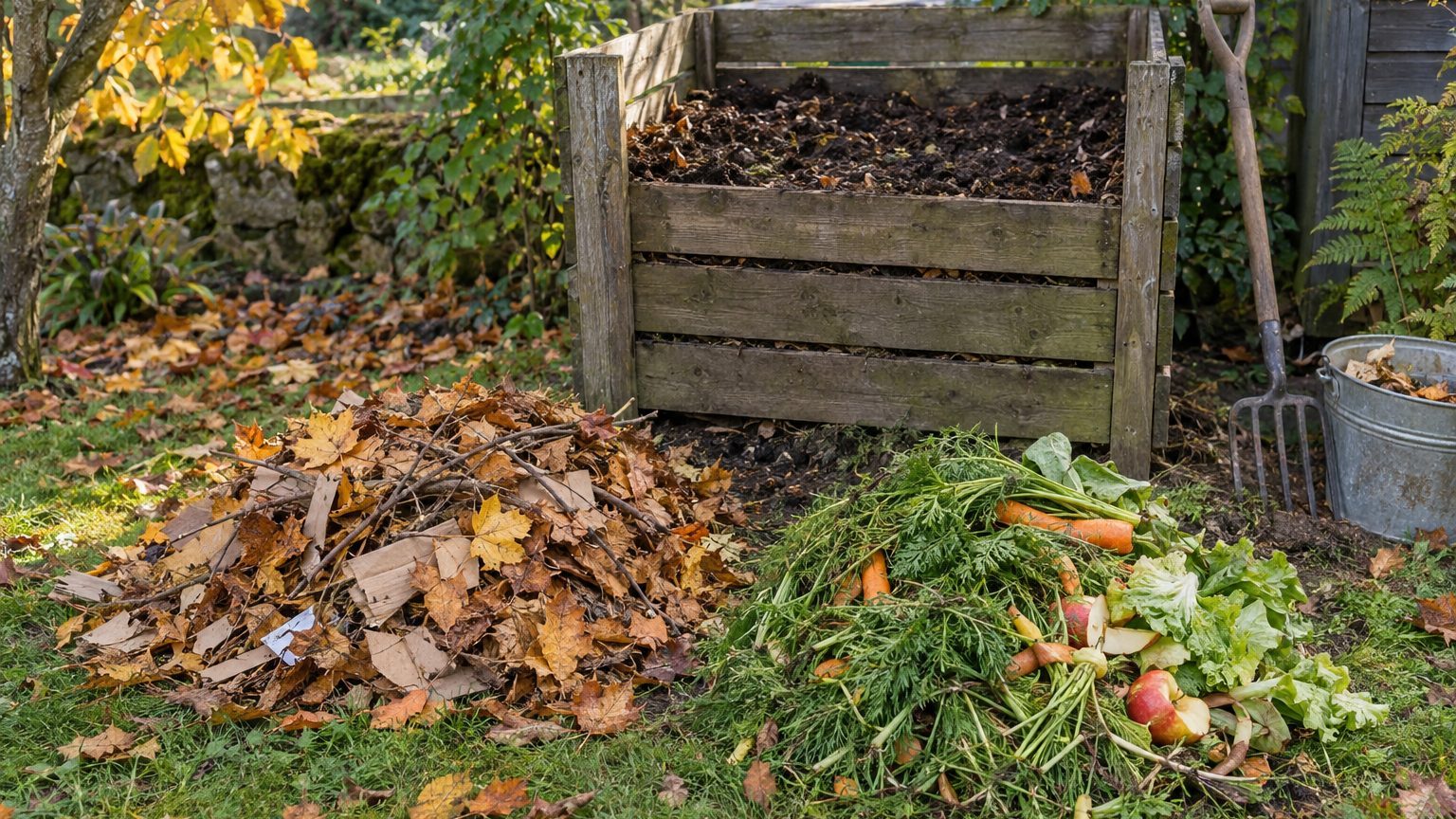
Start with two to three buckets of browns for every bucket of greens, measured by volume. That is the guideline the EPA gives home composters:
add at least two to three times the volume of browns, such as dry leaves, to the volume of greens, such as food scraps.
The bucket count is a shortcut for a different number, the carbon-to-nitrogen (C:N) ratio. Extension services put the ideal at roughly 30 parts carbon to 1 part nitrogen, and the two measurements don’t line up the way most people assume.
Compost list of browns and greens
“Brown” and “green” describe what a material gives the microbes, not what color it is. Browns are dry and carbon-rich. They feed the microbes energy and keep air moving through the pile. Greens are moist and nitrogen-rich. They supply the protein that lets decomposers multiply.
The microorganisms that break down organic waste use carbon for energy and nitrogen for protein.
A pile short on either one stalls.
Cornell’s composting program sorts the common backyard ingredients like this:
grass clippings, plant cuttings, and fruit and vegetable scraps are high in nitrogen, while autumn leaves, wood chips, sawdust, and shredded paper are high in carbon.
The EPA’s backyard guide adds more browns to the list:
shredded paper, cardboard, paper rolls, dry leaves, small branches, twigs, straw, sawdust, and used potting soil.
One caution: color is a hint, not a rule. Plenty of materials look brown and behave like greens, and the coffee grounds example below is a classic one. Another reason the labels blur is that every ingredient contains some of both elements. Browns just carry far more carbon per unit of nitrogen than the pile needs. Greens carry less.
Examples of browns and greens for composting
Numbers make the sorting concrete. Cornell’s reference table gives
autumn leaves at 30 to 80:1, straw at 40 to 100:1, and wood chips or sawdust at 100 to 500:1
, with
grass clippings at 15 to 25:1
on the nitrogen side. Purdue Extension lists
table scraps at 11 to 15:1.
Compare the two ends. Sawdust carries many times more carbon per unit of nitrogen than a pile of kitchen scraps. That gap explains why a small bag of scraps can wake up a big heap of dry material.
Browns worth stockpiling
Fall leaves are usually the biggest free source of browns in a yard. They also vary more than people expect. Cornell’s tree-by-tree data shows
alder leaves at 15:1, ash at 21:1, birch at 50:1, and aspen at 63:1.
A bag of ash leaves behaves almost like a green, while aspen or oak-type leaves act like true browns. If your yard has a mix of trees, you get a built-in blend.
Shredded cardboard and paper work all year, which matters in spring and summer when leaves are scarce. Straw works too, but its structure is tougher. Cornell notes that
corn stalks and straw are slow to break down because they are made of a resistant form of cellulose.
Chop or shred woody stuff first. The University of California’s guidance points out that
shredding or clipping these materials increases the surface area and makes decomposing easier for the microorganisms.
Greens, and the ones that fool you
Fresh grass clippings, vegetable peels, fruit scraps, and plant trimmings are the standard greens. Coffee grounds are the classic trick question.
They are a green even though they look brown, with a C:N ratio of about 20:1.
Spent coffee from a household can add up quickly, and it clumps when it’s dense, so blend it into the pile instead of dumping it in one layer.
Grass clippings come with two conditions. First,
clippings alone pack down and restrict airflow, which limits the oxygen needed for decomposition.
Second, the lawn they come from matters:
when clippings go into the pile to add nitrogen, the lawn should be chemical free, otherwise plants receiving the compost may be seriously damaged.
For the full leaf-and-clipping combination, see how to compost leaves and grass clippings.
Some things stay out of a basic backyard pile no matter which category they’d fit. The University of California advises that
with kitchen scraps, you should avoid fats, meats, and bones, because they attract pests such as rodents and dogs.
Stick with vegetable waste, coffee grounds, eggshells, and fruit waste.
Brown vs green compost ratio
Here is the apparent contradiction. Extension publications say 30:1, the EPA says two to three parts browns to one part greens, and NRDC says
two to four parts brown materials for every one part green.
These can all be right, because 30:1 is a chemistry target and the volume ratio is a practical translation of it. A 30:1 carbon-to-nitrogen ratio does not mean thirty buckets of leaves per bucket of scraps. It describes what the materials contain, and the ratio of materials needed to hit it is much smaller.
The math shows why. Nebraska Extension’s example:
a mixture of one-half brown tree leaves (40:1) with one-half grass clippings (20:1) gives a pile at the ideal 30:1.
That is about 1:1 by weight. Missouri Extension offers a similar shortcut,
averaging the ratios of the individual materials, so equal parts grass clippings and leaves might come to (20 + 50) ÷ 2 = 35.
A 35 is a bit carbon-heavy but workable. Treat these as estimates, not lab results. Nebraska’s guidance says the balancing
works best on a weight rather than volume basis.
So why does the volume rule call for so many more browns? Dry leaves are fluffy. A bucket of them weighs a fraction of a bucket of wet scraps, so you need several buckets of leaves to match the weight of one bucket of kitchen waste. Heavy, wet greens pack more nitrogen into the same space. That is why the volume guideline leans toward browns even when the weight math says closer to equal.
What happens when the balance is off
The pile tells you, and the University of Arkansas explains the cause.
When the C:N ratio is too high, there is too little nitrogen and decomposition slows. When it is too low, the excess nitrogen vaporizes as ammonia gas and causes odor problems.
A cold, unchanged pile often means too many browns (or too little moisture). A sharp, slimy, ammonia-smelling one usually means too many greens. The fix is the same in both directions: add the opposite material and mix.
Moisture and air matter alongside ratio. The EPA recommends that
the combined materials have the consistency of a wrung-out sponge
, and that
food scraps always be covered by four to eight inches of dry leaves or other browns.
That cover layer also helps with fruit flies. NRDC’s advice for a fly problem is to
increase the carbon-rich browns to help the waste dry out.
A workable build in fall
Leaf season makes the ratio easy to hit. The EPA suggests starting the pile with
a four- to six-inch layer of bulky browns such as twigs and wood chips
, then
layering greens and browns like lasagna.
Keep a dry reserve of leaves beside the bin, since the EPA also recommends setting aside
an outside area to store a steady supply of leaves, twigs, or other carbon-rich material.
That reserve is what lets you add scraps all winter while keeping the right proportions.
For a pile made mostly of leaves, you’ll want to adjust. A leaf-only heap is high in carbon and slow. Mixing in nitrogen helps, and shredding the leaves first speeds things up. The step-by-step version is in how to compost leaves, and the speed-focused techniques are in how to compost leaves faster. If you’re composting sawdust, plan on extra greens. The University of Arizona’s extension guide notes that
sawdust requires the addition of extra nitrogen.
One detail explains why the 30:1 starting point isn’t the finish line. As the pile works, the ratio falls.
It drops from 30:1 to 10 to 15:1 in the finished product, because each time microorganisms consume organic compounds, two-thirds of the carbon is given off as carbon dioxide.
Your pile is meant to lose most of its carbon on the way to becoming compost.
Sources : hotbincomposting.com | cwmi.css.cornell.edu