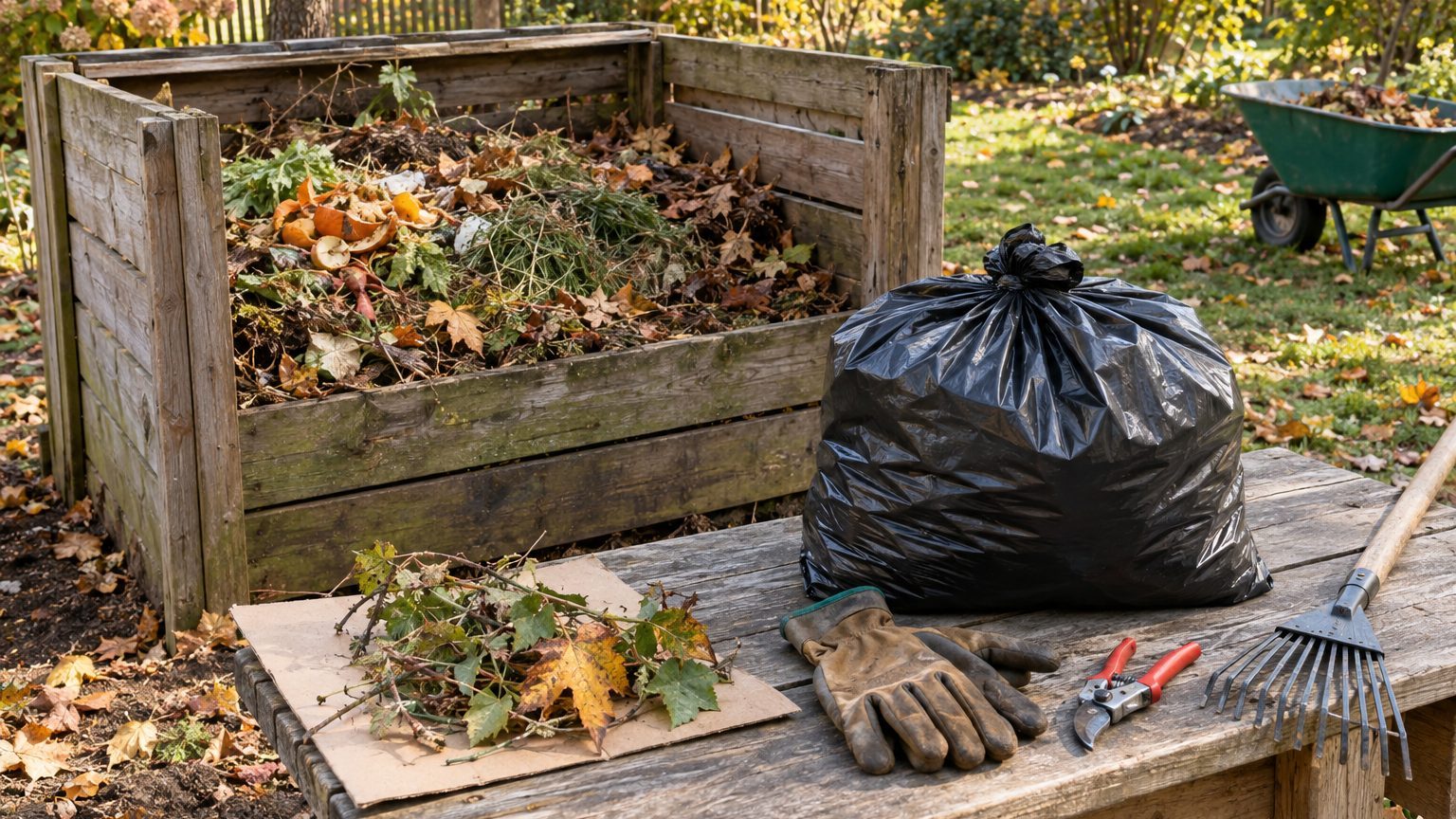
Very few leaves are truly off-limits in a compost pile. The firm no’s are poison ivy, poison oak and poison sumac foliage, leaves and clippings carrying persistent herbicide, and diseased vegetable foliage headed for a cool pile. Black walnut is a conditional yes. Rhubarb leaves, despite their scary reputation, get a pass from Iowa State University Extension.
What plants should not go in compost
Start with the one that can put you in urgent care. Extension guidance on poison ivy is blunt:
do not burn or compost the ivy.
The oil behind the rash, urushiol,
can bind to garden tools, pet hair, and clothing for long periods.
A compost fork becomes a delivery system. Fall raking makes this easy to get wrong, because
all parts of poison ivy contain urushiol at all times of the year, even when bare of leaves and fruit in winter.
A hairy vine pulled off a tree trunk and tossed into the bin is just as irritating in January as it was in July. One Extension specialist noted that
most home compost piles do not achieve the consistently high temperatures that commercial operations do
, so nobody can promise the oil breaks down in your backyard. The disposal route is
a heavy, sealed garbage bag, to the trash.
Herbicide residue is the quieter hazard. Three chemicals worry Oregon State specialists most:
picloram, clopyralid, and aminopyralid, because they can remain active in hay, grass clippings, piles of manure, and compost for an unusually long time.
Oregon State Extension states plainly that
clopyralid and aminopyralid are examples of herbicides that persist through the composting process.
Tree leaves are rarely the source. The trouble starts when you rake leaves and clippings from a recently treated lawn into the same pile. The warning signs in the garden are
stunted growth and distorted, curled leaves
, and tomatoes, beans and potatoes tend to show them first. If you can’t vouch for the lawn, skip its clippings (for how to combine clippings with leaves in a pile, see how to compost leaves and grass clippings). You can also test finished compost:
if peas or beans in the control pots grow normally and the ones in the compost pots do not, assume the compost is contaminated.
Diseased foliage is where experts split, and it’s worth knowing why. A Master Gardener volunteer answering a question on Ask Extension said
most diseased tree leaves do not pass the fungus from the tree to your compost or to your garden plants
, and personally composts Norway maple leaves with tar spot. Yet the same expert does not compost diseased plants from the vegetable garden. That distinction makes sense. A maple’s fungus has no interest in your tomatoes, but tomato blight, powdery mildew on squash and black spot on roses can hit the plants you grow next.
Diseased material can be composted if the pile reaches at least 148 degrees Fahrenheit and the plant material completely breaks down
, but
typical home compost piles may not become hot enough for long enough to kill many pathogens.
No thermometer, no guarantee. Bag it for municipal yard waste if your town accepts diseased material, or send it out with the trash.
Then there are leaves that are merely stubborn. Oak has a reputation as toxic to compost, and the horticulturist behind Laidback Gardener calls that
essentially a myth
. The real issue is speed.
Oak leaves are very slow to decompose
, and
shredding them first
helps a lot. Thick, waxy leaves like magnolia behave similarly. Some gardening sites also tell you to keep eucalyptus out because of its oils, though I found no university research settling that question, so treat it as a judgment call. Slow leaves belong in the pile in moderation, and a mower pass can shorten the wait considerably (see how to compost leaves faster for the full routine). For the basic method, start with how to compost leaves.
Black walnut leaves compost
The old rule says never. The extension answer is more nuanced. Oregon State Extension says
yes, you can apply compost made with black walnut leaves to your vegetable garden.
The worry is juglone, a compound that stunts or kills sensitive plants, with tomatoes the classic victim.
Sensitive plants often yellow, grow poorly or look stunted, and may eventually die.
The catch is how the pile is managed.
Oregon State’s conditions are specific. Juglone breaks down in a well-managed pile, which means
mixing in other plant materials and keeping nitrogen high, since compost that heats up breaks juglone down best.
A pure heap of walnut leaves left to sit won’t do it. A separate Ask Extension answer, citing OSU, adds that the pile must be
hot, turned and moist, with complete composting (no leaf pieces) including a curing phase.
Season matters too.
Walnut leaves have the highest juglone content in spring
, so don’t assume fall leaves let you skip the other precautions.
How long is long enough? Sources differ, which is itself useful information. One Extension answer says
black walnut plant material composted for six or more months should be safe to use around any plant.
University of Maryland Extension is more conservative, advising that
compost made with black walnut leaves, twigs or nuts should be aged at least one year before being applied
(quoted on a herb society blog). If tomatoes are your priority, take the longer figure. Test the result first by
planting tomato seedlings in the finished compost.
If they yellow, use that batch around juglone-tolerant plants instead.
Distance matters more than most people expect. Oregon State points out that
transmission of juglone into the soil through the roots is of the greatest concern
, so the location of your vegetable bed relative to the tree can outweigh anything you do in the compost bin. Hulls and nuts are another matter.
Walnut hulls and shells decompose slowly because they are so woody
, so keep them out of a leaf pile you want finished by spring.
Rhubarb leaves in compost bin
Rhubarb leaves are the opposite case: scary label, no real problem. Iowa State’s answer is short.
While rhubarb leaves contain poisonous oxalic acid, they can be placed in the compost pile.
The reasoning is that
oxalic acid, like other organic acids, is not readily absorbed by plant roots, and compost containing decomposed rhubarb leaves can be safely applied to the vegetable garden.
Some websites claim the acid suppresses microbes and sabotages the pile. I found no extension source backing that up.
The practical problem is physical, not chemical. Rhubarb leaves are big and flat. An Ask Extension reviewer warns that
whole leaves mat down and block the movement of water and oxygen.
That advice was about mulch, but the same logic applies in a bin, where a thick whole leaf can form a slick layer. Chop the leaves into pieces, and mix them in with drier browns like fall leaves instead of dumping them in a layer.
One handling note. Fresh rhubarb leaves remain a poison risk before they break down. A University of Wisconsin food scientist describes them as
poisonous to humans and animals due to high concentrations of oxalic acid.
If dogs or small children have access to the bin area, cover the leaves with a layer of browns right away. Safe for the soil and safe for a curious pet are two different questions.
Sources : compost.bc.ca | homesandgardens.com