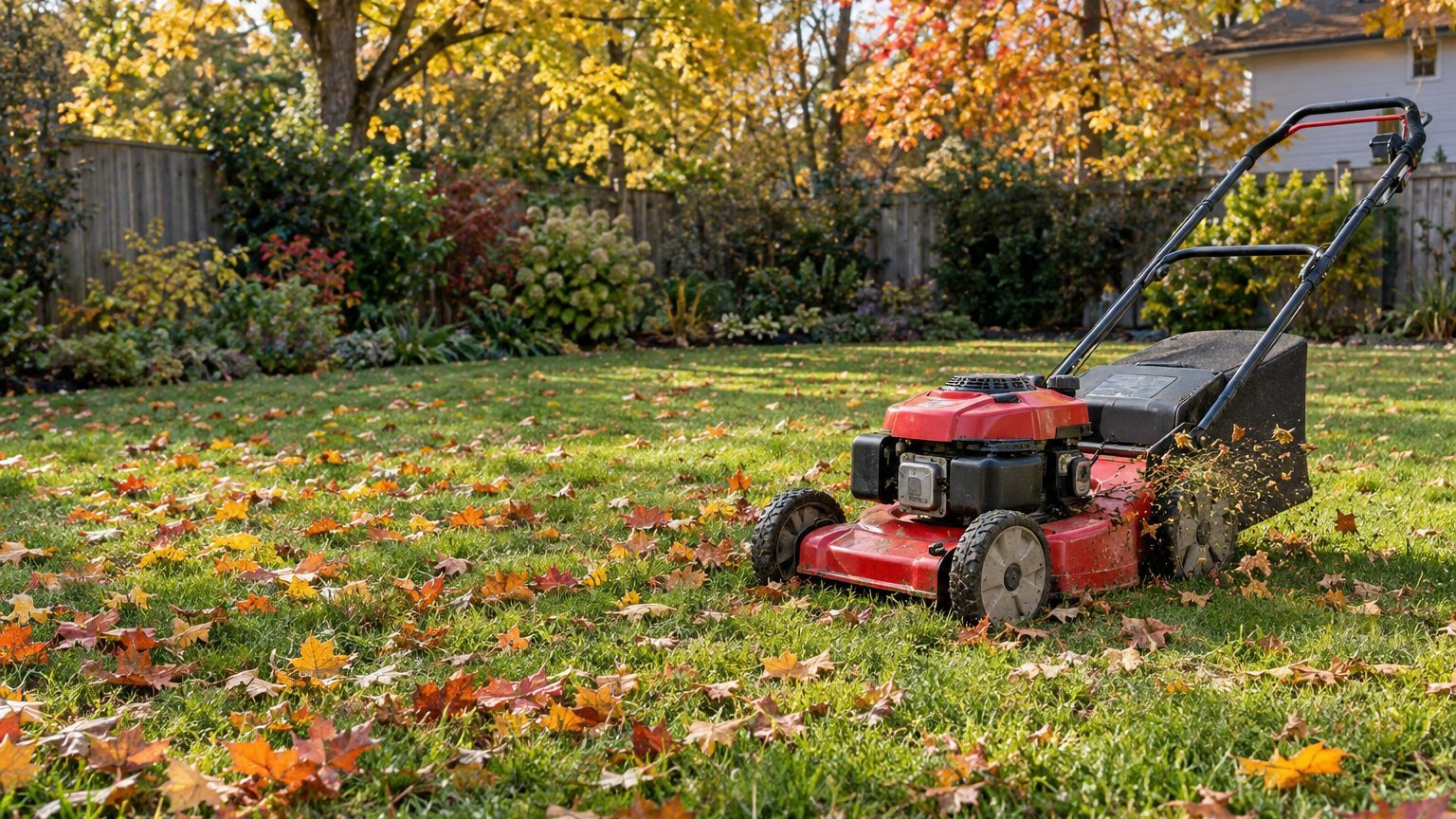
Usually, no. If you can still see grass through the leaves, run the mower straight over them with a sharp blade and let the chopped pieces sift into the lawn. Rake or bag first only when the layer is deep or matted, the leaves are wet, or they come from a diseased tree. A heavy drop can also be mowed in two passes or two sessions. The wider debate is in should i rake leaves, and calendar timing is in should i rake leaves before winter.
Should i rake leaves or mow them
The quick rule: mow first when you can still see grass through the leaves
Stand at the edge of the lawn and look down. Blades showing between the leaves means the mower can handle it. A Colorado State University Extension horticulture professor puts it plainly: “As long as you can see grass through the leaf litter, you won’t cause damage to the lawn.”
Why raking first is usually extra work on a light leaf cover
Michigan State University’s turf trials mulched leaf layers of 3 and 6 inches into bluegrass with a rotary mower every October. Turf color and quality held up. Researchers also reported fewer dandelions and crabgrass over time, because fine leaf pieces cover the bare soil where weed seeds germinate. Still, a light cover is a lot less work to chop than to rake, bag and haul.
When the order flips and raking has to come first
Four situations reverse the sequence: grass hidden under a thick layer, soggy leaves, leaves from a diseased tree, and leaves hiding sticks or nuts.
Mulching leaves with mower
Mower setup before you start: deck height, blade condition and mulching kit
Take the bag off, fit the mulch plug if your mower has one, and sharpen the blade. A mulching blade or kit helps, and Colorado State’s guidance calls for at least two passes over the lawn. For deck height, one major mower manufacturer suggests setting the front one or two notches above the rear so leaves can pass under the deck. Full details are in mulching mower settings and technique. Before the mower leaves the garage:
- Leaves are dry, and the lawn surface is too.
- Sticks, nuts, toys and wires are cleared (leaves hide them).
- Deck height is raised for the first pass.
- Blade is sharp.
- Mulching kit is installed, or the bag is attached if you plan to collect.
How many passes it takes to chop leaves into dime-size pieces
Two is a common answer. Virginia Cooperative Extension says multiple passes may be needed to chop leaves thoroughly, and Michigan State Extension describes mowing across the leaves several times. Crisscross the lawn, go slowly, and aim for pieces around the size of a dime. They are small enough to drop between the grass blades.
How to tell if the lawn looks right when you finish
Keep going until you can see about half an inch of grass through the shredded layer, the benchmark in Michigan State-based guidance. The pieces should filter down into the turf. If grass is still hidden after your passes, switch to bagging for the last one. Three common problems:
- Clumps left on the lawn: the leaves were too wet or the deck too low. Mow again once dry, at a slightly higher setting.
- Mower bogging down: the layer is too deep for one pass. Raise the deck, take half the volume, then lower it for a second pass.
- Pile building at the discharge chute: slow down, make sure the mulch plug is in, and shut the engine off before clearing it.
Mulching leaves vs bagging
Mulch or bag: a decision checklist for the mowing day
Three questions settle it. Volume: if the leaves still hide the grass after two passes, bag. Health: leaves from a tree with a leaf disease usually go in the bag, not back on the lawn. Lawn size: a small lawn with a light drop is almost always a mulch job, while a large lawn under mature trees may fill a catcher every few minutes, which is when raking some off beats bagging the lot. Extension guidance also allows alternating, raking or bagging one week and mulching the next when the layer gets too thick.
What to do with bagged leaves so the extra work pays off
Chopped leaves are good raw material. Michigan State Extension suggests collecting them with the bagger and spreading them over flower beds and vegetable gardens, or working them into the soil. Composting works too, and chopping first speeds it up. The alternative is worse: in 2018, the latest year EPA reports, the U.S. generated 35.4 million tons of yard trimmings (12.1 percent of municipal solid waste). About 10.5 million tons still went to landfills, while 22.3 million tons (63 percent) were composted.
How many leaves are too many to mow without raking first?
Judging leaf depth and coverage by eye
Scan the lawn in sections. Grass visible across most of the area means mow once. Grass visible in patches means moderate cover, so plan two passes. No grass at all means rake or blow some off first. Mow one pass and look again.
| Leaf condition | What to do before mowing | Mowing approach |
|---|---|---|
| Light cover with grass visible | Walk the lawn and clear debris | Mow once |
| Moderate cover | Raise the deck for the first pass | Mow in two passes or two sessions |
| Heavy layer covering the grass | Rake or blow some of the layer off | Rake some off first, then mow what remains |
| Wet or soggy leaves | Let leaves and lawn dry | Wait for dry weather |
| Diseased or moldy leaves | Rake them up | Bag and dispose, or compost separately |
| Leaves mixed with sticks or nuts | Pick or rake the debris out | Then mow once or twice, depending on the layer |
Splitting a heavy leaf drop into two mowing sessions
Start with a high first pass to chop the top, then lower the deck for a second. If the layer is too thick even for that, spread the work over two days or weekends. Unmulched leaves left over winter can smother the grass beneath them.
Can I mow wet leaves?
Why wet leaves clump, clog the deck and leave mats on the grass
Not if you can avoid it. Michigan State Extension warns that heavy, wet leaves can spell disaster for next spring’s lawn, and University of Georgia Extension notes that even a new blade will not pick up wet leaves matted to the ground. The mower’s manufacturer says the same: mow in dry conditions to reduce clogging. Wet leaves stick under the deck, discharge in clumps, and settle on the turf as a mat that blocks light and air.
How long to wait after rain or dew
Extension guidance generally gives no set number of hours, so use a hand test. Grab a fistful from the bottom of the layer and squeeze. If it holds together like a snowball, wait. Dew dries off sooner than leaves after soaking rain, when the bottom layer can stay wet for a day or more. If a wet mat is already smothering the grass, rake it off rather than mowing it.
Which leaves should I rake up before mowing anyway?
Diseased, moldy or pest-infested leaves
Apple scab is a well-known case. The fungus overwinters in fallen diseased leaves, and University of Minnesota Extension recommends raking them up and destroying them before the first snow. Oregon State guidance adds that they should not be used as mulch. Advice isn’t uniform, though. University of New Hampshire Extension lists chopping with a mower as an alternative to raking. To be cautious, bag leaves from any apple or crabapple that showed scab leaf spots this season.
Thick, matted layers and leaves from trees that need special handling
Matted leaves, the kind that peel off in a sheet, block sunlight and airflow, and a mower tends to skim over them. Pull them apart with a rake first.
Sticks, acorns, nuts and debris that can damage the mower or the blade
Leaves hide things. The manufacturer’s fall guidance advises walking the mowing area first to look for toys, rocks and wires. Sticks and nuts can nick the blade or be thrown from the deck, so rake them out. Switch the engine off before clearing anything from the deck, and clean the leaf debris off the mower afterward, since the manufacturer says buildup raises fire risk.
Frequently Asked Questions
Is it bad to mow over dry leaves?
No. Dry leaves chop best. Michigan State guidance says to mow them slowly with a sharp blade so they are ground fine.
Can mowing leaves damage my lawn mower?
Leaves alone rarely do. Trouble comes from hidden rocks, sticks and wires, a dull blade, wet clogging, and leaf buildup that can raise fire risk around a hot engine.
Do I need to rake after mowing leaves?
Usually not. If you can’t see grass after your passes, rake or bag the excess instead of leaving it.
How often should I mow when leaves keep falling?
Keep to your normal mowing interval, or a bit more often during peak leaf drop.
Should I bag the clippings when I mow leaves?
For most lawns, no. Remove the bag so the chopped leaves return organic matter to the soil. Bag only when the layer is too thick, the leaves are diseased, or you want them for beds and compost.
Sources: 19january2021snapshot.epa.gov | archive.lib.msu.edu | ext.vt.edu